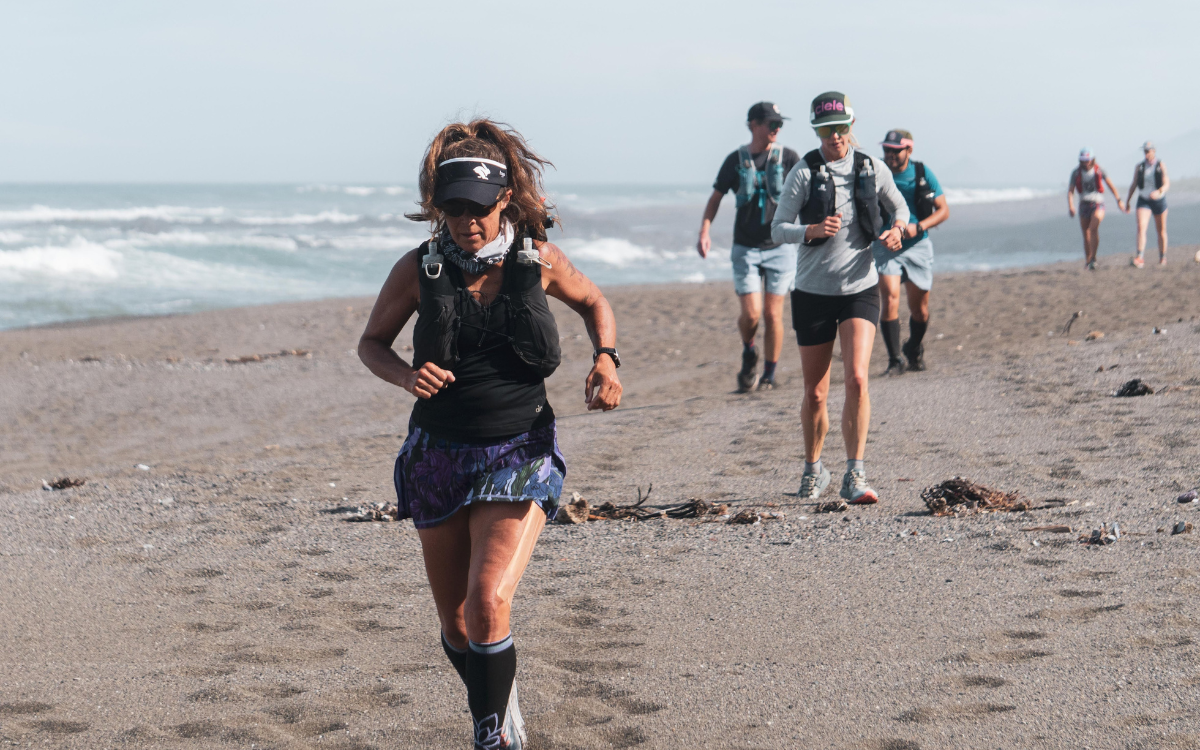
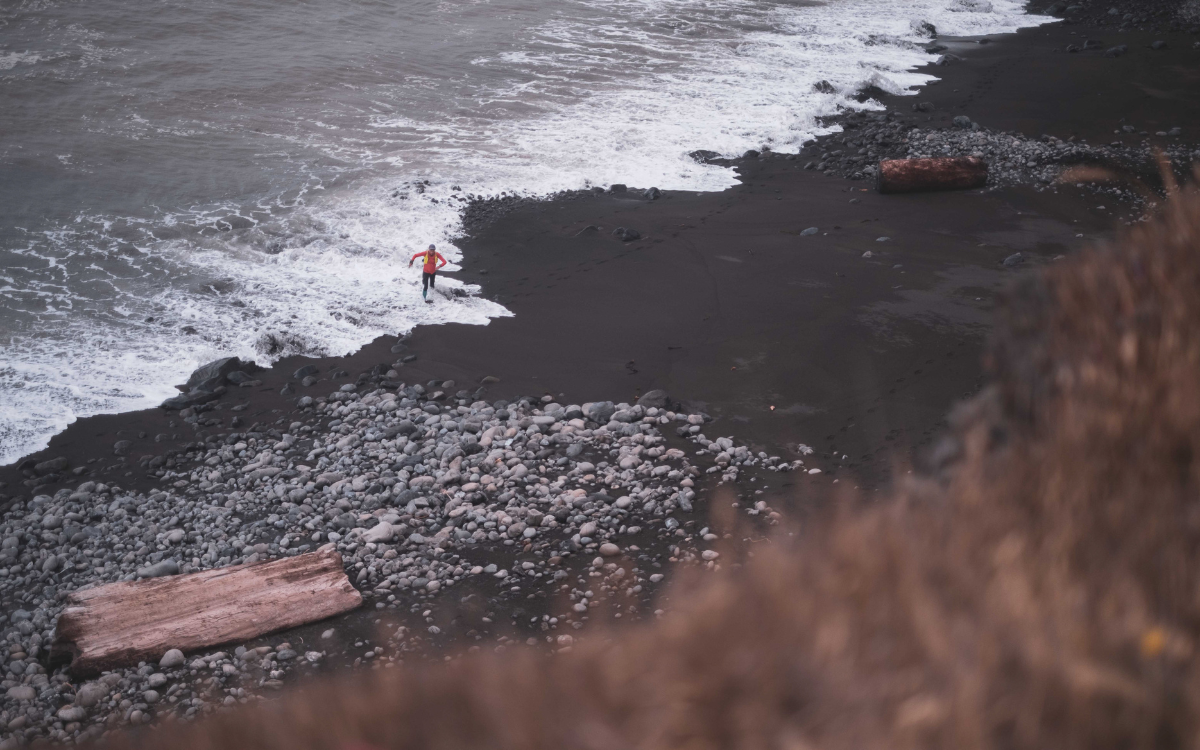
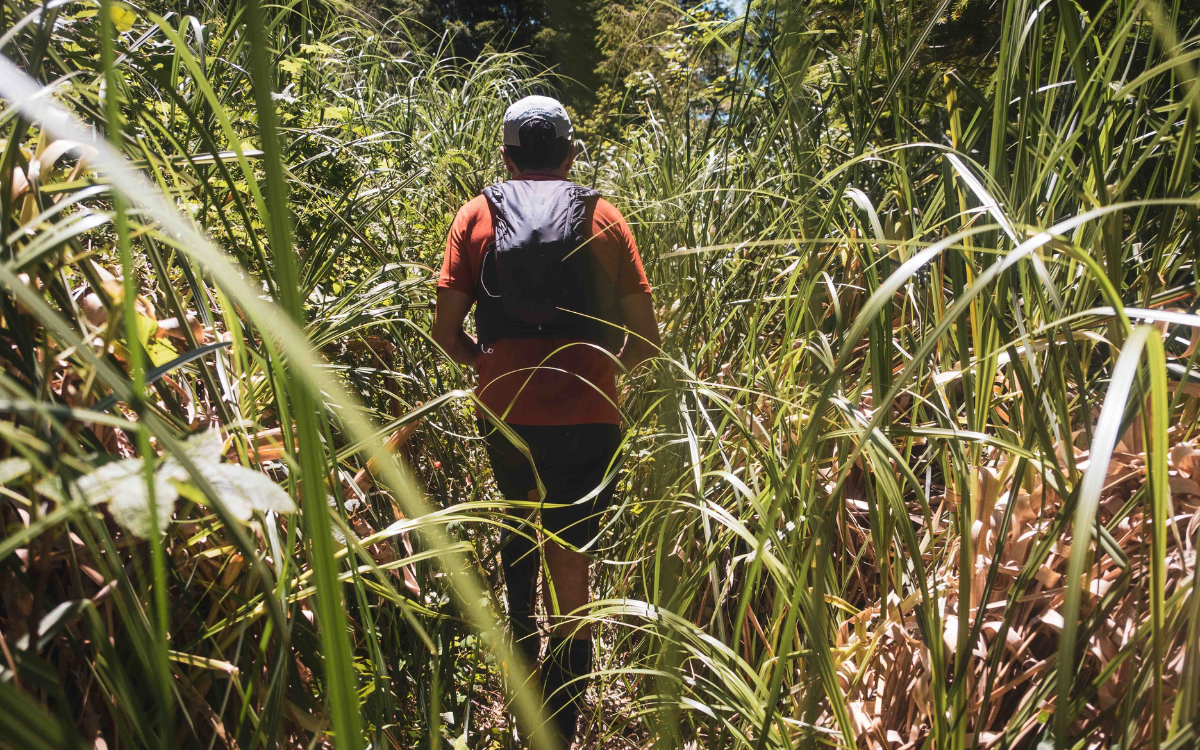
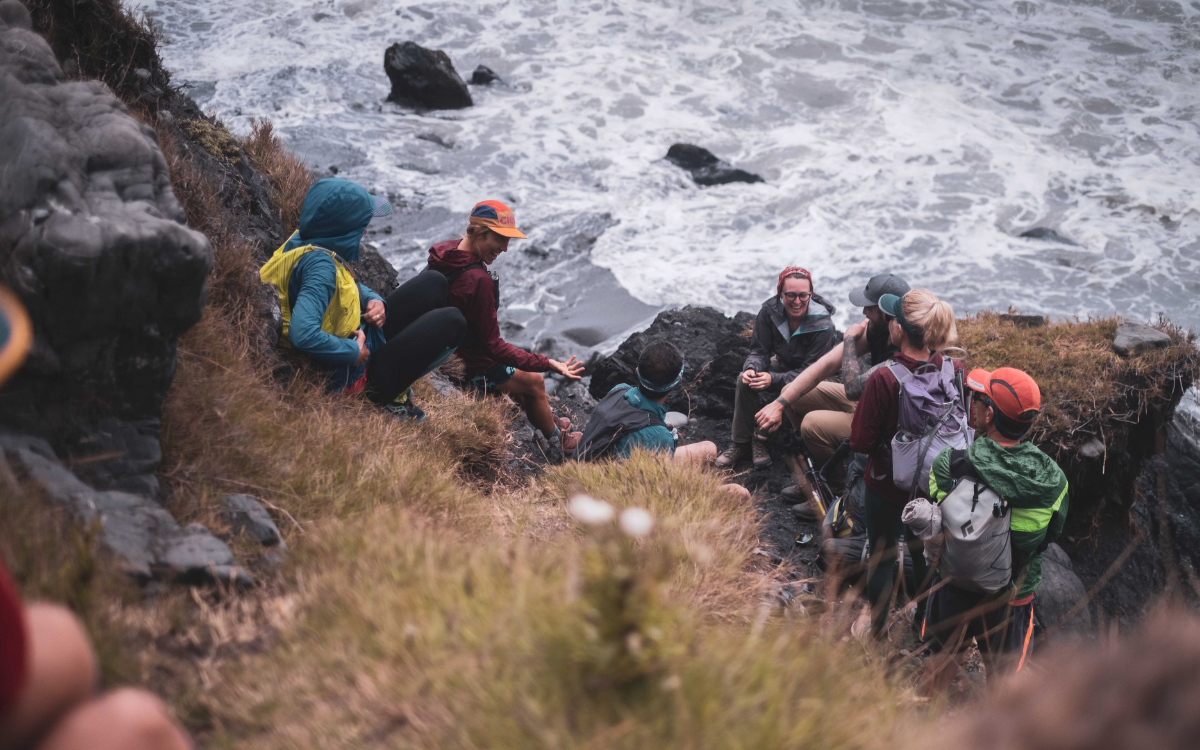
I’m a desert rat at this point, spending the last 20 years in Arizona, but I will jump at any chance to visit and explore the vastness of the PNW landscape. Last year, My Spring Energy reached out to me to see if I’d be interested in attending an Aspire Adventure Running trip in WA to shoot some promo images. I jumped at the opportunity as I had attended one of Aspire’s trips a few years back and that tripin the North Cascades, was so memorable for me.
Photos by Steven Mortinson
My takeaway from my first Aspire adventure? You just show up and run! Camp was all setup, food was prepared. It was bougie run camp. The morning of that first run they dropped us off via boat on the Canadian border and we had to run 50 miles back to camp up and over Desolation Peak. Aid was provided for us, but it was more about the adventure of just carrying everything on your back. When we got back, food and drinks were waiting. It was marvelous. Yes, I wanted to do that again.
Mt. Adams from the Goat RocksWilderness
Now, I had circumnavigated the Wonderland Trail around Mt. Rainier a few years back, but I really had no knowledge of the neighboring Goat Rocks Wilderness. The Wonderland was one of the most magical places I’d ever run, almost like an alien planet. Some quick research of the Goat Rocks showed that I’d be in for high alpine running, covering a section of the PCT that included glacial lakes and an extinct volcano wilderness. Aspire’s itinerary covered 50 miles over two days, including 14k of ascent? SIGN ME UP!
Upon arrival in Packwood WA, I was quickly greeted by other runners and some familiar Aspire faces including Abram Dickerson, who founded the guiding outfit back in 2014. Alyssa Clark, my Spring Energy teammate, was also there with Steven Mortinson, who was shooting photography.
Runner’s receive beta for the upcoming day’s run at basecamp.
You could feel the excitement amongst everyone. Everyone was there to have their own experience, but we were all there to run and take in the majesty of the Goat Rocks. After some spectacular dinner (they literally will cater to everyone), we got an early night’s rest preparing for the first 20 miles of the route.
Day 1 was an ascent up and over Angry Mountain to Goat Lake, then back down to Snowgrass Flats and Chambers Lake. After a short drive up the forest road, we unloaded onto the single-track trail that headed straight up Angry Mountain. Runners started to group up together, and I started to get to know Alyssa and Steve. Alyssa is an incredibly strong runner and after some quick conversation, I realized that we had run many of the same races, and sometimes at the same time. I knew quickly that if she shared the same love for insane vertical rugged ultramarathons as I did, it was going to be a fun couple of days.
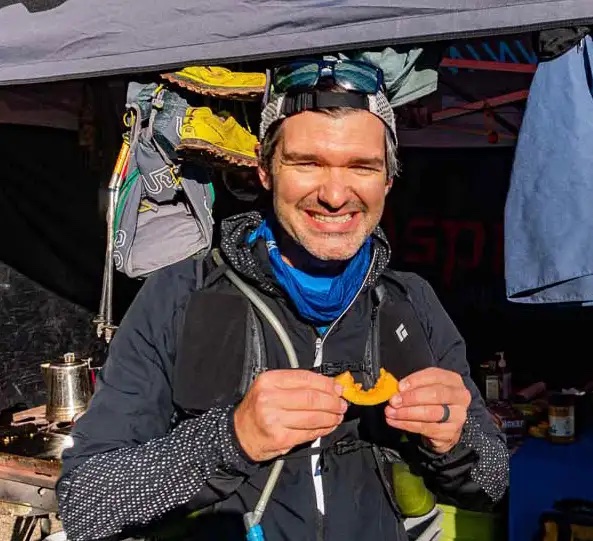
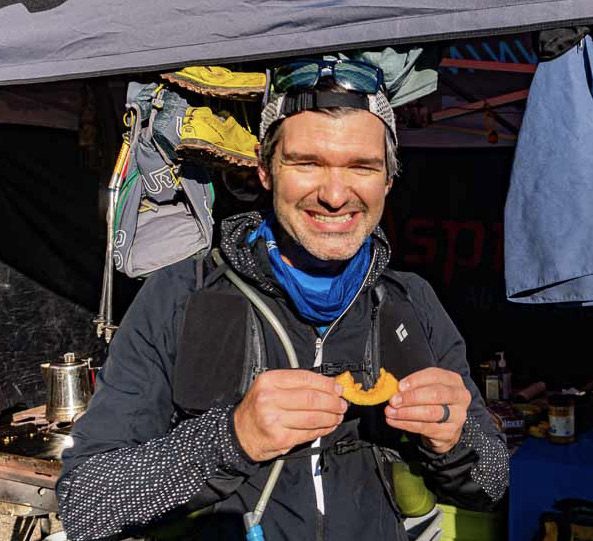
Peter Mortimer and Alyssa Clark enjoy My Spring Energy gels on trail.
Although I live Flagstaff (Arizona with trees), the level of greenery is like nothing else in the dense forests of the Cascades. The green has green. It’s almost luminescent. After a punchy climb, we finally broke through the luscious tree line to bright blue skies and amazing views of Mt. Rainier and Mt. Adams. “This is why we’re here,” I remember thinking.
The single-track ridgeline down to Goat Lake was phenomenal. I had to stop frequently to take it all in. It’s moments like that when you feel so tiny in such vast beauty that you remember why trail running is like no other. After a short stop at the glacier lake for lunch, Alyssa and I decided to turn on the jets and bomb the descent back down to the Aspire group at the trails end, who were waiting with snacks and beverages. The evening was spent with a nice fire and some time by Walupt Lake relaxing. Day 2 would be longer. 30 miles and a touch more climbing.
An alpine lake in the Goat Rocks Wilderness.
Day 2 conveniently started from camp. Overnight a storm had blown in and with it, a tremendous amount of smoke from a fire north of us. Although it made the visibility a little hazy, we weren’t about to let it ruin our fun. The route would take us up to Sheep Lake, where we’d join the PCT up to the summit of Old Snowy Peak. From there it was ridgeline running all the way to White Pass campground where there was talk of victory tacos awaiting us.
Miles of single-track.
As we departed the campground, Alyssa reminded me that Karel Sabbe was currently attempting the FKT for the Pacific Coast Trail. We knew he was close, and wondered if we run into him? With a stroke of luck, it didn’t take long. I noticed a trail runner up ahead as we were starting our first climb. We passed and said hello. Karel and I looked at each other in passing, but I didn’t think anything of it in the moment. After a 1/4 mile I stopped and said, “I think that was him.”
Then he rounded the corner, and we started chatting. Karel and I both have history at the Barkley Marathons. He mentioned that he had read a race report of mine. I was star struck. “Like, you know who I am?” “No, I know who YOU ARE!” I was very flattered and asked if he would let us tag along for a few miles. He was happy to have the company.
As we made our way to the ridgeline and summit, I was in awe in how fast he was moving. He was on the last stretch to the Canadian border, and he looked fresh. He was also days ahead of the record. I just couldn’t believe it. Alyssa and I departed with Karel at Old Snowy Peak as we wanted to tag the summit and we’d try and catch him on the way down.
Peter Mortimer and Alyssa Clark descend from Old Snowy Mountain.
The descent from Old Snowy was epic. Loose shale and rocks just fell apart under our feet. For a mile, it sounded like running on broken plates. As we made our way back down to the forest, I pushed ahead. I wanted to catch back up with Karel before the campground. With about a half mile to spare, I managed to close the distance and share some time with him and his family at the campground. Running into Karel just made the trip that much sweeter.
One by one, the Aspire runners started to roll in. Tacos for everyone! It was a wonderful running experience, but sharing it with staff and runners really made it feel special.
Lunch is laid out at basecamp for runners to pack, including an assortment of Spring Energy gels. Yum!
Aspire had done it again. They had wowed me with their kindness and hospitality, and they had showed me a side of Washington I had never seen. The group caters to all levels, and everyone has that opportunity to experience something special at their own pace. The camaraderie that the runners share, the friendships gained, and the remoteness of it all is why I’ll continue to go back.
Peter Mortimer is ultra runner, coach, My Spring Energy athlete, and someone who turned his life around through running and has since evolved into a seeker of the toughest races on earth. Races like the Georgia Death Race, the Dragon’s Back across Wales, the Orcas Island 100, and the HURT 100 on Oahu. Pete is passionate about inspiring others and sharing the beauty of trail running.
The Goat Rocks Wilderness is one of the most spectacular pockets of the Cascadia region. If narrow ridgelines, volcano views, and endless alpine single track is your jam, then this trip is your bliss.
Get the full itinerary, maps, .gpx, route descriptions and more in the COURSE PACKET:
“Who goes on Aspire trips?” It’s a question we hear often. The truth is, the runners who show up for our trips come from diverse backgrounds and bring a wide range of running and mountain experience with them to the trails. We all relate to mountain spaces in unique and personal ways. We are excited to add some depth to our response to the “Who?” question with a series of Aspire trail runner profiles. We enjoyed hitting the dirt and building friendships with these runners on our trips, and we think you’ll enjoy hearing their stories!
Name: Mario Scalcucci Age: 33 Hometown: Westfield, Indiana
Which Aspire Trip(s) have you participated in?
Wonderland Trail 2020
What is your favorite trail snack?
Peach rings
Describe your experience, background, and enthusiasm for running and/or wilderness and backcountry experiences?
I’m very new to the sport of trail running, love being outside, and away from heavy traffic. Being supported makes these remote trips doable.
What questions, concerns, or unknowns did you have going into your trip? How were they resolved?
Ha! Our unknown was Covid-19. Resolved our worries with professional guidelines and procedures. Campsites were also up in the air and again, Aspire rolled with the changing reservations and made it work. All we had to do was run/hike to the next campsite.
How did you prepare for your trip? Given your experience would you prepare differently, if so how?
I prepared for this trip like any other long distance run. With the amount of elevation gain and distances each day, it was important to be ready. But the support we had put us at ease if a long day turned a bit longer.
What story or description would you give to represent the group dynamic on your trip?
As a person with a quiet personality, it was out of my comfort zone to camp with a group of people who I’ve never met before. But with everyone sharing the same enthusiasm for the outdoors and adventures we all fit in quite well.
What was the most difficult moment from your trip?
Leaving at the end after celebratory drinks and an amazing dinner.
What advice or thoughts would you offer to someone considering signing up for an Aspire trip?
This is a must try for all adventurous people. The amount of support received was above any expense we put in.
“Who goes on Aspire trips?” It’s a question we hear often. The truth is, the runners who show up for our trips come from diverse backgrounds and bring a wide range of running and mountain experience with them to the trails. We all relate to mountain spaces in unique and personal ways. We are excited to add some depth to our response to the “Who?” question with a series of Aspire trail runner profiles. We enjoyed hitting the dirt and building friendships with these runners on our trips, and we think you’ll enjoy hearing their stories!
Name: Gerald O’Keeffe Age: 53 Hometown: Arlington Heights, Illinois
Which Aspire Trip(s) have you participated in?
Wonderland Trail 2020, North Cascades Traverse ’22
Describe your experience, background, and enthusiasm for running and/or wilderness and backcountry experiences?
After running a number road marathons, I started getting more into back-country experiences like backpacking and wilderness camping. I did a trail run and immediately realized that trail running combined my love of running and my desire to spend more time in wild and natural places. I was hooked.
What questions, concerns, or unknowns did you have going into your trip? How were they resolved?
Mainly, I was concerned about the vertical gain. I live in Illinois and it is quite challenging if not impossible to run in nearby areas and get significant vertical gain. Every week, I traveled to Wisconsin to run in the hilly terrain of the Kettle Moraine State Forest and also supplemented with incline runs on the treadmill but the treadmill runs ended once the pandemic hit and I couldn’t go to my health club. Fortunately, I did do a lot of training in the heat and humidity that is typical for the Chicago area in summer. Then, my partner Christine and I did a 55 mile backpacking trip on the Northern Loop in MRNP the week prior to the run. This was extremely helpful in terms of familiarizing me with the terrain and getting my legs ready.
How did you prepare for your trip? Given your experience would you prepare differently, if so how?
I used a six month 100k training program from Training Peaks and also ran a 54 mile ultra in the Colorado mountains three week prior to the WT run. The ultra was at average elevation of 10,500 feet and had about 8,500 feet of vertical gain, so once I finished that, I was more confident that I was in good enough condition for the 93 mile Wonderland Trail. If I were to do this again, I would find a way to spend more time running in the mountains, maybe do a few 50k races in the months leading up to the Aspire stage run. I would also be more disciplined about doing core and strength work as part of my weekly running program. I did some core work but could have done more. Last, I would do more back to back long runs. I typically did my long run on Saturday and would then do a 5-10 mile recovery run on Sunday. I never managed to do something like a 25 mile run on Saturday followed by a 20 mile run on Sunday. Given this, I did wonder whether I would be able to handle multiple days of ultra distances on the Wonderland Trail.
What story or description would you give to represent the group dynamic on your trip?
The six of us were all pretty evenly matched in terms of our running ability. We didn’t all run together but we weren’t hours and hours apart, either. This was nice because it was possible to visit with different people at various points throughout the day of running.
What was the most difficult moment and/or a surprising episode from your trip?
On day 2 we ran from Mowich Lake to White River via the Spray Park route. It started raining a few hours into the day and even though I was wearing a long-sleeve Smartwool shirt, I was worried about getting a chill. I put on my windbreaker so I had another layer but everything was soaked with the rain. Fortunately, my legs were feeling surprisingly strong and I was able to keep cranking at a good pace and this helped me stay warm. Getting to the heated Aspire tent at White River was quite wonderful!
What advice or thoughts would you offer to someone considering signing up for an Aspire trip?
Spend time talking with your fellow runners and Aspire guides and getting acquainted with them. They are interesting people! Go with the flow, stop and at any waterfall or glacial stream you find interesting and take in the moment by splashing your face or soaking and resting your feet. Water is a very prominent and awesome part of the Wonderland Trail. Most important, enjoy the journey.
The 2022 Aspire calendar boasted our very first multi-sport trip, a raft/run excursion down Idaho’s remote and legendary Middle Fork of the Salmon River. As the lead guide for the trip, I had long been looking forward to a week away from cell service in the Frank Church-River of No Return Wilderness, collaborating with the river guides to create a unique experience for our runners and their families on the boats. By June, however, it was clear that conditions in the mountains had other ideas.
Flood Stage
A week before we were set to launch, runners received an email from Kelsey Helfrich, owner of Helfrich River Operators, explaining that with the surrounding mountains at 300% of average snowpack, the river was running at 6.5 ft, … dangerously high. Due to the increased safety risks associated with high water (more intense rapids, debris in the river, and with these an increased risk of drowning), they were canceling the trip. Given that the search was still on for the body of a rafter who’d attempted the river a week before, the cancellation was hardly worth questioning.
Immediately my phone began to buzz with an incoming call from Abram (Aspire Course Director).
“What do you think of an air-supported alternative?” he asked.
“Like, we get heli-dropped?!” I responded, immediately intrigued.
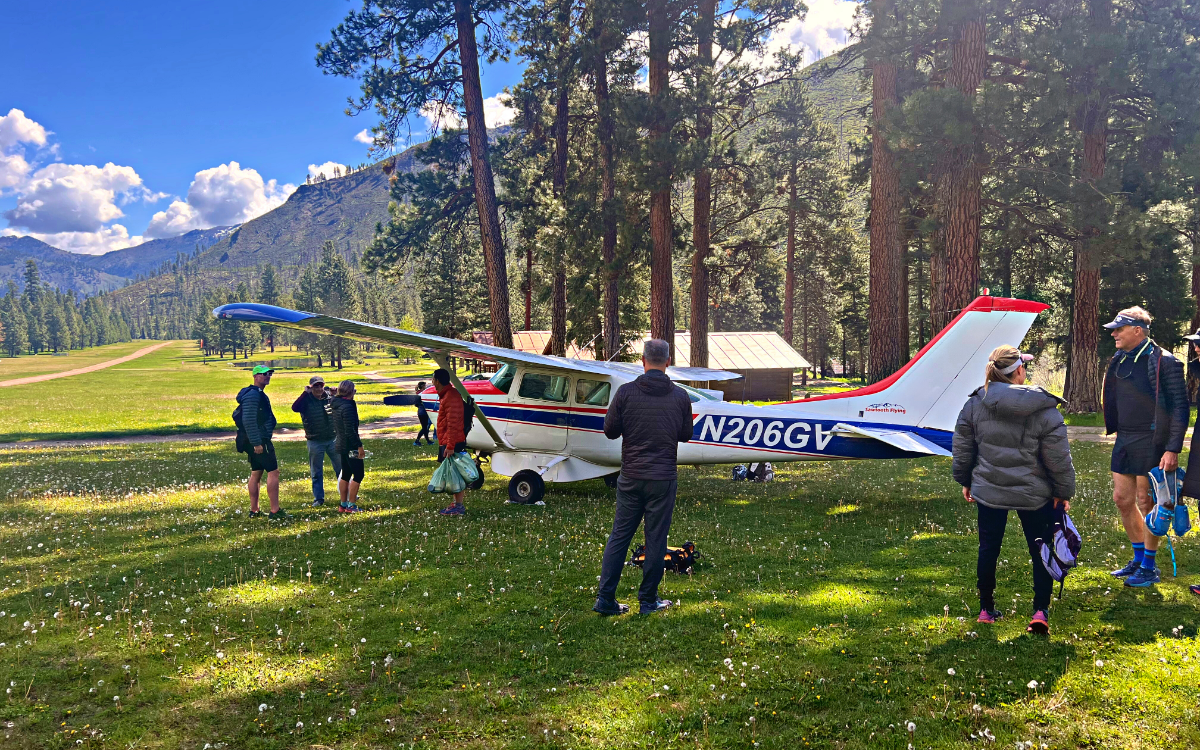
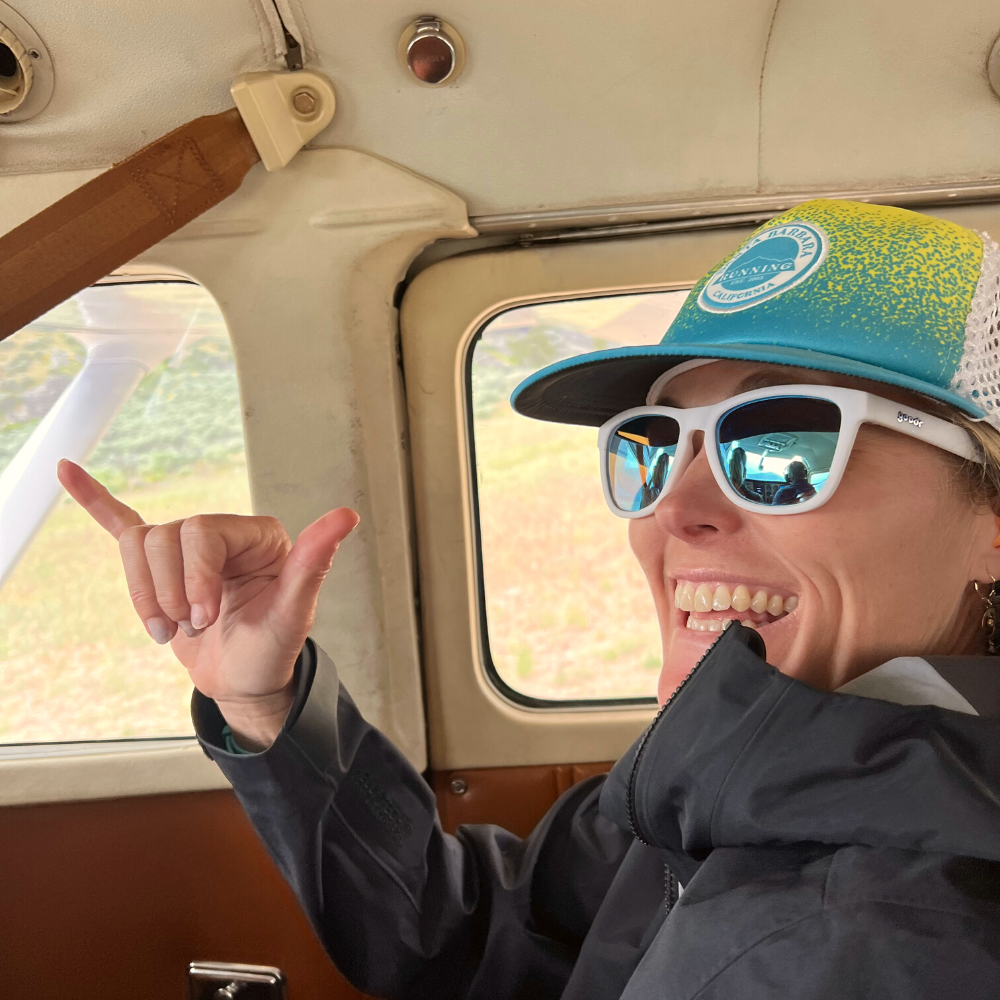
The plan he proposed involved using Bi-planes supplied by Sawtooth Flying Service to drop runners off at one of the primitive airstrips which dot the river to access the basecamp and trail system for four days of exploring.
“This sounds like a PROPER adventure! Let’s do it.” I replied.
Abram laid out the options for participants: runners could use trip insurance to reimburse their trip, take a partial credit that could be put towards a future trip, or join us for the air-supported alternate trip that promised to be both unique and wild. We needed only 6 runners to say yes to the plan and by the end of the night, we had 8. We were going to Idaho.
Preparing for Take-off
Stanley, ID is a tiny town set in a sweeping valley under the jagged Sawtooth Mountains. The power of the Salmon River pulses through this town: its bars crowded with river guides and its streets dotted with outfitters. This infectious energy makes it a perfect jumping off point for adventure.
Runner’s met up at the back porch of River One Outfitters, looking over the rushing main fork of the Salmon River for orientation with the river guides. Evening presented the opportunity for a visit to Mountain Village Resort’s private hot spring, and runners returning from the pools wore that spiritually refreshed look that only the inner Mountain West can offer. After a quick stop at the Stanley Bakery, a refreshingly modern cafe featuring quality baked goods, runners showed up on the runway energized, looking toward the distant Sawtooth Range with anticipation. During orientation, Kelsey had informed us that Sawtooth Flying was her first choice for flights through the region because “she prefers pilots who know what they’re doing over pretty planes and clueless pilots.” Indeed, this squad of pilots had seen some time in the air, as had the planes. Anticipation and nerves were palpable as the pilots loaded our baggage and divided the group by weight into the small prop planes. As opposed to larger passenger planes, you can FEEL the force as these planes take off. White knuckles gripped seatbacks as our planes took off and rose over Stanley toward our 26 minute flight to Pistol Creek.
Heading Down River
Petroglyphs along the Middle Fork of the Salmon River
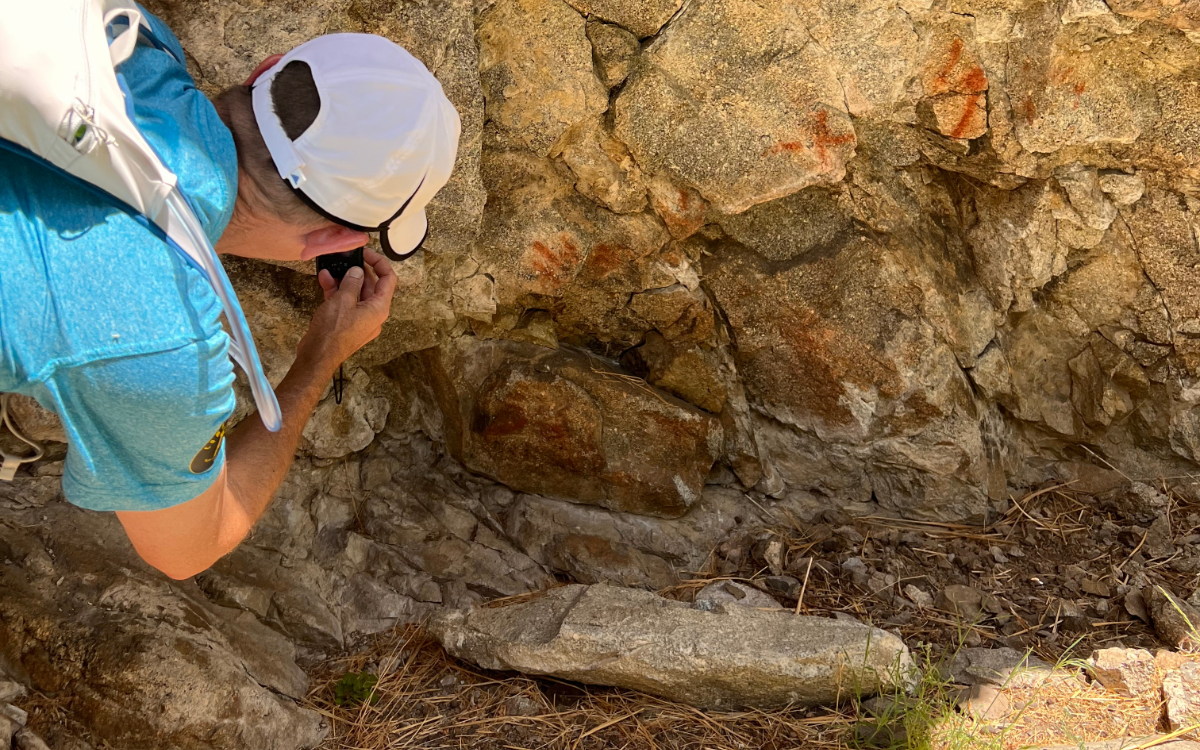
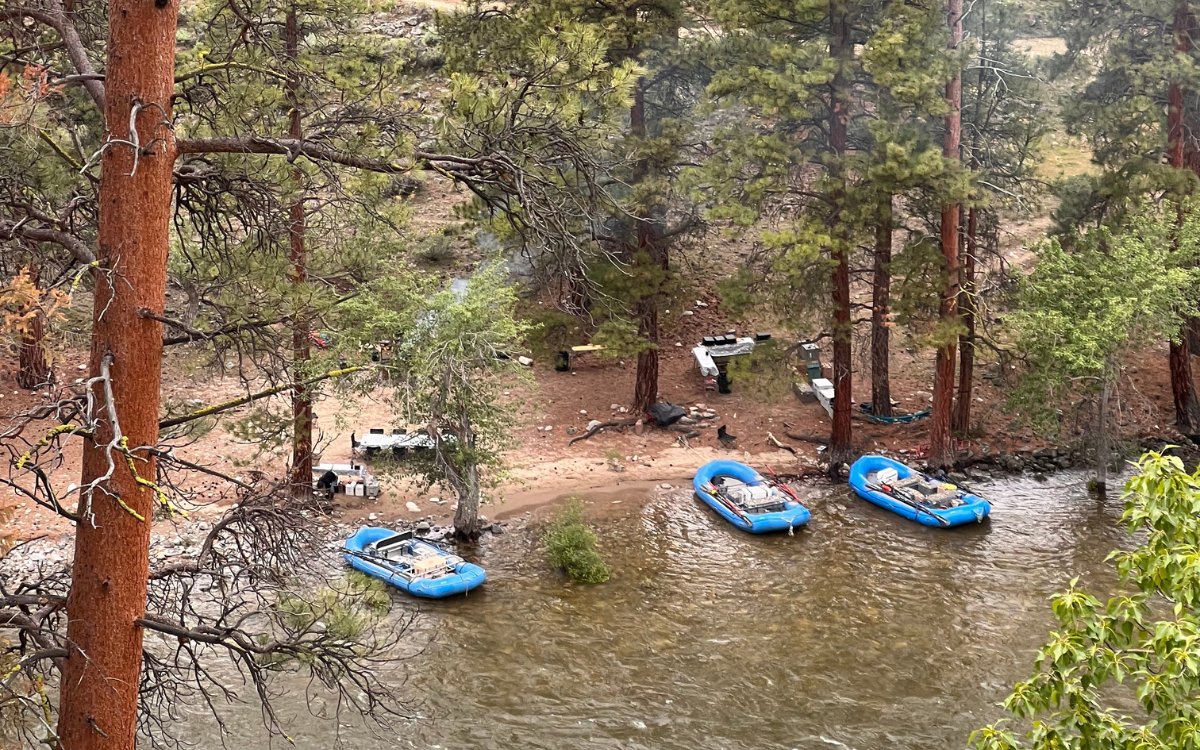
Our initial run took runners ~15 miles down river from Pistol Creek to our basecamp at the Little Creek Campsite. These were CRUISER miles, almost exclusively downhill along the river, with side canyons to explore and eddies for dipping in when runners needed a break from temps in the upper 70’s and low 80’s. Side canyons offered mines to explore and petroglyphs to investigate. At basecamp we foundTim Gunderson, the lead for Helfrich’s team of river guides who was cracking into appetizers and slicing salami as we rolled in. The rest of the river guide team had braved the more treacherous reaches of the upper middle fork for a High Water Training, bringing the tents and kitchen equipment down with them. They arrived that night and unpacked camp like they could do so with their eyes closed. With their whole team at camp for the evening, I started up conversations with the guides about the surrounding high country.
Planning for the Unknown
The joy and challenge of this unplanned reroute was gathering beta on Idaho’s notoriously remote and rugged backcountry and transmuting that information into an enjoyable experience on trail for the runners on the trip.
As the saying goes, “the map is not the place,” and the river guides held most of the knowledge I would be able to glean before heading out for the week’s excursions. As we sat down to dinner, I presented our routes to runners, providing the details and information I’d been able to gain and deduce from studying maps and probing the guides about their experience on land through the Frank Church/River of No Return Wilderness.
Our next three days would be filled with exploratory runs up canyons to ridgelines we had scouted only days before, and only on Gaia GPS’s online mapping software. We laid out the week to gather information as we went. Our first day’s route would tell us a lot about conditions in the canyons, and snow levels up on the ridgelines. Day 2 offered a 14 mile run to the Mahoney Creek Lookout which we could see was snow free from camp and from which we could gather quality beta for the following day’s route up to the ridgelines across the river. Depending on Thursday’s beta, runners were provided with two options for the final day: an exploration up the Marble Creek Drainage and return for an afternoon in the hot springs, or a larger exploratory run up Cougar Creek, covering 27 miles of Idaho wilderness, incurring 6700’ of elevation gain and some sections of “mystery” trail on which we had no beta.
With runner’s prepped, we spent the night enjoying the company of the river guides and the sound of the river before turning into our tents. Adventure awaited.
Route #1
As we took off up Thomas Creek the following morning, we passed a work crew setting off on the trail who warned us of landslides up the trail, before expressing excitement about gathering beta from us after our return. We came to the landslide about a mile on, the side of the hill crumbling downhill into the river, but runners made quick work of the obstacle before continuing on.
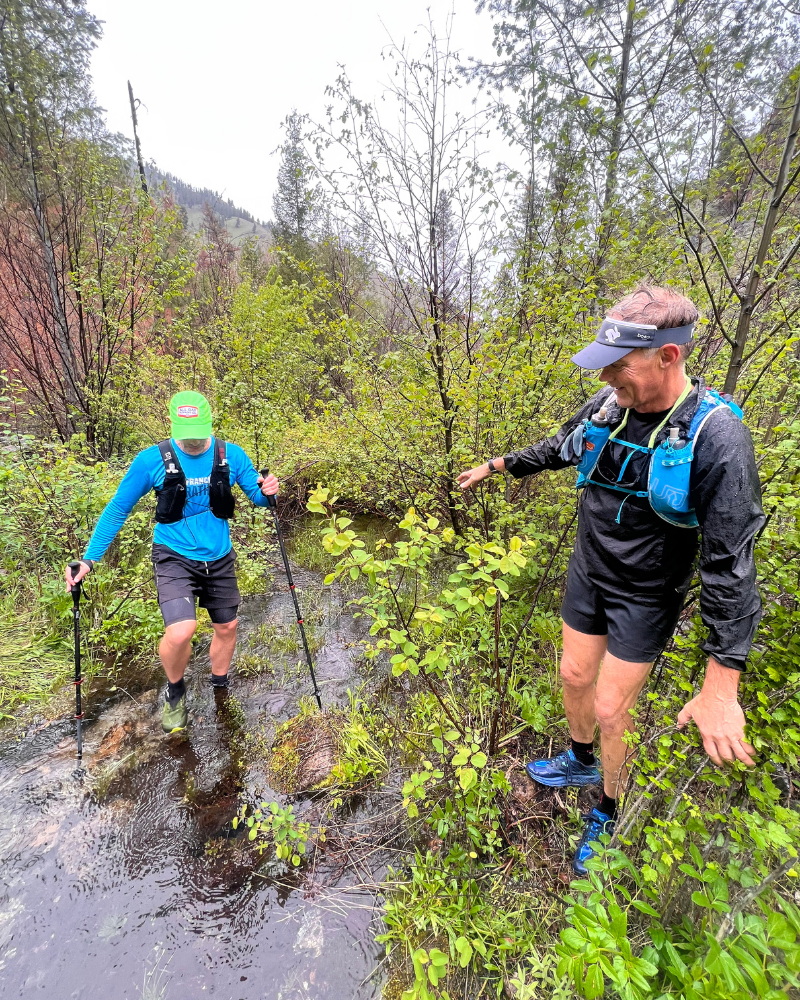
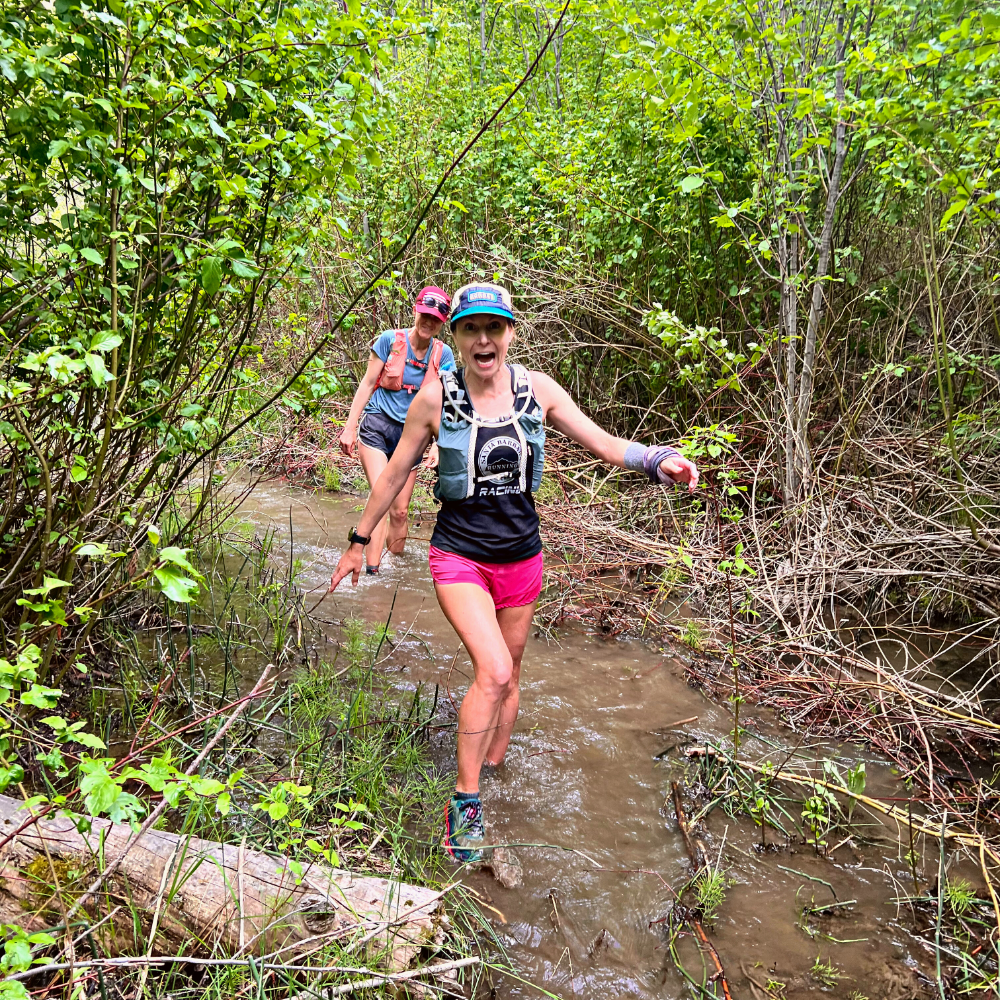
Crossing Thomas Creek there was no choice but to plunge into rushing knee deep water Wet feet would prove to be the name of the game as the trail continued alternating between rock, mud, and becoming a creek itself.
Navigating the Thomas Creek Trail
“Are we having fun yet?” While it was certainly an adventure, bushwhacking through thick shrub in ankle deep water is not everyone’s idea of a great time. Following the check in and a reminder that hotsprings awaited for anyone who wished, the group split up, with a small group continuing on the route, and the rest returning to camp for lunch and a soak in the springs.
For the three of us that carried on, the trail eventually climbed away from the creek up the dry hillside of a burn zone, where we were able to pick up the pace for a few miles before breaking at the junction of two drainages for a snack. As we sat and enjoyed the sun, something caught Adam’s eye.
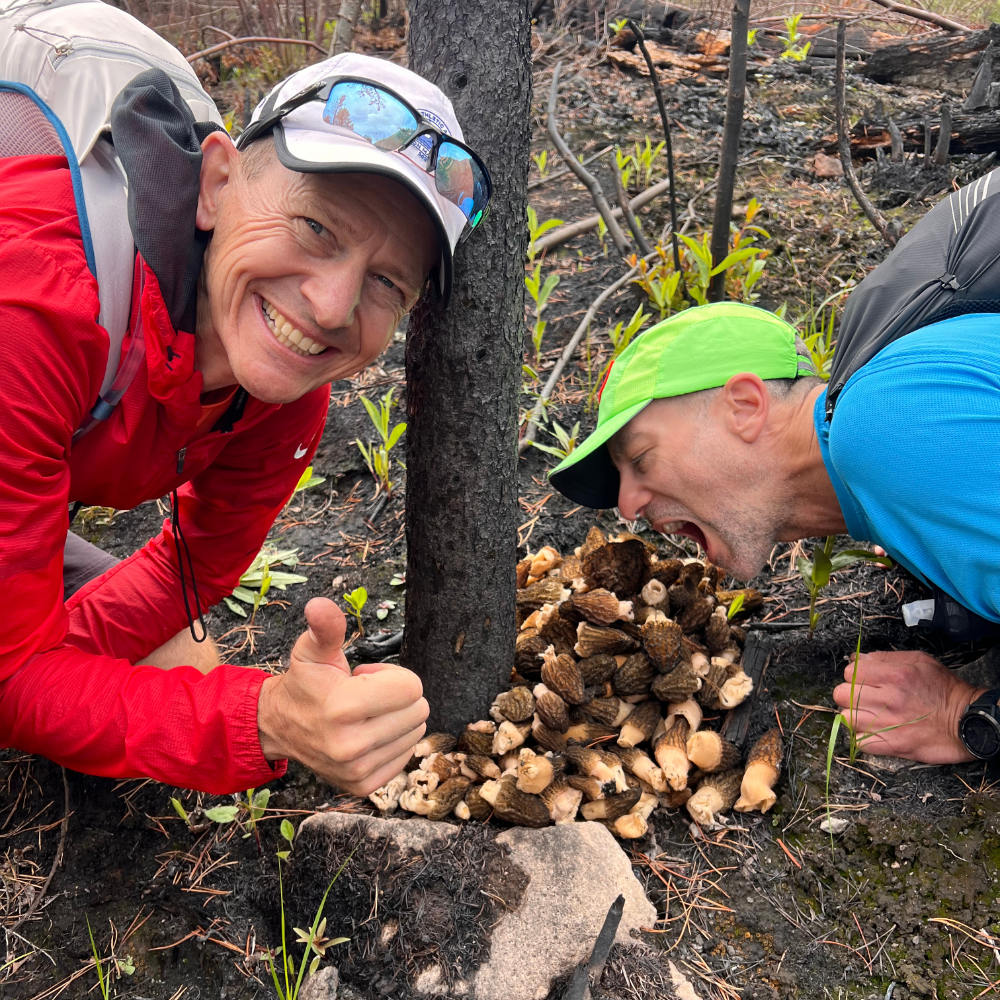
“Morels!”
Indeed, hundreds, no, thousands of them!
Morels!
There’s a defined THRILL to discovering a patch of morels, and the pure volume we were looking at pulled us into an hour of foraging the hillsides. We collected more than four pounds and tied them up in my Houdini before continuing to explore up the trail for a few miles more.
We didn’t make the ridgeline that day to complete the loop, but we learned a few things: the morels in the Thomas Creek drainage are profoundly plentiful, and the Idaho backcountry is rugged, not inclined to give up miles without a fight.
Route #2
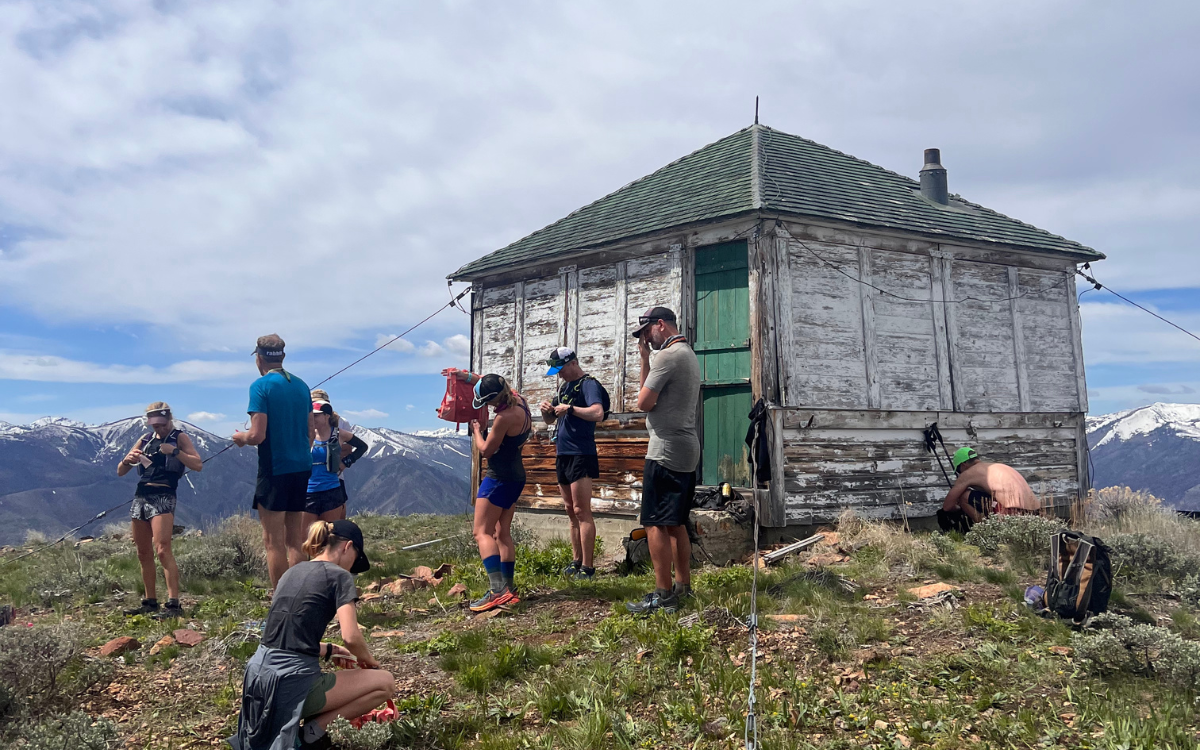
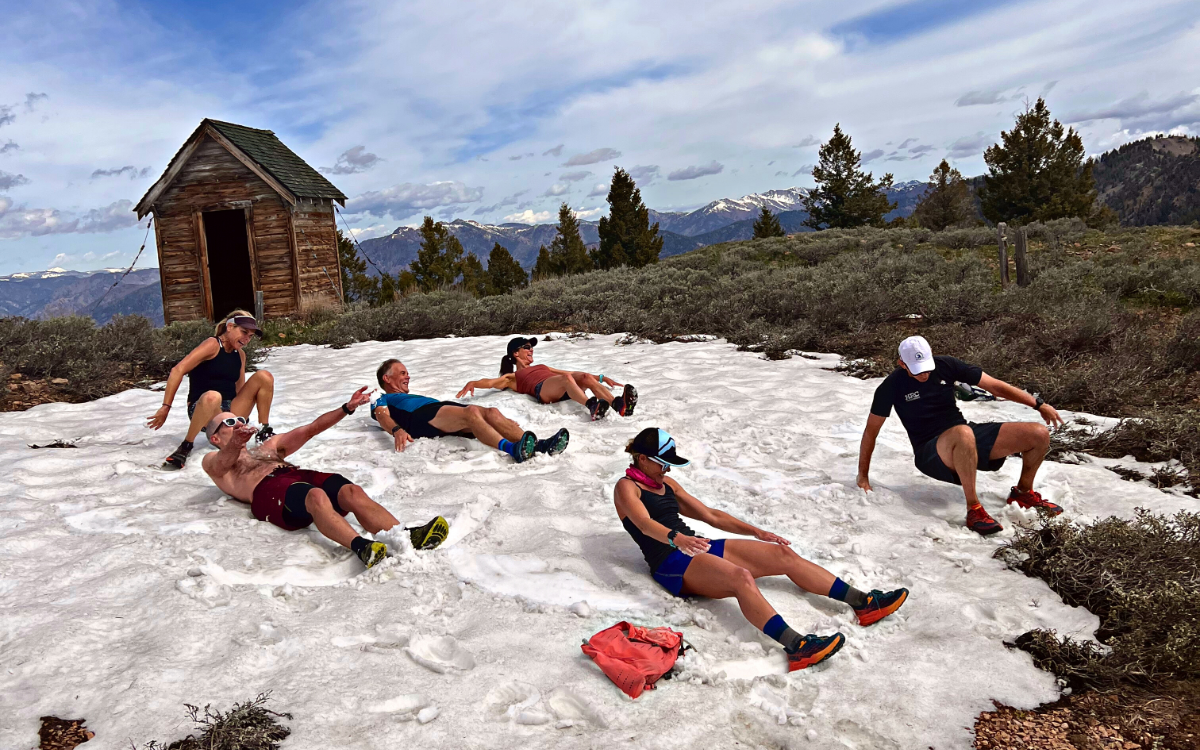
Snow angels at the Mahoney Creek Lookout
Day Two’s plan was clear cut: follow the trail above camp up along the ridgeline to the lookout, soak in the views, and then return to the river for hot springs and food. Fortunately, the ridge trail was clear of the shrubs and brush that had made travel on the previous day’s route tedious, and was instead covered by a brilliant showing of wildflowers. We climbed the seven miles to the lookout as the Idaho sun shone across the vibrant mountainsides of the Sawtooth Range.
From the lookout, we were able to confirm that ridges we had been considering for the final day’s route would go… minimal snowfields and promising open mountaintops awaited.
On the descent back to the river I took a detour and swung through camp, swiping cold beverages and snacks and packing them out to a birthday party soak at the Sunflower Flat Hot Spring. The springs, redubbed “Gucci Springs” by the group, feature multiple soaking pools 10’ above the river, and a steamy waterfall that drops directly into the Middle Fork… a place I’ll return to in dreams when the PNW’s drippy, cold winter rains set in.
Route #3
On Day Three the group split, with the party pace squad heading up Marble Creek and enjoying some extra time at “Gucci Springs”, and the motivated runners heading out for 27 miles of unscouted trail up Cougar Creek to the ridgeline, and then out the Little Loon drainage back to camp.
I went out with the motivated squad and rambled down 5.5 miles along the Middle Fork. Each corner unveiling new rock formations and gorgeous hillsides. Reaching Cougar Ranch brought us to our climb up to the ridge – 7 miles and 4,100’ of climbing and we would make the ridgeline that had called to us all week. After the long, sun-exposed climb, we reached the ridge at 7400’ and the mountain breeze cooled us off. We enjoyed several miles of ridgeline runned to Castle Rock, and the beginning of our downhill out the Little Loon drainage back to camp.
The “trail” in the lower canyon following the first creek crossing.
Mountain runners often expect the downhill to be generous with the clock, allowing us to cover ground quickly and find our flow state. Almost immediately after dropping down off the ridge, it became apparent this would not be the situation for us. The trail quickly feathered as we passed through a burn zone, and we began more active navigation as we picked the best lines through Idaho’s sharp, pokey undergrowth. This proved to be slow going, but as we reached the canyon bottom and joined up with the Little Loon trail, we held up hope for clearer travel ahead.
It would not be so.
Little Loon Canyon was gorgeous, a braiding “creek” winding through an idyllic valley, but the trail down the canyon crossed the creek many times. Water levels at this point were still rising, and had turned the creek into a rushing torrent none of us were keen to cross. Avoiding the crossing meant bushwacking and scrambling boulder fields alongside the creek, navigating landslides, and praying the rattlesnakes had taken up residence elsewhere for the day. Treacherous as this was, we continued downstream avoiding the crossings, sometimes traveling only 1 mile per hour.
Then the canyons began to close in, and I could see on our topo map profile that the creek would pass through tight channels with cliffs on either side. A few miles from our junction with the Middle Fork Trail, the terrain asserted its will, forcing us into a crossing of the creek.
I stepped into the flow and felt the icy waters wrap around my scraped-up legs and rise to my waist, choosing a line where the river was wider and without holes and boulders. I signaled to the group to unstrap their chest straps and link up, pointing to our exit on the far side of the crossing, and in we went. The flow was strong enough to make crossing a challenge for the lighter members of our group, but we crossed without incident. Having broken the threshold, the next few crossings proved, while still challenging, less imposing. We utilized what nature provided, propping downed trees across the creek for stability and supporting each other, only to dive back into the brush on the other side. When the trail finally spit us out onto the junction with the Middle Fork Trail, our group laughed, cried, and swapped high fives. We had just passed through some proper type two fun, and the bonds that formed while waist deep in the creek were palpable now that we were out of the thick of it. I sent an Inreach message to the team back at the campsite, “These runners are going to want showers tonight, eta 90 minutes”, and we took off. It had been an epic day.
Unexpected Magic
While recounting our adventures over dinner back at camp, the river guides let us know that a storm was moving in, bumping our pick-up time for the flight out of the canyon up to 11am. We planned for our run downriver to the pickup spot accordingly, setting alarms and packing up before bed. Upon awakening in the morning, however, we learned the storm was pushing in more quickly and after conferring, we decided to forgo the days run in exchange for a pick-up directly from camp, rather than risking the storm making pick-up impossible downriver and trapping us on the river for 2-3 extra days.
What was one more alteration during this freewheeling week of adventure? By the time the pilots made it onto the Thomas Creek airstrip, the storm was right on their heels, making for an exhilarating flight out through rain and sleet in the six-seater planes, but we got there in one piece, stepped foot on terra firma and concluded a trip full of incredible moments.
Departing from the scheduled itinerary opens us up to new experiences by default, and the exploration and celebration on the Middle Fork this year made for an incredible reward for the risk. The squad of runners who joined for the alternate River of No Return trip this year were down to roll with the unexpected, thus experiencing the magic of the Middle Fork in a unique way.
Trent Banks is a senior guide and marketer for Aspire, as well as a DJ and event producer, and father of two daughters, based out of Bellingham, WA. He joined the Aspire crew in 2018.
Adventures in Risk Management on the Lost Coast Trail
Risk management is a cornerstone of Aspire operations. Each trip’s unique variables call for a different approach to keeping runners safe and ensuring an enjoyable experience. Even so, when running through wilderness environments, nature makes the final call. Our “Expecting the Unexpected” series recounts times when things didn’t go according to plan, and the unique opportunities for bonding and adventure those moments create when risk is managed well.
There’s a mercantile in Leggett, CA, (population 56) that serves as a meet-up point and final outpost for adventurers heading off the grid and into the remote coastal wilderness. The shop offers basic provisions like you’d expect. It also sells a green-brimmed hat with a punchy message about the picturesque and famously twisted route nearby: “I survived Highway 1.”
It’s a given that things go wrong on long-distance backcountry excursions. Runners might like to focus on physical strength and race tactics. But problem-solving is the core of ultrarunning and outdoor adventuring. With the right mindset, risk management plan and a bit of luck, getting out of that tough time is also the root of the story everyone shares at the end-of-trip campfire.
At least that’s how it went on Aspire’s unforgettable June trip along the Lost Coast.
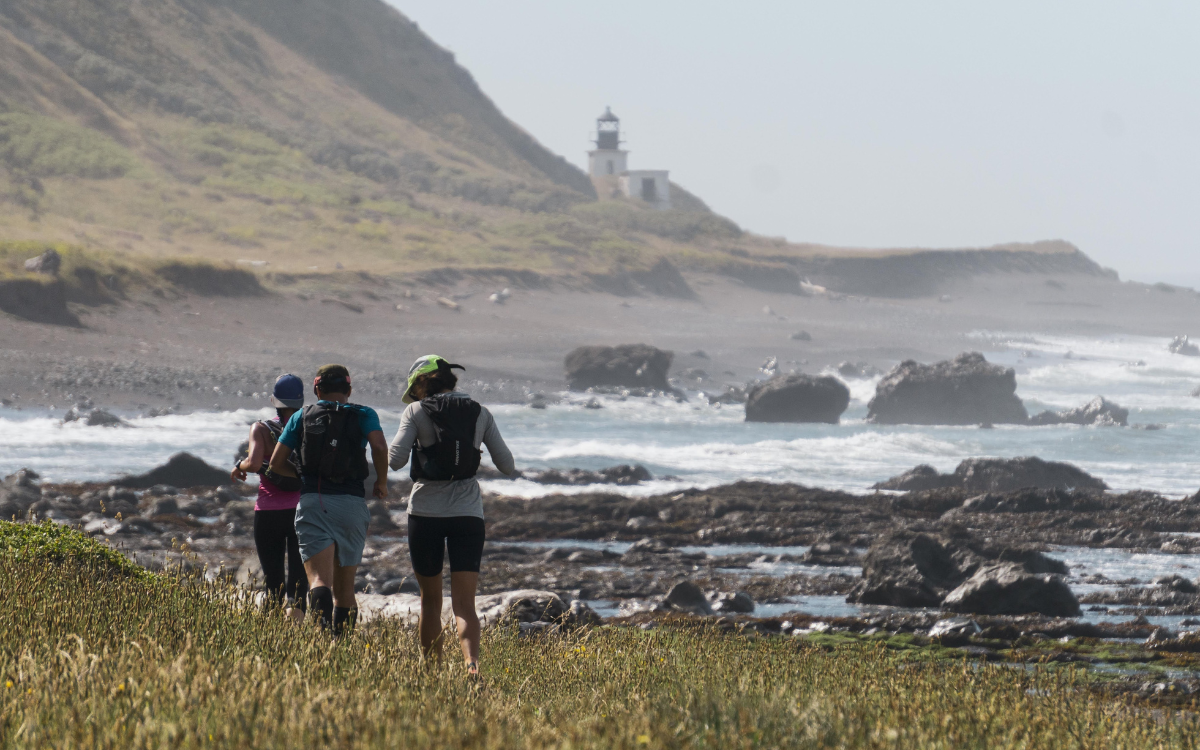
A runner dodges the tide.
A three-hour’s drive north of San Francisco, this remote and wild slice of the King Range National Conservation Area and Sinkyone Wilderness feels more like a scene out of Jurassic Park than a protected patch of land in the most populous U.S. state.
Cell signal? Forget about it. Roads? Hope you don’t get car sick, don’t have to pass anyone, and have an hour or three to get where you’re going. People? Mostly just backpackers doing a sandy 25-mile beach trek in several days — a section Aspire runners will be covering on Day 1. And then there’s the thistle-berry-poison-oak bushwhack interspersed along the 60-mile route.
Infamously brushy sections abound on the Lost Coast Trail.
The 19th century Gold Rush brought death and disease to the indigenous Sinkyone people here. Then, timber harvesting and oil drilling carved up the land and left behind sawed-off redwood stumps and squiggly roads that seemingly go to nowhere. When the oil boom dried up in the 1930s, people left the region in droves, giving it the apt name. But by hour five on a trail here, it’s reasonable to think that the bluffs just don’t want to be found.
If things have to go sideways in such remote places, one hopes it’ll be something relatively minor. An irked knee after a 25-mile day on a slanted sand beach, perhaps, or a bent tent pole while rushing to pack up camp in the pouring rain. They’re the kind of things that in the moment can — and do — feel crushing. Managed with a well-stocked tool kit and a bit of know-how and they just become part of the experience.
Where the real strength shines is when something bigger happens, when things really start to go off-script, and when a group is tested in bigger, more complicated ways.
Welcome to Day 1.
The Lost Coast run begins with a near-marathon-length run through deep sand, slick rocks and precarious bluffs spanning Mattole River Campground to Shelter Cove. The route has three tide-dependent crossings that runners must traverse before a certain time or else risk being cut off from the trail until the water recedes. The longest crossing, the Rattlesnake High Tide Zone, is a 3-mile stretch that, on this particular trip, runners needed to be through by about 4:30 p.m.
It would be a push for everyone.
For the six who didn’t make it in time, it’d be the setting for a story that would dominate the trip.
An Aspire guide bringing up the back of the pack realized by about 3:30 p.m. that they were up against the clock and unlikely to make it through the tide zone in time. With waves inching higher, the group needed a backup plan. So they made one.
Runners wait out the tide on the Lost Coast Day 1.
One runner scouted ahead for a possible bailout route that was loosely sketched out on a map, a creek and possible trail that climbed toward the hills. Meanwhile, the guide bounded between runners and ensured everyone knew the plan — or, more to the point, knew that there was a solid plan to begin with.
Before long, they’d made the turnoff, climbed above the water and hunkered down next to now-infamous Buck Creek. That’s where the problem-solving really began.
Sundown over the Pacific Ocean.
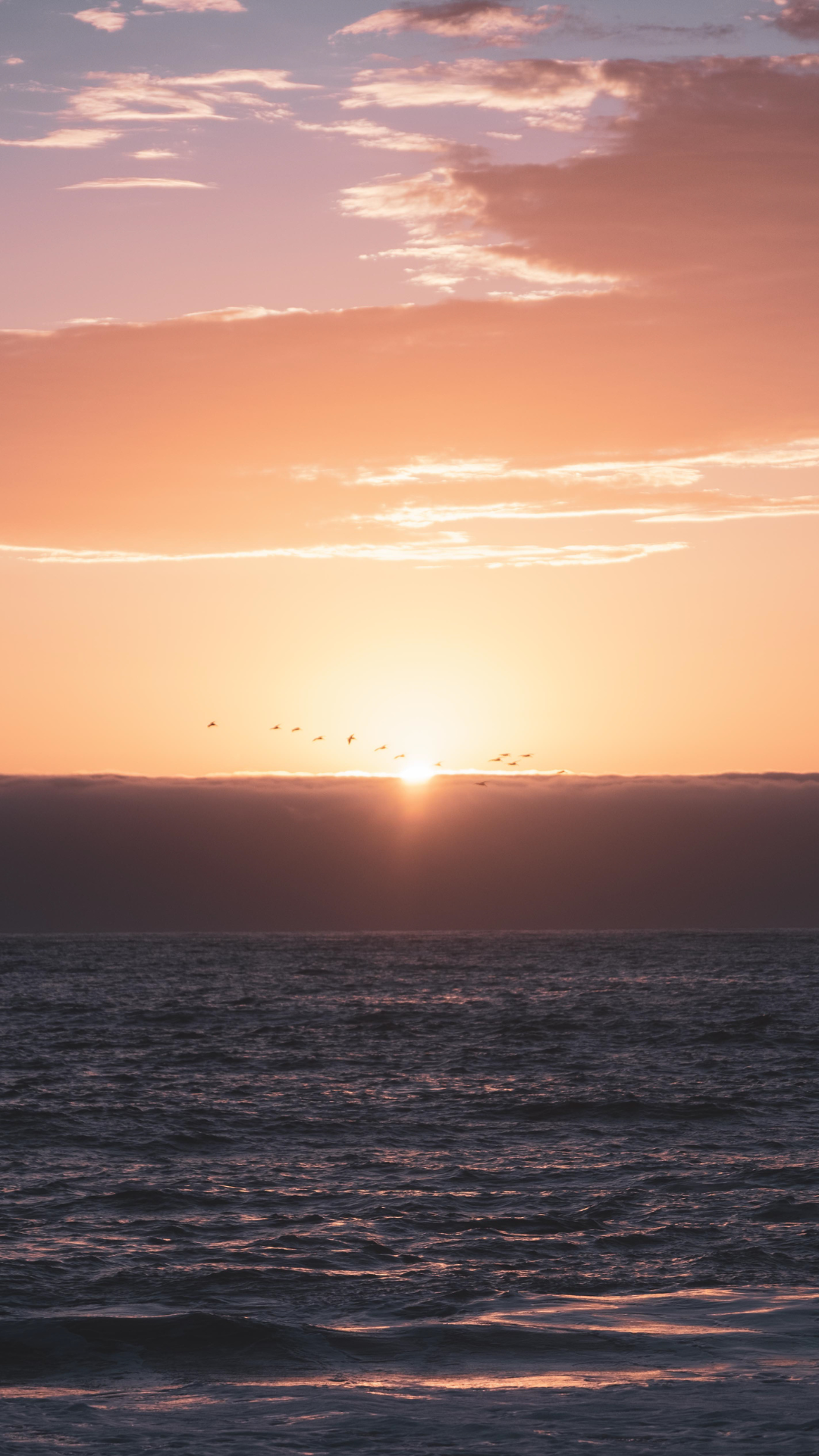
Realizing they would be out for at least twice as long as they had anticipated when they started running that morning, everyone emptied their running packs to share food. They inventoried supplies as it became clear they’d be bivvying on the bluff deep into the night. “What happens at Buck Creek stays at Buck Creek,” they’d say over and over, huddled in gold-colored emergency blankets as the sun dropped below the Pacific and turned the sky a stunning shade of orange.
Unplanned and worrisome as it was at the time, it certainly could have been worse.
Aspire guides and many clients travel with Garmin inReach devices, which allow for some communication while in the field. By mid-afternoon on, the team shuttling camp toward Shelter Cove knew that nearly half the runners were taking an impromptu trek inland. So they made plans to meet runners who made the crossing in time and prepped backup plans for those who hadn’t. Even when things were uncertain and when communication became spotty, the situation never spiraled. It was one decision after another.
At one point that night, a guide loaded a van with food, water and beer and headed toward the beach group’s bail-out route in the event they abandoned the beach. The plan to meet them midway down the path was ultimately scrapped after the beach group decided to smartly wait out the tide and resume their beach trek at midnight.
Alongside fresh bear prints, and with a renewed motivation to finish, the group pushed the pace and arrived at a twinkle-lit Sprinter van at 2 a.m. Hot food and beer awaited them, as did dry clothes, pitched tents and rolled-out sleeping pads back at camp.
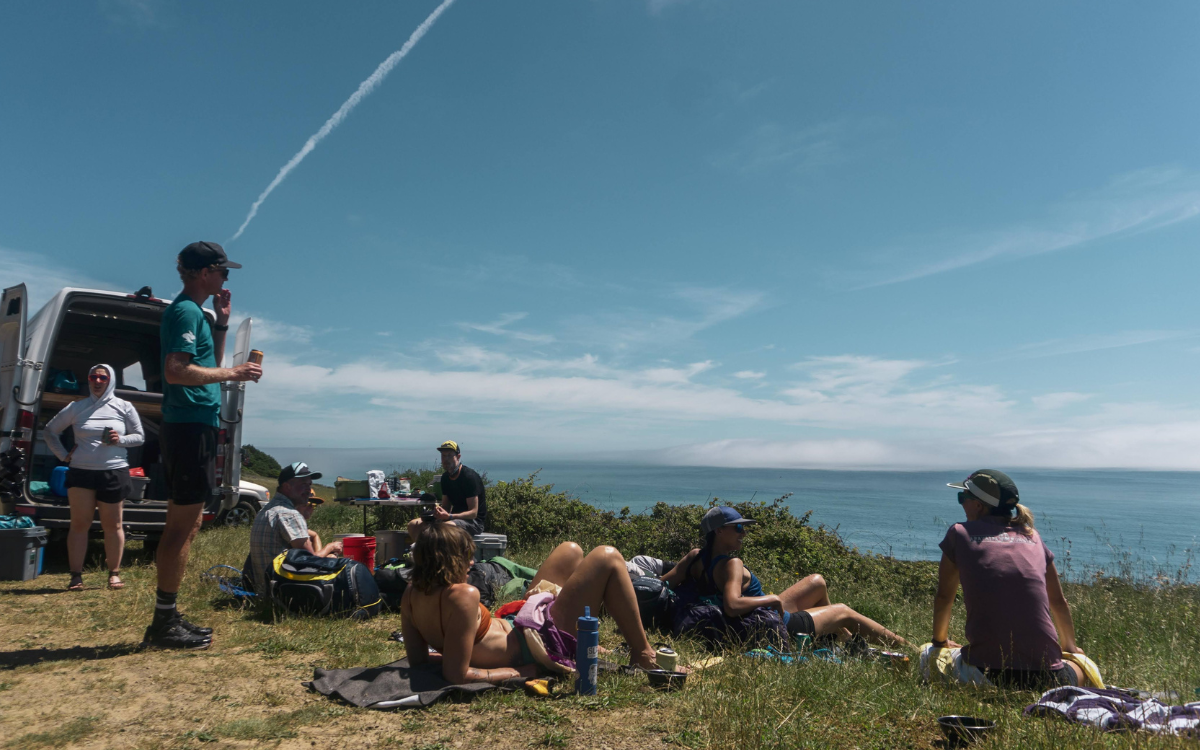
Situations like these are rare. They’re also where staying level-headed and thinking through decisions pays dividends, knowing that with proper risk management, it’s all-but-guaranteed everyone will stay safe and walk away with a story to tell. By breakfast some six hours later, the beach group was regaling everyone with stories of what happened, who stepped up and how well — all things considered — the night ended up going. Despite the lack of sleep, the beach group rallied and hit the trail for an abbreviated Day 2 trek. Everyone’s reward? Hammocks, lounge chairs, burgers and sunset over the Pacific, albeit this time from the comforts of a wooden camp bunkhouse alongside easy-going conversation and a bowl of dutch-oven-baked apple crisp.
Soaking in expansive Pacific Views at the aid station.
The first day set the tone for the rest of the trip, both in terms of things going wrong and finding solutions. Multiple runners’ water filters broke, so people worked together to share. On Day 3, when most of the beach group decided against making the 20-mile run/bushwhack to round out the trip, some pitched in on helping a guide navigate the harrowing narrow roads. Once everyone arrived at Usal Beach, the party at camp — complete with margaritas around the fire — lasted late into the night, up until a few raindrops began to fall…
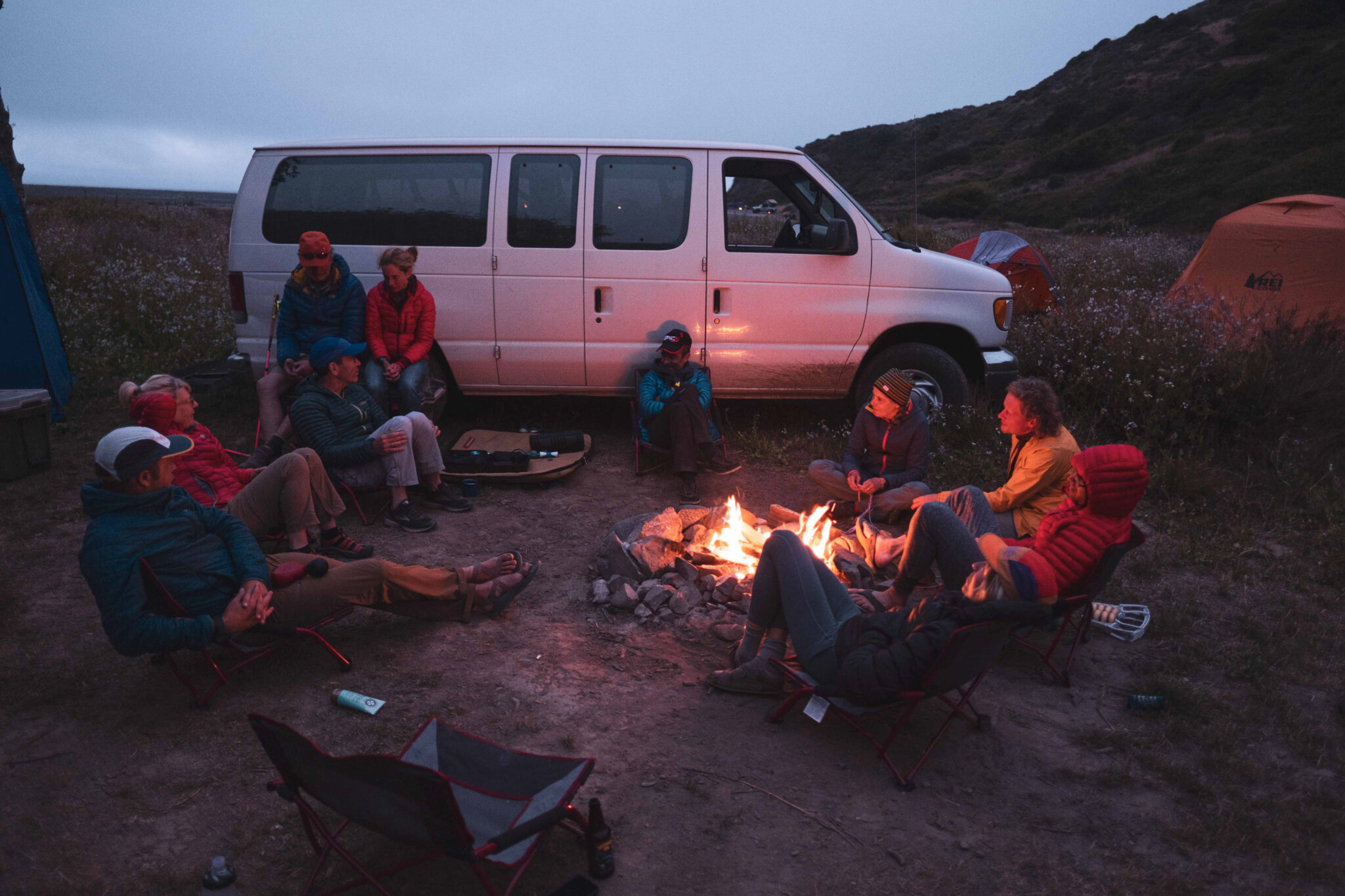
Runners unwind by the fire after finishing the Lost Coast Trail Stage.
Raindrops turned to a downpour overnight. Bags and bodies were sopping wet by the time everyone piled into the vans to leave that final morning. But the rain had turned the campsite to tacky soup that swallowed Aspire’s loaded Sprinter van tire.
For a moment, anxiety swept the group. Some people had flights to catch later that morning. Most everyone had “real lives” to return to. But the van went nowhere, even with a dozen runners attempting to shove the van forward. So much for Plan A.
Plan B: Surely one of the 4×4 crews camped a half-mile away at the beach had some traction skids they could loan out. But one by one, the gruff beach campers told a guide that they didn’t have skids and hadn’t seen anybody with them, either. Despair deepened.
On to Plan C: Build an improvised skid, replete with rocks that both guides and clients had scooped up from camp and smashed together into an improvised backcountry traction device. Some looked on skeptically. Others made the kind of nervous laugh someone makes when they know something will make a hilarious story someday when they’re dry and not off the grid hanging around camp in a downpour with a stuck van.
One more hope-filled push from everyone and the Sprinter lurched forward and fishtailed through camp toward the hard-packed road.
Cheers. Claps. Problem solved.
Then gasps.
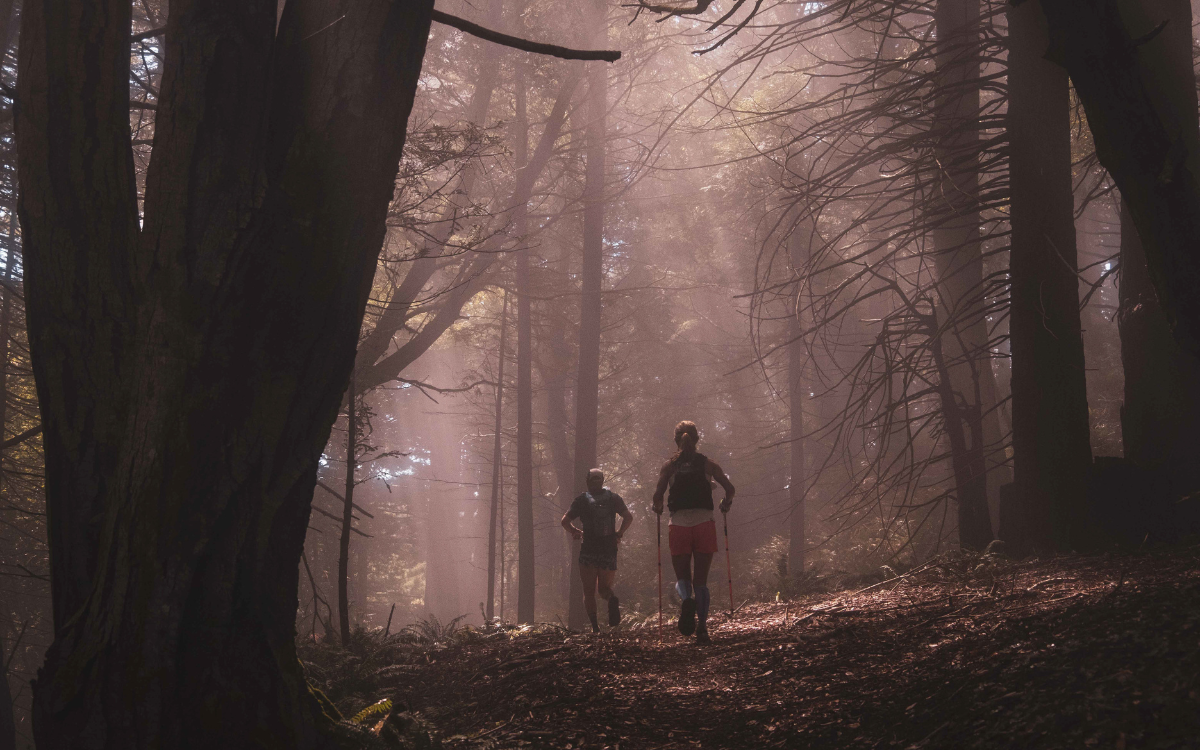
Running through dappled sunlight in the eucalyptus groves.
Exactly what happened before the Sprinter made it to that road will make for a helluva story on problem solving, that is, after the body shop gets a look at the dented side and damaged door, courtesy of a leaning tree.
At the Leggett mercantile where a group of strangers had met several days earlier, now everyone high-fived, hugged and swapped phone numbers after an unforgettable trip on the Lost Coast.
The views and stories will no doubt outlive any “I survived” hat.
There is talk, though, of making a t-shirt about what happened up Buck Creek…
Jason Pohl, 32, raced road marathons for a decade while also bagging peaks in Colorado’s high country and taking backpacking trips throughout the West. He ran the Boston Marathon twice and in 2012, largely on a whim, did a self-supported bicycle tour from Washington to Maine. He’s now all-in on trail running with a handful of 100k finishes in the books and a string of self-supported adventures on the horizon. He works in the “real world” as an investigative journalist in Sacramento, California, where he lives with his partner, Mel.
Do you want to run through the deepest wilderness in the lower 48? Float one of the continent’s most remote and wild rivers? Encounter the tracks of wolverines and Bighorn sheep? Run through deep forest and steep, rugged mountains? Soak in hot springs? Explore ancient indigenous caves and pictographs? Swim in the cleanest water you’ll ever experience? Cast flies in one of the healthiest trout fisheries on the planet? How does it sound to do all this away from any motorized vehicles or roads for five days?
New Terrain to Run
Running and floating along the Middle Fork of the Salmon is truly a once-in-a-lifetime experience. This year Aspire Adventure Running -in collaboration with Helfrich River Outfitters- is excited to introduce a one-of-a-kind running/rafting wilderness trip.
Over five days, run up to 80 miles along the river (~20 miles each day) and then float the final 40, or you can float as many days as you want. You can bring family or friends who can float while you run. And every night, you can gather up around the campfire to trade stories and scouting reports from your adventures in this deep, beautiful, one-of-a-kind wilderness.
A Wild and Scenic River
Known as “The Best River in the World,” The Middle Fork of the Salmon flows 104 miles through the deep heart of the Frank Church River of No Return Wilderness. It has over 350-nearly continuous- rapids between class I-IV. The Salmon gained its name, the “River of No Return,” when early twentieth-century wooden boats could navigate downriver, but not get back up through the powerful rapids. Unlike the Main Stem of the Salmon River, the Middle Fork has no motorized jet boats, so you are in true, remote wilderness. Outside of Alaska, there is nowhere more remote in the United States.
The Salmon River canyon is even deeper than Arizona’s Grand Canyon, but unlike the Grand Canyon’s towering cliffs, the Salmon River Canyon is a diverse combination of wooded ridges, huge bluffs and slides, solitary crags and stone towers. It’s a classic northern Rockies landscape of Douglas Fir and Lodgepole pine beneath steep scree and rock slopes. This is the ancestral land of the Tuka Deka Sheepeaters tribes and the Shoshone and Nez Perce. Their artifacts and pictographs are spread throughout the landscape, along with the remnants of a handful of old mining and pioneer cabins.
History of Wilderness
Designated in 1980 and including a mixture of National Forest and BLM land, The Frank Church-River of No Return Wilderness is the largest contiguous wilderness in the lower 48 with 2.367 million acres. Together with the Gospel Hump Wilderness and connected roadless Forest Service land, it is the core of a 3.3 million acre roadless area. Nearby, separated only by a single dirt road, the Selway-Bitterroot Wilderness adds over a million more acres to this massive area of wild, conserved land tucked up in northern Idaho.
The Wilderness is named for US Senator Frank Church, a Senate floor sponsor of the 1964 Wilderness Act (which protected 9 million acres of US land) and the Wild and Scenic Rivers Act, which included the Middle Fork of the Salmon. Indeed, Church-who also helped to create the Hells Canyon Recreational Area and the Selway-Bitterroot Wilderness- was, along with luminaries like Mardie Murie, Stewart Udall and Howard Zahniser, one of the pivotal players in the mid-century US conservation movement that became a model for the rest of the world.
Because of its size and remoteness, this region provides habitat for wolverines, mountain lions, gray wolves, black bears, lynx, coyote, bighorn sheep, mountain goats, elk and moose. While there are no established populations of Grizzlies here, there probably will be in the future because the habitat is perfect for them. As you run and float, you’re sure to see wildlife, and lots of sign.
Crown Jewel of American Conservation
As an old rafting guide myself, I can tell you that the Middle Fork of the Salmon is one the handful of premier river trips on the continent, a dynamic mixture of great whitewater, remote wilderness, and beautiful landscapes. I can also tell you that there are few experiences more privileged than a wilderness float trip, where you can be a remote area, but with coolers of food, dutch ovens, and all of the other things you can’t bring on a backpacking trip. To combine such an opportunity with trail running is truly special.
Frank Church once wrote that, “The great purpose is to set aside a reasonable part of the vanishing wilderness, to make certain that generations of Americans yet unborn will know what it is to experience life on undeveloped, unoccupied land in the same form and character as the Creator fashioned it. It is a great spiritual experience. I never knew a man who took a bedroll into an Idaho mountainside and slept there under a star-studded summer sky who felt self-important that next morning.”
So, come experience one of the crown jewels of American conservation, one of the great wildernesses and remote rivers. Run. Float. Cast. Soak. Put a bedroll down on an Idaho mountainside with us. You’ll be glad you did.
Run/Raft the River of No Return Stage Trip
A Raft Supported Multi-day Run on Idaho’s Famed Middle Fork of the Salmon River
About the author: With three decades spent exploring the PNW and Alaska, Ian Ramsey is based in Maine, where he directs the Kauffmann Program for Environmental Writing and Wilderness Exploration, and teaches writing, ecology, brain science, music and mindfulness to high school students. With over two decades leading trips and expeditions across the US, Alaska and internationally, he loves empowering people to take agency in their lives and discover new places. Ian is a poet and graduate of the Rainier Writing Workshop, and his writing has been featured in places like Terrain.org, Orion and High Desert Journal. He also directs a community steelband, loves kayaking big water, drinks copious amounts of coffee, geeks out around nutrition, literature and fitness, and was once a member of an Inuit Dance Troupe.
Yosemite National Park is the birthplace of American environmental activism, as well as modern rock climbing, backpacking, and landscape photography. So much that we consider as American “wilderness” started right here.Ian Ramsey gives some insight into some of this Yosemite history and how it lives on today in this incredible place.
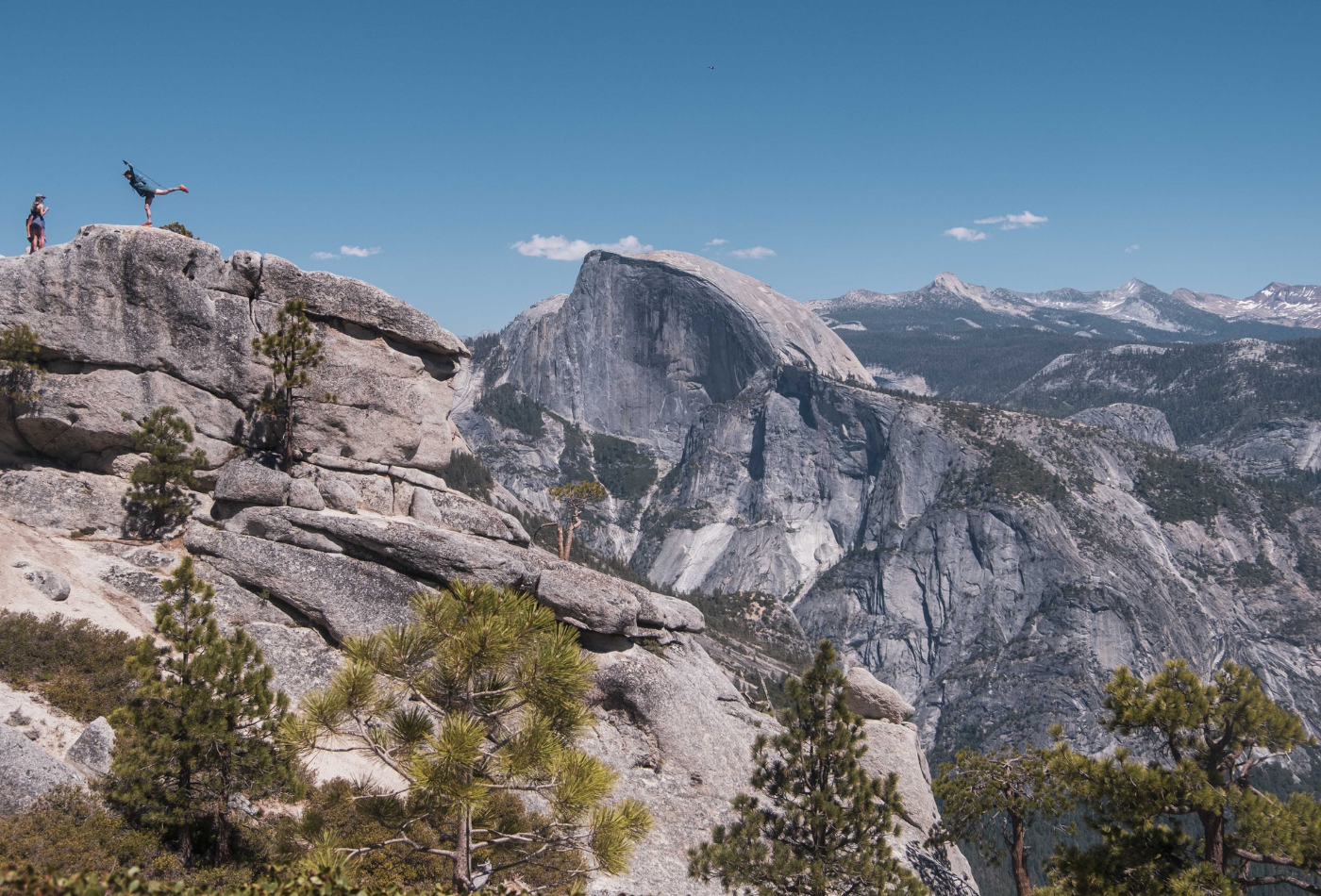
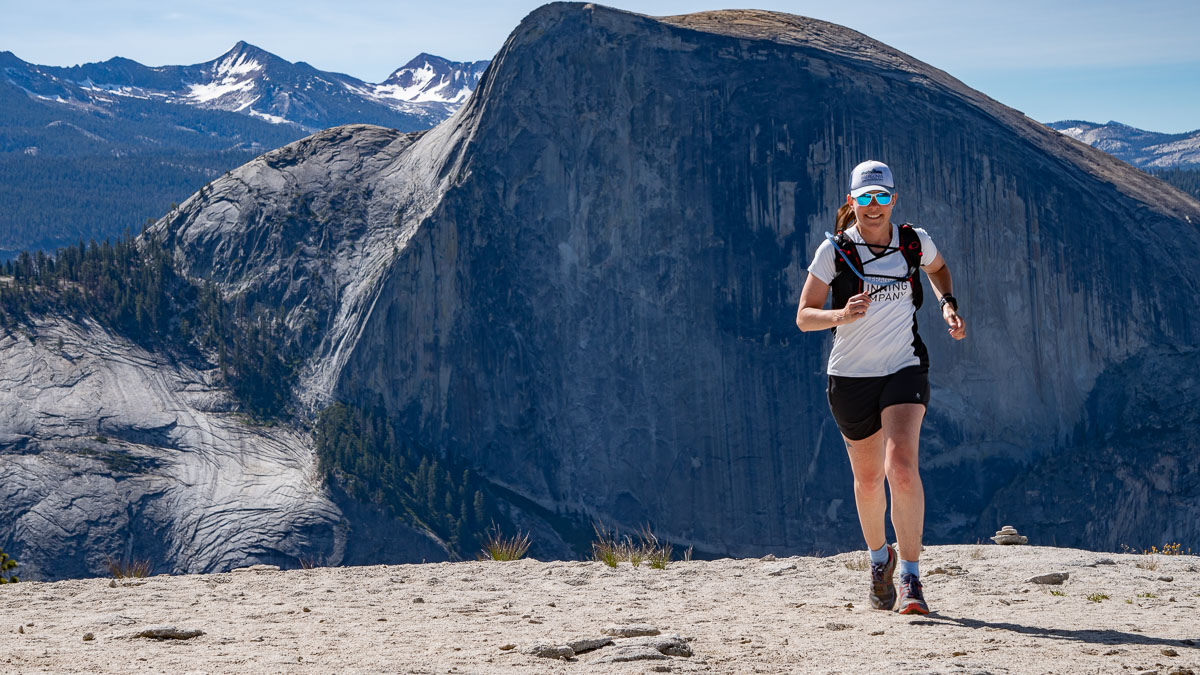
From my backcountry overlook on the Snow Creek trail, I’m looking across the valley at Half Dome. To my left, Cloud’s Rest rises into the sky. The dimensions are unfathomable-Is that distant ridge two miles or twenty miles away? I haven’t seen anyone in hours.
Over the past few days, I’ve run, power-hiked, skidded and sprinted my way around the valley. I’ve also sat in quiet wonder, watching the light reflect off of El Cap, listening to waterfalls, and watching deer ambling through meadows.
In between backcountry adventures, I’ve also gotten glimpses of industrial tourism-trails, restaurants, and visitors centers packed full of families, senior citizens, crying toddlers, international tourists, and scout troops. Overfull parking lots and long lines at ice cream stands. With 4.5 million visitors in 2019, Yosemite is the fifth-most visited National Park. Movies like Free Solo have featured the park, and if you open any Patagonia catalog or climbing or backpacking magazine, you’re sure to see images of the great granite walls, alpine meadows and forested slopes. Heck, Yosemite was even in a Star Trek movie.
The History of Yosemite
Native Lands of the Ahwahnechee
The name “Yosemite”-which means “killer” in Miwok-was the name that the local nineteenth-century settlers mistakenly called the local Ahwahnechee tribe who lived in the valley. The Ahwahnechee, relatives of the Northern Paiute and Mono tribes, had lived in the valley that they called “Ahwahnee”-meaning “big mouth”-for hundreds, if not thousands, of years. Indeed, the valley has been inhabited for over 3000 years. In 1849, their lives were disrupted when the California gold rush brought 90,000 non-native settlers and miners to the region.
In 1851, as part of the Mariposa Wars intended to suppress Native American resistance, the State of California funded a private militia, and these soldiers -the first documented Europeans to enter the valley in Yosemite history-drove most of the Ahwahnechee people from the area. While a few native people held on, living and working in the valley, they still faced terrible discrimination.
A century later, in 1969, the National Park Service would continue this inequity, evicting the remaining Native people from their residences and destroyed their village as part of a fire-fighting exercise. Today, the Park Service is doing its best to honor the legacy Native people’s connection to this land, but there is much work to be done.
Early Development
Starting in 1855, entrepreneur James Mason Hutchings started to publicize Yosemite and bring tourists to the valley, where he built roads and a hotel. Other hotels and businesses started to pop up in the valley, and tour operators started to cut roads through sequoia trees. As awareness of the area’s unique beauty spread, along with fears of rampant development, prominent citizens advocated for protection of the valley. In 1864, the US Congress passed a bill creating the Yosemite Grant-it was the first instance of park land being set aside specifically for preservation and public use. This set the precedent for the creation of Yellowstone as the first National Park a few years later, in 1872.
Muir and early conservation
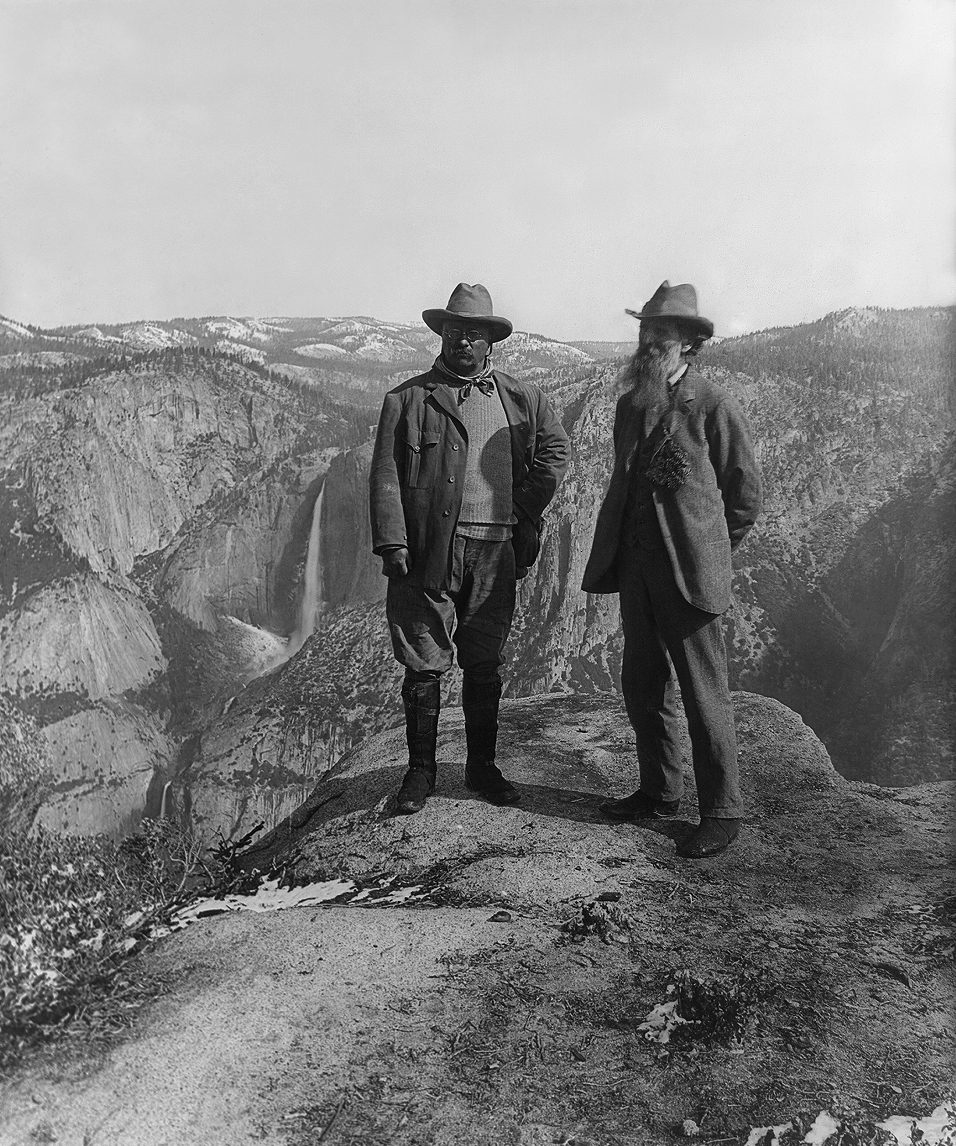
John Muir and Theodore Roosevelt
In 1878, a Scottish immigrant named John Muir arrived in San Francisco and immediately set off on foot across the central valley for Yosemite. He would spend the next eight years living in, and exploring the valley. During that time he would build a small cabin, work as a sheepherder and run a sawmill, but mostly he would explore and adventure around Yosemite and the Sierras.
Muir’s writings about Yosemite and the Sierras would not only introduce the region to the world, but would also introduce new ideas about conservation, earth-based spirituality, mountain-climbing, ecology, and glaciology to the world. Muir hosted people like Ralph Waldo Emerson and Teddy Roosevelt, who shared his message. In 1890, after decades of activism by Muir and others, Congress signed an act to create Yosemite National Park. Two years later, in 1892, Muir would create the Sierra Club to inspire people to hike the Sierras and protect them.
In 1923, despite decades of efforts of Muir and others, the nearby Hetch Hetchy Valley was dammed to provide water for the growing Bay Area, a conservation loss in Yosemite history that would serve as a cautionary tale for decades.
Throughout the 1920s and 1930s, a young photographer and Sierra Club member named Ansel Adams made the valley and Sierras even more famous with his evocative black and white photos of the landscape. Through the work of Adams and the Sierra Club, the John Muir Trail was created, as well as nearby Kings Canyon National Park. Adams, who would go on to become America’s most famous landscape photographer, became synonymous with conservation, documenting, and advocating for, the National Parks.
As automobile travel, the highway system, and the population of California increased, visitation to the park increased. In the 1920s, the park concessionaire, hoping to make Yosemite “The Switzerland of America” even put in a bid to host the winter Olympics in the park, but fortunately it was unsuccessful.
As I look out across the valley, I’m so grateful that this wasn’t developed for the Olympics. Where I ran yesterday across granite ledges, there might have been a ski lift. Tolumne Meadow, with its carpets of richly-scented wildflowers, might have been yet another hotel.
I’m so grateful that running here in Yosemite still translates into a wild, sensory experience of cold rushing water and the pitchy scent of sequoias. I’m glad that I can feel the warmth of the granite on my face and that, an hour later in a completely different ecosystem, my eyes are ringing bright with the colors of subalpine paintbrush and monkeyflowers. And I’m glad that, because Yosemite wasn’t developed as much for industrial tourism, it was discovered by rock climbers.
Scaling the granite monoliths
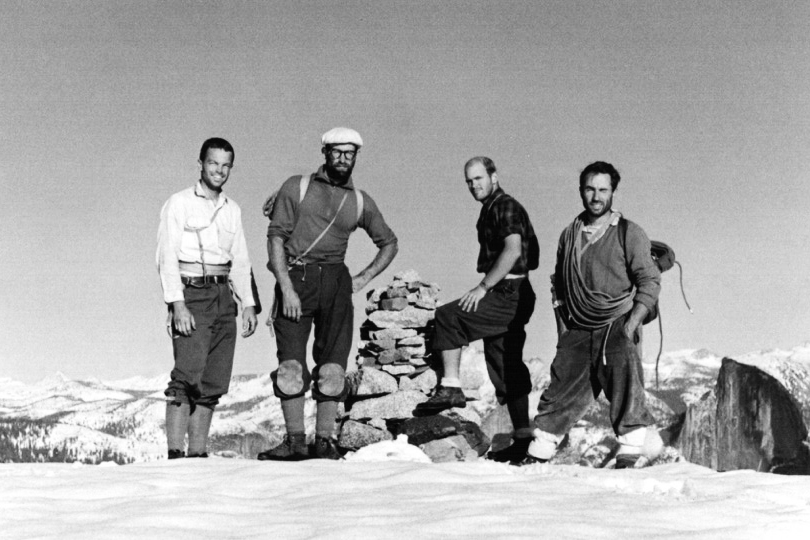
In the 1950s and 60s, Yosemite became the center of American rock climbing, with climbers like Yvon Chouinard (who would go on to found the company Patagonia) and Royal Robbins putting up many first routes and making big walls like El Cap and Half Dome world-famous. They would also develop new climbing technologies like molybdenum pitons and nuts. Their achievements would inspire generations of climbers like Jim Bridwell, Lynn Hill, and Ron Kauk to live at the infamous Camp Four and push the limits of human possibility.
Today groundbreaking climbers like Emily Harrington, Alex Honnold, and Tommy Caldwell are still sending routes that would have been impossible even a few years ago. One of the early Yosemite climbers-David Brower-would go on grow the Sierra Club from a regional hiking and advocacy group to America’s most prominent environmental organization.
Yosemite and the Sierras are also the birthplace of American backpacking, where people inspired by Jack Kerouac and Gary Snyder’s “Rucksack Revolution” started putting on Kelty framepacks in the 1960s. Today, nearly 4,000 people hike the John Muir Trail each year, half of them through-hiking the entire Pacific Crest Trail.
Royal Robbins and friends climbing in the park, 1964
Running amongst the monoliths
While Yosemite is best-known for climbing, there is a rich modern history of trail-running here, particularly on the John Muir Trail. Over the past decade, an assortment of ultrarunners have kept lowering the FKT (fastest known time) for the 212 mile trail, including Hal Koerner, Mike Wolfe, Darcy Piceu, and Leor Pantilat, before Frenchman Francois D’Haene set the current record at 2 days, 19 hours, and 26 minutes. Former FKT holder Catra Corbett actually yo-yo’ed the trail, running the 424(!) miles in just over 12 days. Elsewhere in the park, climber Dean Potter set the FKT for Half Dome just two weeks before dying in a tragic wingsuit accident in 2015. Recently, Jason Hardrath set a number of records on the Yosemite Valley Loop El Capitan, and the Trans-Yosemite Trail. Countless other trails offer opportunities for runners to explore, whether they set records or not.
Yosemite, 2021
Today, Yosemite is a perfect example of the challenges the National Park Service faces as it tries to balance tourism and recreation with conservation. A century of Forest Service fire suppression policies combined with drier, hotter weather and smaller annual snowpack due to climate change have created a landscape that is prone to intense annual wildfire. These fires disrupt visitation and destroy ecosystems and infrastructure.
At the same time, record-setting numbers of tourists and their cars mean that that the valley’s air quality can sometimes be substandard. Backpackers, hikers and big-wall climbers often find themselves in situations where rescue and other medical services are called for. The park service struggles to create a safe, quality experience for all visitors while maintaining the unique landscape and ecology of Yosemite.
And today, as I watch clouds drift across the tip of Half Dome, I’m one of those grateful visitors. If you rock climb, or backpack, or enjoy photography, or consider yourself an environmentalist, or enjoy public lands-anywhere in the world- you owe a debt of gratitude to this place. But all of those stories and facts and historical figures fade away when you look at the 2,425 foot high Yosemite Falls, or find yourself in a Sequoia grove. Yosemite’s greatest legacy is awe, the opportunity to deeply experience something bigger, wilder and more beautiful than you knew was possible.
Run Yosemite with Aspire!
Half Dome for the win.
If Yosemite with less crowds and more mountain running sounds like your kind of daydream, you are only one step away from a dream come true. Join us for some truly elevated trail miles on top of the Sierras.
We’ve already sold out 2 trips for 2021. The third trip has a handful of spots left. Hop on board!
Ian Ramsey
With three decades spent exploring the PNW and Alaska, Ian is based in Maine, where he directs the Kauffmann Program for Environmental Writing and Wilderness Exploration, and teaches writing, ecology, brain science, music and mindfulness to high school students. With over two decades leading trips and expeditions across the US, Alaska and internationally, he loves empowering people to take agency in their lives and discover new places. Ian is a poet and graduate of the Rainier Writing Workshop, and his writing has been featured in places like Terrain.org, Orion and High Desert Journal. He also directs a community steelband, loves kayaking big water, drinks copious amounts of coffee, geeks out around nutrition, literature and fitness, and was once a member of an Inuit Dance Troupe.
“Who goes on Aspire trips?” It’s a question we hear often. The truth is, the runners who show up for our trips come from diverse backgrounds and bring a wide range of running and mountain experience with them to the trails. We all relate to mountain spaces in unique and personal ways. We are excited to add some depth to our response to the “Who?” question with a series of Aspire trail runner profiles. We enjoyed hitting the dirt and building friendships with these runners on our trips, and we think you’ll enjoy hearing their stories!
Name: John Kolman Age: 65 Hometown: Chicago, Illinois
Which Aspire Trip(s) have you participated in?
Wonderland Circumnavigation 2020
What is your favorite trail snack?
Almost anything (and everything) I start healthy and progressively eat junkier food as the day goes on.
Describe your experience, background, and enthusiasm for running and/or wilderness and backcountry experiences?
I have had a reasonable amount of backpacking and back-country experience. I also have a good amount of running experience, but not at the ultra level. Until this year I had never run more than 26.2 miles. I like running, and I like the backcountry, it was nice to bring these two things into unity.
What questions, concerns, or unknowns did you have going into your trip? How were they resolved?
First, I was concerned the trip would be cancelled. As the pandemic raged on I found it hard to motivate myself to train for a trip that probably wouldn’t happen. Once I was convinced the trip was a “go” I was worried that I didn’t have much (any) hill training. I was sure I could do the mileage, but the vertical was worrisome. I really only got comfortable when Abram put out the estimated completion times for each segment. I just had to avoid setting a new “slowest” record. I felt I could do that.
How did you prepare for your trip? Given your experience would you prepare differently, if so how?
Doing it again, I would up my mileage and especially try and get some more vertical either through traveling to a hilly region to train or purchasing a treadmill with a good elevation controls.
In terms of gear, I would totally and whole heartily endorse getting the “full package”. Even though I own 3 different tents and various sleeping bags and pads it was great having Aspire handle those logistics
What story or description would you give to represent the group dynamic on your trip?
The back of the pack group had great stories. We needed them as we were on the trail for a lot of hours :). (There were) many wide ranging discussions that made the miles almost fly by. I still think about my discussions with Ian (Aspire staff) about the nature of time.
Even though, by its nature, the activity is a solo event, I found the group to be super supportive and friendly.
What was the most difficult moment or a surprising episode from your trip?
My most difficult moment was the last part of the first day, hiking up to camp in the dark, in a cold light rain. It was followed by my most wonderful moment, when I got into camp and found dinner and drinks waiting in a HEATED!!! common tent. Totally awesome!
“Running” into 4 bears on 3 separate occasions kept the days interesting.
What info/advice/thoughts would you offer to someone considering signing up for an Aspire trip?
Train as much as you can, then come and enjoy the scenery. It will all work out!
“Who goes on Aspire trips?” It’s a question we hear often. The truth is, the runners who show up for our trips come from diverse backgrounds and bring a wide range of running and mountain experience with them to the trails. We all relate to mountain spaces in unique and personal ways. We are excited to add some depth to our response to the “Who?” question with a series of Aspire trail runner profiles. We enjoyed hitting the dirt and building friendships with these runners on our trips, and we think you’ll enjoy hearing their stories!
Name: Monica Burnside Age: 48 Hometown: Mercer Island, Washington
Which Aspire Trip(s) have you participated in?
Wonderland Traverse 2020, Cypress Island 2021
Describe your experience, background, and enthusiasm for running and/or wilderness and backcountry experiences?
I’ve run my whole life, but only starting running ultra distances in the past few years since I stopped working to be home with my kids. I squeeze longer runs in when they’re in school or at activities. I started out only running trails close to home, but have quickly gotten more brave about exploring less-traveled trails with each ultra race I’ve completed. I am NOT fast, but my husband says my super-power is the ability to just keep going and going! That said, I really enjoy stopping when I want to put my feet in lakes or take pictures. Usually I run by myself or with my dog– I enjoy the solitude and quiet. As for camping, I learned how to set up my tent the night before I left for my trip!
What questions, concerns, or unknowns did you have going into your trip? How were they resolved?
I had no idea how fit or fast everyone would be, or if I would be anywhere close to others with my own fitness and speed. I was! I was also concerned that everyone would come with a partner/buddy and I would be a constant 3rd wheel. I was thrilled when everyone on my trip came solo, too.
How did you prepare for your trip? Given your experience would you prepare differently, if so how?
I averaged 40 miles/week for the months leading up to our trip. I did one 50k and several 20+ mile runs. Approximately 4 weeks before my trip I did back-to-back longer runs. If I had to do it all over again (and I definitely want to sign up for another Aspire trip) I would replace some of my runs with steep hikes or weight-vest hikes. Wonderland, at least for me, involved a lot of hiking! In terms of gear, I felt like I packed perfectly following the guide Aspire sent me.
What story or description would you give to represent the group dynamic on your trip?
There were only six of us because of COVID. We ranged in age from mid-30’s to maybe mid-50’s. During our three days of running I spent about half my trail time on my own and half with others. Everyone was warm, funny, friendly, interesting, and just really lovely to be with. My favorite times were when we were all warm, cozy, and swapping trail stories while eating dinner together. I also loved how close we all became with one another and with our fearless leaders by even the end of day one!
What was the most difficult moment from your trip?
About 20 miles into day one I started suffering from altitude sickness. My head really hurt and I got nauseated. I was on my own with only liquid and gels for energy, but those were just not staying down. I kept moving (slowly) until Ian (Aspire guide) came upon me and gave me solid bars from his pack. These helped me get over my nausea and continue on to camp at mile 34. Ian, you are my hero.
What advice or thoughts would you offer to someone considering signing up for an Aspire trip?
Do it! My family had to hold me back from immediately signing up for the North Cascades trip that left two weeks after my Wonderland trip. The feeling of running on gorgeous trails with kind folks knowing that each night I would get to eat TONS of delicious food– does it get any better than that?
“If you were to tell me that getting stung multiple times by bees in the backcountry (FYI i’m severely allergic) and finishing our second day in the dead of night, exhausted after 16+ hours on the trail, would somehow be my personal ‘highlight’ of the entire trip crossing the North Cascades, I would have called you crazy.“
Soaking in the North Cascades
The North Cascades Traverse is an epic three day stage run covering 80 miles of pristine wilderness in the beginning of autumn, crossing the North Cascades via less travelled trails through the rugged mountain range sometimes referred to as the “American Alps”. After closing off an unreal Wonderland season and spending back to back weekends on such magical trails, I was excited and curious to step into totally new territory!
Day 1: Highway 20 to Colonial Creek via Easy Pass
We met our small but mighty crew bright and early for our shuttle start and headed out mid-morning to climb up Easy Pass. Runners were stoked on crossing the North Cascades. The first few hours up to Easy Pass flew by. We laughed while taking in the big views into Fisher Basin from the pass, knowing the remaining 20 miles was essentially a gradual downhill grade. Once reaching camp, I took a moment to quickly dip into the icy waters at Diablo Lake before the last patch of sun was lost behind the towering mountains. After a quick refresh and icy jolt to the muscles, I headed back to camp to cheer on our other runners coming in. It was time to relax around the fire with a big meal.
Day 2: Ross Lake Dam to Graybeal Backcountry Camp
Crossing the Ross Lake Dam with Doug McKeever
Waking early the next morning, my job for the day was as the ‘sweep’ guide, hanging back with the last runner. With 33 big miles ahead of us, I was ready to hit the trails with 72 year old Doug Mckeever (a bit of a local ultra running legend in the North Cascades). I got to know Doug briefly the day before, and having been informed by others of his endless stories and knowledge of the Cascades, I was thrilled to a have a big day out together.
As we crossed Ross Dam towards Big Beaver Creek that morning, it was evident we were in for a solid day out together. We dove right into sharing epic adventure stories, talking in great depth of our favorite trail snacks, laughing at the sluggish pace in which Doug would eat said trail snack, foraging for berries along the route, and listening to him reminisce on memories from before I was even born on the exact trails we were running on now.
A mountain buzz
Day two crossing the North Cascades was going great, but that quickly turned when a group of three hikers came forward, warning us of a very angry swarm of bees 2-3 miles ahead. One of the hikers was stung 11 times and the others were also bit multiple times. Knowing Doug was allergic to bees and keeping in mind my own personal experience breaking out in full body hives from the last time I was stung, we continued forward apprehensively.
We ran forward checking our watches as we neared the 3 mile point, unsure of what to expect. Reaching 3.3 miles, we began loosening up, believing we had hit a stroke of luck and passed the hive. As soon as we convinced ourselves we were ‘in the clear’, the raging bees emerged from their domain ready to attack. We lunged forward in a full sprint, evacuating the area completely. Doug and I were both stung multiple times and quickly retrieved our ‘miracle drug’, Benadryl, out of our med-kit. Knowing this would concurrently be our saving grace and make us feel drowsy and light, we continued on for the remaining 18 miles.
What happened from that point on until reaching the base of the climb up to Whatcom Pass, was a blur of ridiculous jokes, tons of snacks and berry foraging to keep our energy high, along with one or two deep internal desires for a short nap on the trail. Our energy low as night began to creep in, we began the endless climb up to the pass covering more switchbacks than one would hope so late into the night.
As we carried on surrounded by darkness, headlamps lighting the way, we knew we were making progress. We both genuinely felt this sense of calm and enjoyment being out there together so late at night. After endless switchbacks, we hit the peak of our climb. We were unable to see so much of the ‘epic views’ we were told about, but that didn’t bring our spirits down. We continued on, repeating Doug’s famous phrase, “I always have more to give”. Besides, while everyone was already at camp, we were at the top of the pass feasting on more blueberries than we had cumulatively consumed all day – enjoying some of the freshest hors d’oeuvres to our soon-to-be late night dinner!
After making our way down towards our backcountry camp at Graybeal, we noticed a few small, glimmering headlamps in the distance. Hooting and hollering as we made our way towards the group, we quickly realized most people were fast asleep after their own big day out. Full of exhaustion and ravenous for a big meal, Doug and I peeled off our sweaty clothes and bundled up in warm layer as Abe fired up the stove.
We sat down and shovelled the steamy, salty, caloric goodness into our mouths. The duality of pure exhaustion and a surge of energy struch while recounting all of our personal shared adventures on the trail for the day. Abe mentioned how astounded he was to see our spirits so high after nearly 17 hours on the trails. I looked up at Doug, and huge smiles broke across our faces. We finished the last of our dinner before heading straight for our sleeping bags for a peaceful night in the open air, under the stars.
Camp vibes: food, drink and good conversation.
Day 3: Copper Ridge
The unrivaled views from Copper Ridge
We all woke early the following morning, with one last big day in the mountains ahead. I ran ahead of our group to reach our final basecamp early and ensure the food, drinks and a welcoming celebratory camp was ready for everyone as they finished!
As I ran ahead thinking I would be solo for much of the day, our photographer Nick caught up in the first few miles and said he’d be joining me up until we reached Copper Ridge. I was elated to have his company, and we ran on, excited for the day ahead. As we started our ascent to the ridge, we were speaking of our epic prior trail days with Doug. 45+ years our senior, he had previously anointed both of us his ‘honorary grandchildren’. Our spirits were high before even reaching the highlight of the day – Copper Ridge. Opening up out of the trees after a big climb, we were gifted with sweeping views across the Cascades that extended for miles.
We stopped for a quick snack together at the lookout point, both full of energy and buzzing from the surrounding landscapes. I then carried on to basecamp. Nick stayed behind to capture photos of our Aspire runners as they came up the ridge, all just as mesmerized by the views as we felt.
I continued to revel in the wild landscapes while my mind kept going back to all the moments of true connection I felt on the trail in only a couple of days. I crossed over Hannegan Pass and ran down into the Ruth Creek drainage to meet the remaining Aspire Crew. Always full of trailstoke and personal stories of our day, we worked together to prepare and set up our celebratory camp for all the runners as they finished crossing the North Cascades.
After having spent the latter part of my day running solo, I couldn’t wait to see everyone run in, all full of exhaustion, admiration for the landscapes, and a healthy level of pride in what they had just accomplished both individually and as a collective.
Cheering for Doug as he ran in felt especially significant after sharing such genuine moments out on the trail with him the day prior. I was also elated to have his beautiful wife (of 50 years) Audrey be there to cheer him to the finish as well.
Seeing everyone come in, sharing stories, scarfing down food and with a buzzing level of contentment, I felt an immense wave of gratitude. At that moment I felt that no matter what happens out on the trail, whether it’s being fully enamored by the wild landscapes, swapping stories, or even something as ridiculous as being attacked by an angry swarm of bees — when they are shared in the company of others, you are setting yourself up for a truly epic adventure.
Join Aspire on a North Cascades Traverse trip and enjoy the sweeping views and rugged valleys of the “American Alps”. Terrain this good shouldn’t be this runnable, and yet…!
Kara Folkerts is a plant powered trail runner, sustainable travel advocate, yoga teacher, and passionate about all things sustainability, travel, health, and outdoor movement. Originally from Canada, Kara has spent the last few years exploring and living abroad in various countries across the globe before joining the Aspire crew in 2020. Kara has been guiding various trail running, sustainability, and health retreats internationally since completing her undergrad in Ecotourism and Outdoor Leadership. With all of these experiences, she seeks meaningful connections with others, loves to learn of new cultures, and fosters the mindset of a lifelong learner. With a big heart for trail running and exploring wild places, she’s always stoked to get out there with others.