Categories
Blog courses Culture Destinations Highlights Rendezvous Reverb Runner Resources Stehekin Rendezvous Territory Run Camp Rendezvous TRC trip report Trip Reports Trip Reports and Trip Styles Trip Styles

The Magic of Lodge Season

Fall comes early in the mountains. The fog hangs heavier over the valleys, the skies begin to welcome the familiar shifting clouds. The days are getting shorter, but there are still berry harvests to be had and some of the trail running’s most wondrous days awaiting. Aspire moves basecamp indoors to mountain lodges, turning up the cozy for a series of charmed autumn trips.


Last fall, I had the privilege of sharing in the magic of Territory Run Camp as a member of the Aspire staff. The luxury of having a lodge, as opposed to our usual outdoor glamping scene, was not to be understated in the midst of the many different types of weather we encountered. It’s quite difficult to imagine it was only a long weekend, the moments of run camp truly felt timeless. 

Settling into the lodge on the first night, we feasted on garlic toast and a hearty carrot-lentil soup, spiced to aromatic perfection. As night fell, runners retired to their bunks, only to be greeted with hot coffee and dutch pancakes at first light. 


These rendezvous trips offer runners many options for what kind of mileage or length of day they would like to have. As a member of the Aspire crew, we coordinate to ensure that each mile of trail a participant chooses to run is swept so that we can make sure everyone makes it home for dinner. 

On this first running day, I was lucky to get to run the traverse from Excelsior Ridge along the High Divide to Yellow Aster Butte. After a few steep miles, the trail breaks through treeline and leads you through miles and miles of blueberry bushes atop scenic rocky ridgelines with sweeping views of the valleys below. Throughout this particular day, the sky was with me. We moved together. Sweeping around turns in the trail and through small stands of cedars. The swirling mist rising from the valleys caught my gaze as a hawk took off from a nearby perch and swooped over a misty horizon. The colors of vibrant green moss, auburn red undergrowth, and pink bells of heather seemed to catch my eye more on this overcast and moody day. How awesome it is to move for hours and miles through these hills, feasting on plump huckleberries, knowing there is a smiling face, a bag of chips, and a cooler of beer awaiting my arrival at the trailhead.

The next day, NOAA forecasted an eighty percent chance of rain, offering us the clear decision to spend the day exploring the trails nearby to the lodge. Of these trails, there are mileage options anywhere from a few miles, to 20+ miles through beautiful mountainous terrain with alpine lakes, broad ridgelines, glacier views, and more. Some folks opted to run out towards Lake Ann and the west face of Mount Shuksan. Others ventured out towards Kulshan along the Ptarmigan Ridge. I decided to run an eight mile loop from the lodge, circumnavigating Table Mountain. The loop is one I have more often completed on skis, while there is a hefty blanket of snow covering the slopes. On this foggy day, with little spouts of rain here and there, I found so much enjoyment discovering the magic that this route holds in the summer months -–shimmering clear alpine lakes, waterfalls and meandering creeks, rock buttresses adorned in moss and lichen, boulder and scree fields with stones of swirly metamorphosed granite. 

The afternoon offered many a moment to connect with others at Run Camp as we all gathered to share stories, read books, and play cards or chess, while our gear dried downstairs. After dinner, we listened to a talk given by a veteran through-hiker named Bacchus. He offered his words of wisdom acknowledging the power of giving in to an “unfiltered” experience. He spoke of the magic that happens when you pay attention, and leave the distractions behind. He called into question the meaning behind why we run? –why we do the things we do? In his words, “It’s not about the miles or the gear, but how you have been changed by the experience.” He encouraged everyone to take a moment and consider our relationship to the external world –to see ourselves in context; in this moment, in this place, as this person. His stories and his message felt potent, and the questions he raised stayed with me through the night.

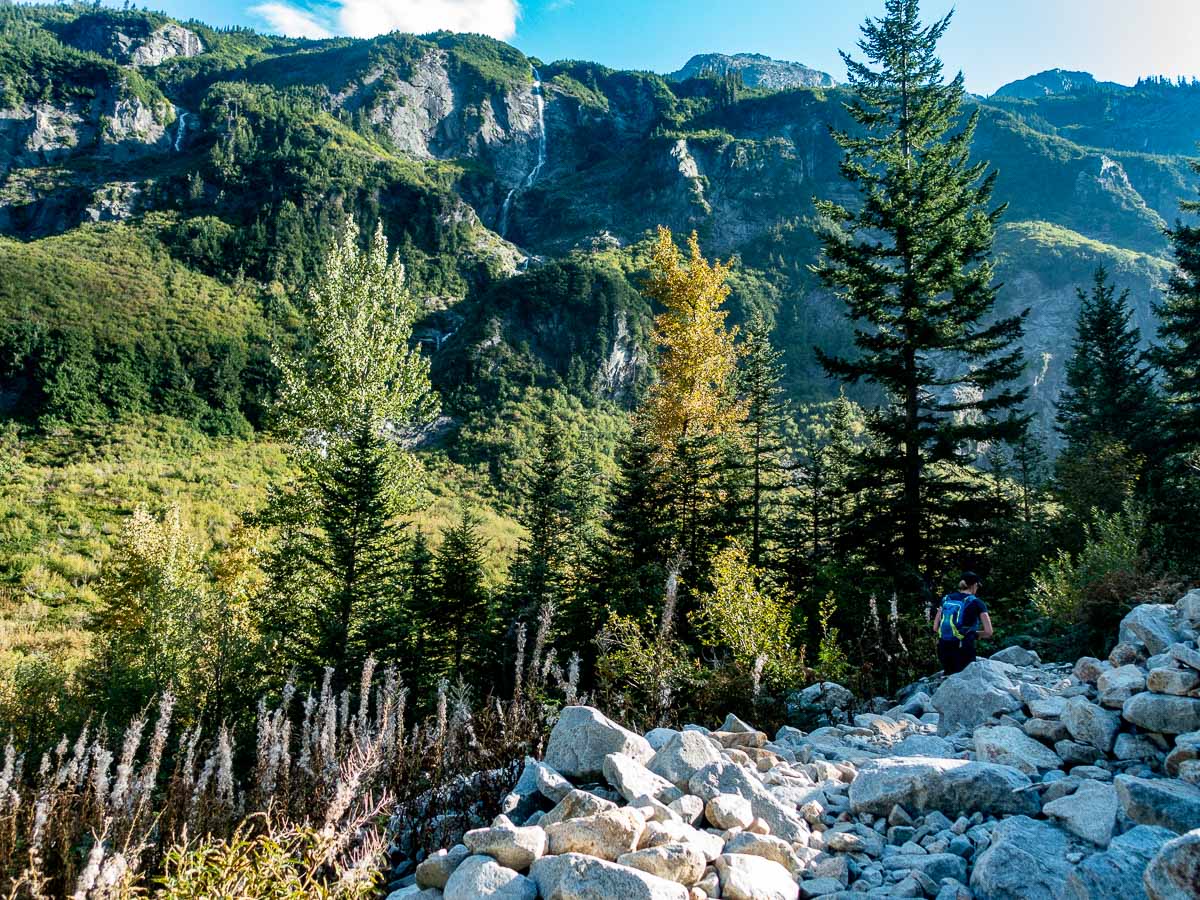
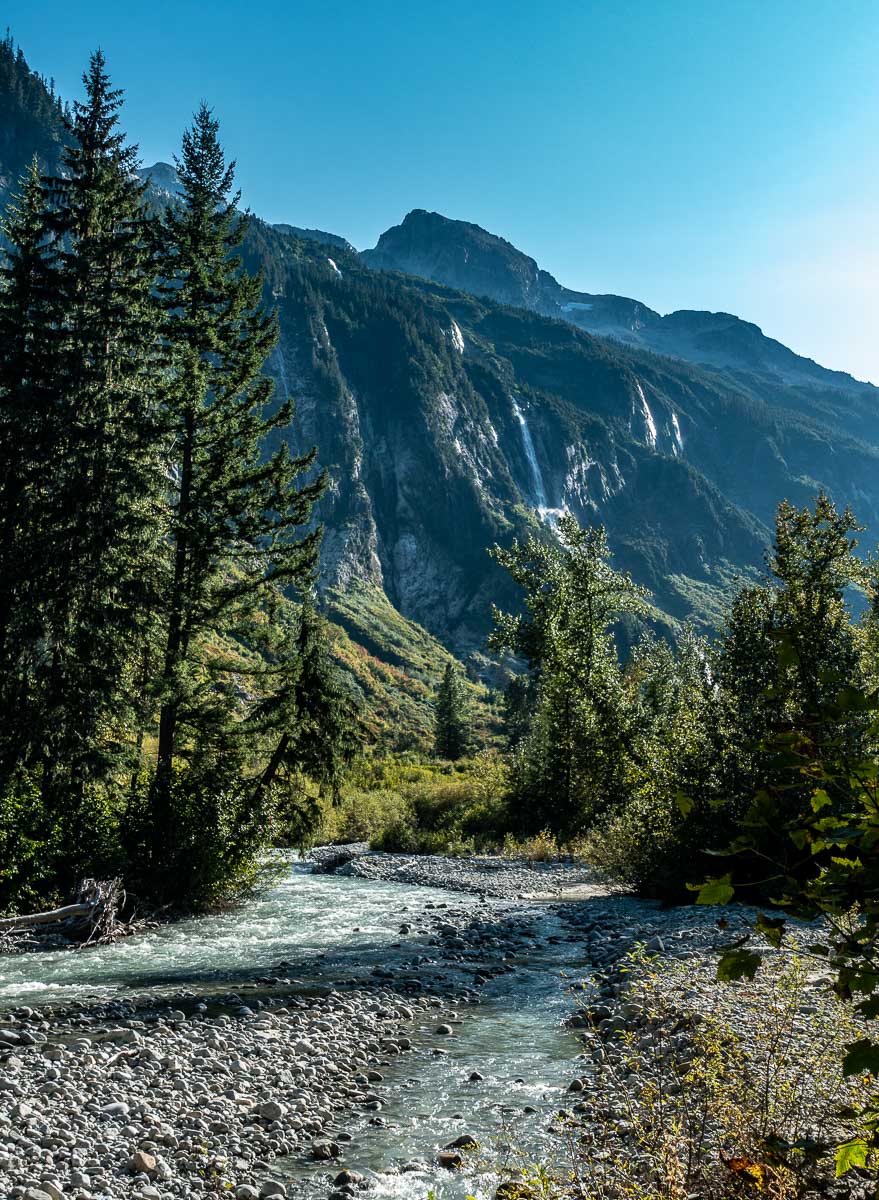
On the third day of running, we had the opportunity to choose between a climb up Goat Mountain, a trail up the riverbed to the Nooksack Cirque, a climbers trail to a lake at the toe of a glacier, or any combination of the three options. As a skier and lover of glaciers, I decided to explore the Nooksack Cirque and glacier fed lake. Emerging from the forest onto the large smooth cobbles of the Nooksack valley, I took note of my slowed pace. As I walked, the river wound, interrupting my route –- ushering me across and through its icy waters. Knee deep in glacial runoff, feet soaked with the ancient melt of glaciers… I felt a reverence come over me. The cirque remained out of sight –around a bend in the river– and so I walked on to get a view. Eager to witness the headwaters where the mighty Nooksack river originates. As the blue ice began to show, and the river curved towards the cirque, I felt a heaviness happen upon my chest. The thought crossed my mind, “Is this ALL there is?” …and soon after, “This is ALL there is!” How magnificent and how frail. How ancient and powerful! How withered and vanishing. 

In the moments that followed, I could feel the messages of Bacchus’s talk taking root in my mind. I could feel myself being overwhelmed with gratitude for an opportunity such as this, to feel human, to feel uncertain of the future, to fully feel any and all emotions that colored the next hours of my experience.


On the final day of Territory Run Camp, everyone awoke before first light and made our way up to the summit of Table Mountain to watch as the sun rose over the shoulder of the neighboring Mount Shuksan. Winding our way up the rocky switchbacks, we could see Kulshan in the distance, radiant in the blue hue of dawn. As the light began to change, a few solitary wisps of clouds became illuminated with orange and pink. The energy amongst the group was one of contentment and awe, underlain by a heightened sense of connection to this place; to these mountains. We were so fortunate to get to experience them in so many different temperaments: the moody days that turned to rain; the rain that turned to hazy sunshine; then to a final burst of sunshine on the clearest morning of all. Gratitude to this degree felt humbling.

To be offered such an opportunity as Territory Run Camp and a progression of experience is such a gift. I am so grateful for the running stoke, the exceptional food, and all the uplifting vibes from Aspire and Territory Running Co. And I also deeply appreciate the sense of adventure; of growing as a human; of discovering what it means to be in connection with wild places. Thank you, Thank you, Thank you! I’m already looking forward to lodge season next year!


Explore Territory Run Camp and the following lodge trips on the calendar this fall:

Stehekin Rendezvous

North Cascades Climate Summit

Territory Run Camp

Out Trails LGBTQ+ Running Retreat – North Cascades


Julie Ann leads Aspire’s mountain based skills courses and fastpacking missions, while also working as a mountain guide in the North Cascades, and teaching wilderness medicine courses.

Categories
Aspire Culture courses Culture Food Highlights NRL nutrition Rendezvous Runner Resources Trip Styles

Elevated Aprés: Aspire’s Basecamp Magic

It’s mid-summer, and runners on the Nooksack Ridgelines Rendezvous stumble off the dusty August trails physically depleted and parched, yet carrying that blissed-out affect only hours of alpine running can impart. Fortunately for their bodies, these runners find themselves at Aspire basecamp, a place where TLC flows like the glacier-fed Nooksack River we’re camped along .

The Ice Cream Social

The Aspire crew prides themselves on their playful and multi-dimensional approach to runner support. Attention to the little details creates the ideal setting for the recovering runner. The crew has a few tricks up their sleeve to bring bodies in line with spirits and minds, including often incorporating an element of surprise.

While magicians cannot reveal all their secrets, we will let you in on just one: the delight of hand-turned ice cream, this past August topped with grilled peaches and candied walnuts. If this sounds like an outrageous offering to partake in on an 85 degree day in the remote depths of the North Cascades, that’s because it is. Outrageously delicious.

Backcountry ice cream is ephemeral by nature, demanding it be eaten in the moment or else be lost to the harsh realities of summer. This insistence brings everyone together. Eating dessert becomes an act of joy. Runners line up for seconds and the experience becomes the gel that defines a community.

Recovery can mean a lot of things, and watching runners forget about their tired bodies and buzz with anticipation at the pleasure of satisfying treats motivates the Aspire squad to keep the surprises coming. Aspire Rendezvous trips offer unique opportunities to get to know a region intimately on daily runs of self-selected mileage and come back to an elevated basecamp for relaxation and connection… and if you’re lucky, ice cream.

If you’re looking for inspiration for your own ice cream social we highly recommend this recipe from Melissa Clark and the New York Times.

Join Aspire for a Rendezvous and experience the magic of mountain running parties that center exploration and a playful aprés culture.

All in for the handmade ice cream? Experience it on one of our North Cascades Rendezvous:

Nooksack Ridgelines Rendezvous
Three Devils Rendezvous

Curious what other surprises we’re holding on to? Join our community on any of our Rendezvous trips to experience our elevated basecamp approach:

Sucia Island Rendezvous
Ross Lake Rally
Cypress Island Beach Camp and Trail Running Extravaganza
Territory Run Camp
Stehekin Rendezvous


Trent Banks is a mountain runner, a disc jockey, and father of two daughters, based out of Bellingham, WA. He joined the Aspire crew in 2018. When not guiding trips with the Aspire crew, you can find him at work on Aspire’s marketing or DJing clubs and hosting events with Reflect.

Listen to his Spirit Ventures DJ mix series, inspired by and made for trail running.


Categories
Blog courses Destinations Highlights NCT North Cascades Traverse Stage Preparation Runner Resources Stage trip report Trip Reports and Trip Styles Trip Styles update

Crossing the North Cascades: A Trip Report

“If you were to tell me that getting stung multiple times by bees in the backcountry (FYI i’m severely allergic) and finishing our second day in the dead of night, exhausted after 16+ hours on the trail, would somehow be my personal ‘highlight’ of the entire trip crossing the North Cascades, I would have called you crazy.“

Soaking in the North Cascades

The North Cascades Traverse is an epic three day stage run covering 80 miles of pristine wilderness in the beginning of autumn, crossing the North Cascades via less travelled trails through the rugged mountain range sometimes referred to as the “American Alps”. After closing off an unreal Wonderland season and spending back to back weekends on such magical trails, I was excited and curious to step into totally new territory! 

Day 1: Highway 20 to Colonial Creek via Easy Pass

We met our small but mighty crew bright and early for our shuttle start and headed out mid-morning to climb up Easy Pass. Runners were stoked on crossing the North Cascades. The first few hours up to Easy Pass flew by. We laughed while taking in the big views into Fisher Basin from the pass, knowing the remaining 20 miles was essentially a gradual downhill grade. Once reaching camp, I took a moment to quickly dip into the icy waters at Diablo Lake before the last patch of sun was lost behind the towering mountains.  After a quick refresh and icy jolt to the muscles, I headed back to camp to cheer on our other runners coming in. It was time to relax around the fire with a big meal.
Day 2: Ross Lake Dam to Graybeal Backcountry Camp

Crossing the Ross Lake Dam with Doug McKeever

Waking early the next morning, my job for the day was as the ‘sweep’ guide, hanging back with the last runner. With 33 big miles ahead of us, I was ready to hit the trails with 72 year old Doug Mckeever (a bit of a local ultra running legend in the North Cascades). I got to know Doug briefly the day before, and having been informed by others of his endless stories and knowledge of the Cascades, I was thrilled to a have a big day out together.

As we crossed Ross Dam towards Big Beaver Creek that morning, it was evident we were in for a solid day out together. We dove right into sharing epic adventure stories, talking in great depth of our favorite trail snacks, laughing at the sluggish pace in which Doug would eat said trail snack, foraging for berries along the route, and listening to him reminisce on memories from before I was even born on the exact trails we were running on now.

A mountain buzz

Day two crossing the North Cascades was going great, but that quickly turned when a group of three hikers came forward, warning us of a very angry swarm of bees 2-3 miles ahead. One of the hikers was stung 11 times and the others were also bit multiple times.  Knowing Doug was allergic to bees and keeping in mind my own personal experience breaking out in full body hives from the last time I was stung, we continued forward apprehensively.  

We ran forward checking our watches as we neared the 3 mile point, unsure of what to expect. Reaching 3.3 miles, we began loosening up, believing we had hit a stroke of luck and passed the hive. As soon as we convinced ourselves we were ‘in the clear’, the raging bees emerged from their domain ready to attack.  We lunged forward in a full sprint, evacuating the area completely.  Doug and I were both stung multiple times and quickly retrieved our ‘miracle drug’, Benadryl, out of our med-kit.  Knowing this would concurrently be our saving grace and make us feel drowsy and light, we continued on for the remaining 18 miles.  

What happened from that point on until reaching the base of the climb up to Whatcom Pass, was a blur of ridiculous jokes, tons of snacks and berry foraging to keep our energy high, along with one or two deep internal desires for a short nap on the trail.  Our energy low as night began to creep in, we began the endless climb up to the pass covering more switchbacks than one would hope so late into the night. 

As we carried on surrounded by darkness, headlamps lighting the way, we knew we were making progress. We both genuinely felt this sense of calm and enjoyment being out there together so late at night.  After endless switchbacks, we hit the peak of our climb. We were unable to see so much of the ‘epic views’ we were told about, but  that didn’t bring our spirits down.  We continued on, repeating Doug’s famous phrase, “I always have more to give”.  Besides, while everyone was already at camp, we were at the top of the pass feasting on more blueberries than we had cumulatively consumed all day – enjoying some of the freshest hors d’oeuvres to our soon-to-be late night dinner! 

After making our way down towards our backcountry camp at Graybeal, we noticed a few small, glimmering headlamps in the distance.  Hooting and hollering as we made our way towards the group, we quickly realized most people were fast asleep after their own big day out. Full of exhaustion and ravenous for a big meal, Doug and I peeled off our sweaty clothes and bundled up in warm layer as Abe fired up the stove.

We sat down and shovelled the steamy, salty, caloric goodness into our mouths. The duality of pure exhaustion and a surge of energy struch while recounting all of our personal shared adventures on the trail for the day.  Abe mentioned how astounded he was to see our spirits so high after nearly 17 hours on the trails.  I looked up at Doug, and huge smiles broke across our faces. We finished the last of our dinner before heading straight for our sleeping bags for a peaceful night in the open air, under the stars.  

Camp vibes: food, drink and good conversation.

Day 3: Copper Ridge

The unrivaled views from Copper Ridge

We all woke early the following morning, with one last big day in the mountains ahead. I ran ahead of our group to reach our final basecamp early and ensure the food, drinks and a welcoming celebratory camp was ready for everyone as they finished! 

As I ran ahead thinking I would be solo for much of the day, our photographer Nick caught up in the first few miles and said he’d be joining me up until we reached Copper Ridge. I was elated to have his company, and we ran on, excited for the day ahead. As we started our ascent to the ridge, we were speaking of our epic prior trail days with Doug. 45+ years our senior, he had previously anointed both of us his ‘honorary grandchildren’. Our spirits were high before even reaching the highlight of the day – Copper Ridge.  Opening up out of the trees after a big climb, we were gifted with sweeping views across the Cascades that extended for miles.  

We stopped for a quick snack together at the lookout point, both full of energy and buzzing from the surrounding landscapes. I then carried on to basecamp. Nick stayed behind to capture photos of our Aspire runners as they came up the ridge, all just as mesmerized by the views as we felt.

I continued to revel in the wild landscapes while my mind kept going back to all the moments of true connection I felt on the trail in only a couple of days.  I crossed over Hannegan Pass and ran down into the Ruth Creek drainage to meet the remaining Aspire Crew. Always full of trailstoke and personal stories of our day, we worked together to prepare and set up our celebratory camp for all the runners as they finished crossing the North Cascades.

After having spent the latter part of my day running solo, I couldn’t wait to see everyone run in, all full of exhaustion, admiration for the landscapes, and a healthy level of pride in what they had just accomplished both individually and as a collective.  

Cheering for Doug as he ran in felt especially significant after sharing such genuine moments out on the trail with him the day prior. I was also elated to have his beautiful wife (of 50 years) Audrey be there to cheer him to the finish as well. 

Seeing everyone come in, sharing stories, scarfing down food and with a buzzing level of contentment, I felt an immense wave of gratitude. At that moment I felt that no matter what happens out on the trail, whether it’s being fully enamored by the wild landscapes, swapping stories, or even something as ridiculous as being attacked by an angry swarm of bees — when they are shared in the company of others, you are setting yourself up for a truly epic adventure.  

Join Aspire on a North Cascades Traverse trip and enjoy the sweeping views and rugged valleys of the “American Alps”. Terrain this good shouldn’t be this runnable, and yet…!


Kara Folkerts is a plant powered trail runner, sustainable travel advocate, yoga teacher, and passionate about all things sustainability, travel, health, and outdoor movement.  Originally from Canada, Kara has spent the last few years exploring and living abroad in various countries across the globe before joining the Aspire crew in 2020. Kara has been guiding various trail running, sustainability, and health retreats internationally since completing her undergrad in Ecotourism and Outdoor Leadership.  With all of these experiences, she seeks meaningful connections with others, loves to learn of new cultures, and fosters the mindset of a lifelong learner.  With a big heart for trail running and exploring wild places, she’s always stoked to get out there with others. 

She writes about all her adventures on her blog at www.karafolkerts.com and on her instagram @karafolkerts

Categories
Blog courses Destinations Highlights Rendezvous Runner Resources STEHEKIN Stehekin Rendezvous trip report Trip Reports and Trip Styles Trip Styles update

Stehekin: A Trip Report

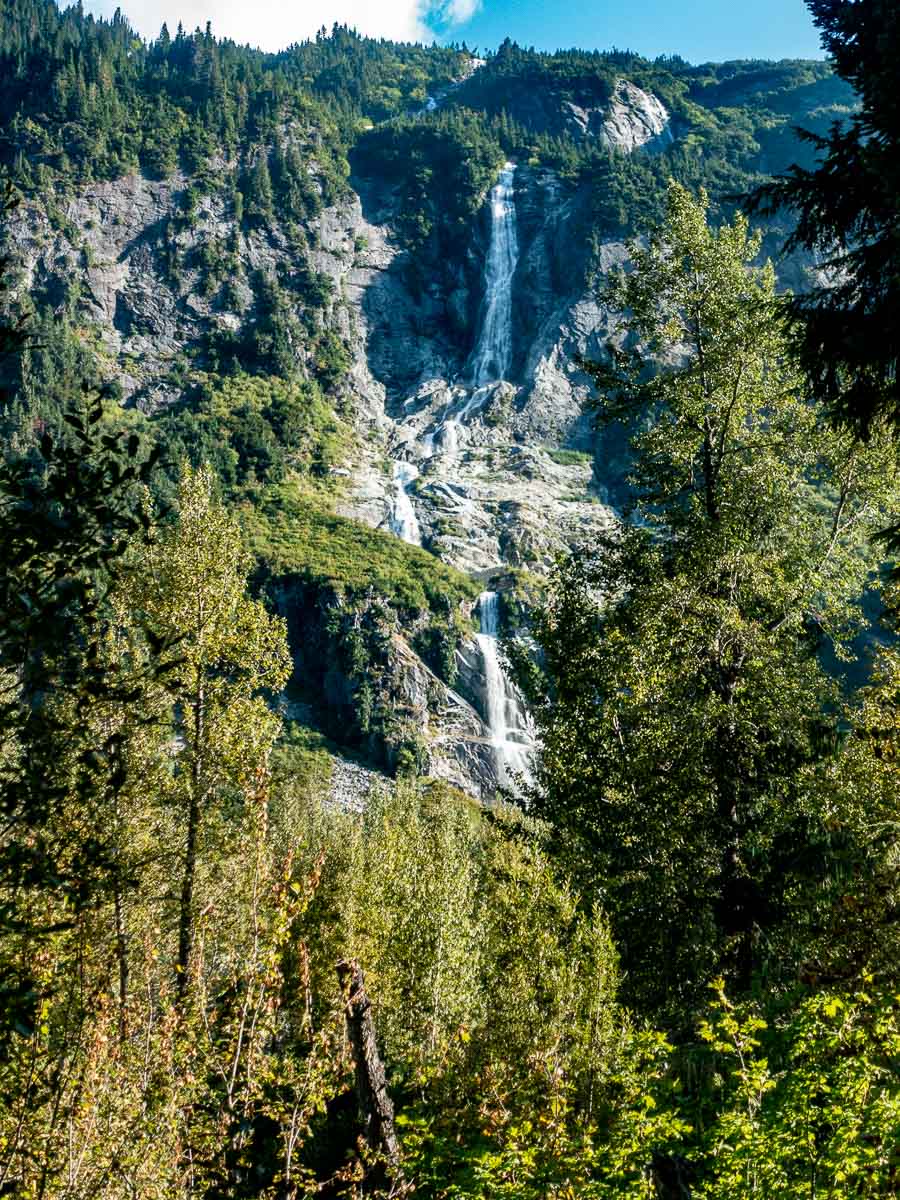
“Stehekin” is an indigenous word meaning “the way through”, for over 9,000 years the Stehekin River Valley has served as a travel corridor connecting the rain shadowed steps of the eastern Cascades with the lush forested coastal regions of the Salish Sea. Dividing these ecosystems lie the formidable North Cascades. Stehekin is a direct reference to the river whose headwaters are a network of alpine snowfields and waterfalls that drain into a rugged valley formed over centuries of glaciation. Woven into this mountain landscape is a ribbon of trail paralleling the river and terminating at the shores of Lake Chelan where crystal waters meet a shoreline lined with an endless crown of mountain peaks. 

Views looking east from Cascade Pass

Day 1: Cascade Pass

We’ve built our Stehekin itinerary around the biggest views, best trails, and the cleanest line into the valley. After an early rendezvous and shuttle, the trip kicks off at Cascade Pass. It’s a 23 mile day and the 3,000’ of climbing is largely front loaded into the first 3.5 miles. The rewards come quickly as runners leave the forest canopy and step into a rocky alpine valley surrounded by high peaks, glaciers, and waterfalls. From the pass the views are long and they beacon to fresh legs practically pulling runners into a 20 mile descent along the Stehekin River. While there is no “cutoff” runners need to make it to High Bridge camp by 6pm to catch the last park shuttle to the Stehekin Valley Ranch. I’ve missed the ride more than once, which means an extra couple miles along the river to finish out the day. 

Runners resting on the porch at the Stehekin Valley Ranch

Basecamp: The Stehekin Valley Ranch

Aspire basecamps are a source of pride and joy all summer long. But as the days shorten, temperatures drop, and the chance of inclement weather increases we turn our sights on more formidable lodges and cabins for our accommodations. Our stay at the Stehekin Valley Ranch is the pinnacle of “rustic opulence”. The ranch is family owned and operated by Cliff Courtney, his sons, and a great team of seasonal staff. Cliff was raised on the ranch and since 1983 has grown his vision of a full-service basecamp on a foundation of good food and hard work. Gardens, hay fields, horse corrals, and a full service lodge and cookhouse service hungry hikers and visitors from across the world. Full course breakfast, lunch, and dinner with homemade pies are staples of everyday life along with the perpetual hearth fire and coffee pot always ready for a “cowboy” pour. 

Runner Descending from the Summit

Day 2: Climb Mt. McGreggor or Choose Your Own Adventure

Over the years the Aspire team have scouted a variety of trails and routes, always working towards an itinerary that optimizes the Stehekin experience. We think we’ve found it, but the beauty of this trip is that once runners have arrived, much of the Stehekin experience is based on a “choose your own adventure” ethic. Folks are welcome to lengthen or shorten their trail miles, from 0 to 30+. Opting out of running and scheduling a massage is always an option as well. 

Our standard go-to option for day two of the Stehekin trip is a run up Mt. McGregor. McGreggor is the highest point in the Stehekin Valley. It’s a 8 mile one-way climb that gains a solid 6,500’. The return for the effort are golden larches, expansive views, and a heart pumping summit scramble for those comfortable with a bit of craggy scrambling and exposure. The bench just short of the summit, is the perfect lunch spot and an ideal place for an afternoon nap if the weather cooperates. Turn around times are based on a budget of being back to the ranch in time for a shower, beverages, and dinner. 

 Dhalia Gardens In Stehekin

Day 3: Stehekin Exploration

No roads lead to Stehekin. All entry and exit is limited to a boat ferry up Lake Chelan, a chartered float plane, or via foot one of the many trails that criss cross the Cascades. Consequently, the character of the hundred or so permanent residents, is defined by this isolation, resilience, and creativity.  The resulting community is an enclave of gardens, homesteads, and ranches. We encourage runners to take a day to run through “town”, rent a bike, or stroll through the historical sites along the valley floor. A few highlights are worth mentioning:

The Stehekin Valley Pastry Company, family owned and operated this bakery will leave a lifelong impression. Expresso, icecream, and a summer’s worth of handmade pastries, pies, and cinnamon rolls fill the counter. 

The Buckner Orchard and homestead were acquired by the National Park Service when the North Cascades National Park was created in 1968. The working orchard has been maintained by the park service and the orchard gates are open to the public for wandering and tasting. 

The Landing is the cosmopolitan center of Stehekin. Here the national park office, post office, and various cafe’s line the shores of Lake Chelan. A lakeside park and picnic tables dot the shore and the cool alpine waters are particularly refreshing on a hot afternoon. 

All of these sites and more are an easy walk from the ranch and can be accessed via a national park shuttle that runs between the landing and the 11 miles of maintained road connecting the lake to the mountains. The shuttle is free for those staying at the ranch, and it will drop you back just in time to hear the dinner bell. 

Runners Headed to Rainbow Pass

Day 4: Out Via the Pacific Crest Trail or Rainbow Pass

Time follows its own arc in Stehekin. By day 4 it isn’t really clear how long you’ve been there or if there is any other world outside of this contemporary Rivendale. 

Multiple trails lead out of the valley, though we prefer one of 2 options. The standard route follows the Pacific Crest Trail. Given the season, it’s inevitable that we fall in line with at least a handful of through hikers who began their journey nearly 2,600 miles earlier at the Mexican border. This route to Highway 20 and the Aspire shuttle is 13 miles with a steady 3,500’ climb following creeks and rivers back to civilization. 

Option two incorporates a longer day in the hills, covering 21 miles and 8,300’ of climbing over Rainbow Pass. The extra miles come with alpine lakes and big views but, finish at the same place, the Bridge Creek trailhead. Here the Aspire team has snacks, drop bags, and libations waiting.  

To encapsulate the whole of the Stehekin experience into one word, it would have to be “magical”. The time of year, the juxtaposition of wilderness and opulence, the food, the ranch, the pie, the people. The whole of the journey seeps into the cells of the body and lodges permanently into the psyche. Forever after Stehekin becomes a place spoken of in awed, mystical, and somewhat reverential tones. 

Rainbow over the Stehekin Valley
Categories
Aspire Culture Blog Culture Highlights Wild

The Presence of a Wild Bear: Grizzlies in the North Cascades

Valleys in the North Cascades come rugged and deep

“The presence of a wild bear, the experience of a wild bear, sizzles through the nerves, jolts the heart, startles the brain; it strips away that filter that separates us from the world and allows us to become part of that world more completely.” – Sherry Simpson

Late afternoon on the Lake Chelan-Sawtooth Wilderness. Sweaty and sore, I’ve been out running all day. I’m hammering down an alpine meadow past a colorful ragout of wildflowers, thinking about the beef jerky and cooler of snacks in my car a few miles off, when something off in the not-so-distant brush moves.

Something big. I freeze.
My heart accelerates and my prehistoric instincts electrify. Could it be a bear? And if so, could it be a Grizzly?

The first time I came to these mountains, a quarter century ago, I was
struck by the wildness of the dense forest and glaciers, the sheer
dimensions of the steep peaks, the turquoise waters of the Skagit.
When I asked my friend, are there grizzlies here? she said, “Maybe. Probably. It’s complicated.”

Are there grizzlies in the North Cascades? Probably.

Could these mountains support a healthy Grizzly population? Definitely.
Biologists estimate that fewer than ten grizzly bears remain in the North Cascades, the most at-risk bear population in North America. The last documented Grizzly kill in the North Cascades was in 1967, and the last verified grizzly sighting in Washington’s Cascades was in 1996, with more recent sightings in the British Columbia portion of the ecosystem. A few years ago, a field biologist friend of mine spent several summers with a dozen other scientists looking for evidence of grizzlies, with no success (they did find hundreds of black bears).

When Lewis and Clark expeditioned to the Pacific in the early 1800s, there were at least 50,000 Grizzlies in the lower 48, but a century-and-a-half of settlement and development nearly eradicated grizzly bears from the US West, with fewer than a thousand left in 1975, when they were listed as an endangered species.

Since then, they have recovered slightly: between 1500 and 1800 grizzlies exist in the lower 48, primarily in the northern Rockies, with a few in the North Cascades.
The North Cascades Ecosystem is one of the wildest places in the Lower 48, with over six million acres of mostly public lands connected to wildlands in British Columbia, where Grizzlies are also rare.

Historically, the omnivorous (but primarily plant-based) big bears are an integral part of the ecosystem’s food chain and ecology, spreading seeds and turning over soil as they dig for roots. In recent decades, Grizzly recovery in these mountains has been a stop-start story. The US Fish & Wildlife Service added the North Cascades to its national Grizzly Bear Recovery Plan in 1997, but little action beside study was taken for nearly two decades. In 2014 a larger Grizzly recovery study was announced, only to be halted without explanation in 2017. A year later, in 2018, Secretary of the Interior Ryan Zinke announced support of Grizzly recovery, but that project was also halted a year later. The US Department of the Interior is currently deciding whether to import grizzly bears into the North Cascades, and will probably make an announcement sometime in 2020.

For several years, USFWS and the National Park Service have been considering possibilities for introducing up to 25 grizzlies or more in the North Cascades over the coming decade. Such reintroduction projects have the goal of establishing an eventual population of 200 in the coming 25-100 years. But bringing bears back is complicated. While surveys have shown that the majority of Washingtonians support Grizzly recovery, bears bring up passionate feelings and fears. Ranchers worry about their livestock. Loggers worry about government regulations. Homeowners worry about their pets and kids.

The lush valleys of the N. Cascades hold bounty enough to support a grizzly population of greater number.

Environmentalists and hikers dream of a landscape with this cornerstone species. Grizzlies fascinate and scare us, and we project many of our fear and dreams onto these big, mysterious creatures. Outdoor Life editor Todd Smith has written, “Why does our fascination with grizzlies continue? Perhaps it’s because they remind us of that secret part of ourselves that longs to be something the grizzly bear has always been . . . indomitable, wild and free.”

Alaskan writer Kim Heacox reminds us that “We speak of that which is bearable and unbearable. In acts of restraint and abstinence we speak of forbearance. We engage in horseplay and monkey around, but from bears we borrow our most precious acts. We bear witness, bear our young, and bear glad tidings. We see in bears a little too much of ourselves and take that familiarity as a threat on one hand, a consolation on the other.” Bears, like wolves, rouse strong feelings and ideas, in people that say as much about us as the animals.

All of this passes through my mind as I’m standing here, alone in this steep meadow, eyes and ears and limbic system tuned to any sound, any movement, any possibility of a wild creature the size of a small car that is above me on the food chain. I’m reminded of the words of another Alaskan writer, Sherry Simpson: “The presence of a wild bear, the experience of a wild bear, sizzles through the nerves, jolts the heart, startles the brain; it strips away that filter that separates us from the world and allows us to
become part of that world more completely.”

I feel more alive, more present in this moment knowing that there could be a six-hundred pound mammal nearby. The possible consequences make time stand still in the same way that great art or meditation do. I’m more connected to something larger and older than myself. Indeed, the North
Cascades are a different place if there are Grizzlies here. I hope they are here, and that in the future, they can thrive in these jaw-dropping wild valleys, forests and drainages. It makes the ecosystem richer, the mountains wilder, the people more aware. It makes us more human.


Ian Ramsey is an ultrarunner, writer and educator based in Maine who has spent twenty five years exploring wild places in the Pacific Northwest and Alaska. He directs the Kauffmann Program for Environmental Writing and Wilderness Exploration, and guides running and kayak trips around North
America. For more information, go to www.ianramsey.net.

Check out our North Cascades trips:

North Cascades Traverse: Run North Cascades National Park from east to west
Stehekin: Run deep into the North Cascades to an idyllic valley set away from everything modern
Sawtooth Backcountry: explore the rugged Sawtooth-Chelan Wilderness in autumn, a women’s trip
Desolation Duo and Ross Lake Rally: early season gems, complete with fire lookouts and a boat ride up Ross Lake

Categories
Blog Culture

Why Trips in the Middle of a Global Pandemic?

After months of uncertainty, we’ve gotten permission from the North Cascades and Mt. Rainier National Parks, and the Mt. Baker National Forest to operate trips this year. We’ve written pages of protocols, revamped our systems to mitigate the risks associated with Covid-19, and issued thousands of dollars in refunds and credits. Now in the middle of a global pandemic, after spending so much attention on the question of “can” we operate, we’ve also had to confront the question of “Should we?“

Summit of Ruby Mountain, Day 2 of the Desolation Duo

All wilderness and backcountry pursuits rest on the premise that while we can mitigate risk, we can never eliminate it. This time honored fact, has application in the COVID era. With complete respect to those making the valid decisions postponing their runs, races, and travel plans this year, we are also keenly aware that we can’t all stay isolated indefinitely. In the middle of this dilemma, we are honestly asking, “What does Aspire and running in the mountains have to offer that is vital against such an overwhelming and unfortunate situation like a global pandemic”?

Runners wrapping 3 Days of Sun and Beach on Sucia Island

The more we’ve thought about it, the more we realize that the answer is “quite a lot, actually.” Aspire offers more than backcountry runs in epic places. In the context of this pandemic, our trips offer a much needed opportunity to reconnect: to nature, to each other, and to experience ‘play’ again. Risk is present in every aspect of our lives. Between the old “normal” of races, concerts, and dance parties and the months we’ve spent sheltering in place, we have to forge a new reality. That reality must balance the social/civil responsibilities to reduce infection with what it means to express ourselves as living, breathing, loving human beings that share a deep connection with others and with the natural world.

Small Group Travel, Headed up to Ruby Mountain

We could all run alone, and many of us have taken on our own self supported or virtual projects this spring and summer. However, despite being well intended and worthy projects, these pursuits cannot replace the human experience that comes from participating together, in real time and in real spaces.  The pursuit of hard and challenging goals as a community creates bonds and connections between humans that are particularly rich. These experiences become vehicles that inspire deep mental clarity and focus, and result in a more grounded and self aware orientation in the world. More than ever, we need experiences that build bridges between people and disrupt the isolation and virtual worlds we’ve been operating in.

Eagle Cliff, The BEST Sunset View in all of the San Juan Islands

In many ways Aspire’s outdoor, small group, deep wilderness and backcountry trips are ideal for a covid world. Social distancing in wilderness is pretty straightforward, outdoor transmissions remain low to non-existent, and small groups are simply easier to manage than large ones. 

Getting in the Views on Desolation Peak

We believe that offering small group excursions into the wilderness, is actually the optimal model for safely and responsibly revitalizing our communities.  We decided that if there is any way that we can give our community something to look forward to, to train for, to achieve together, and to share in a way that clearly mitigates risk, we should do it. Certainly, we’ve changed our model to take every possible precaution against the pandemic.

Headed to South Beach on Cypress Island

As runners, we are all keenly aware of how important physical health is. We also recognize that we need to take care of our spiritual and emotional health. At this point, we are excited to be several trips into our summer season, reconnecting to the core of what we’re all about: awesome places, awesome challenges, and most importantly, awesome people. We believe that when you put those three things together, you get something back that’s bigger than the mountains, lasts longer than a hundred miles, and inspires us all to be a little more awesome.  

Categories
Aspire Culture Blog courses Culture Highlights Ross Lake Rally Wild

Fire Lookout Poets of the North Cascades

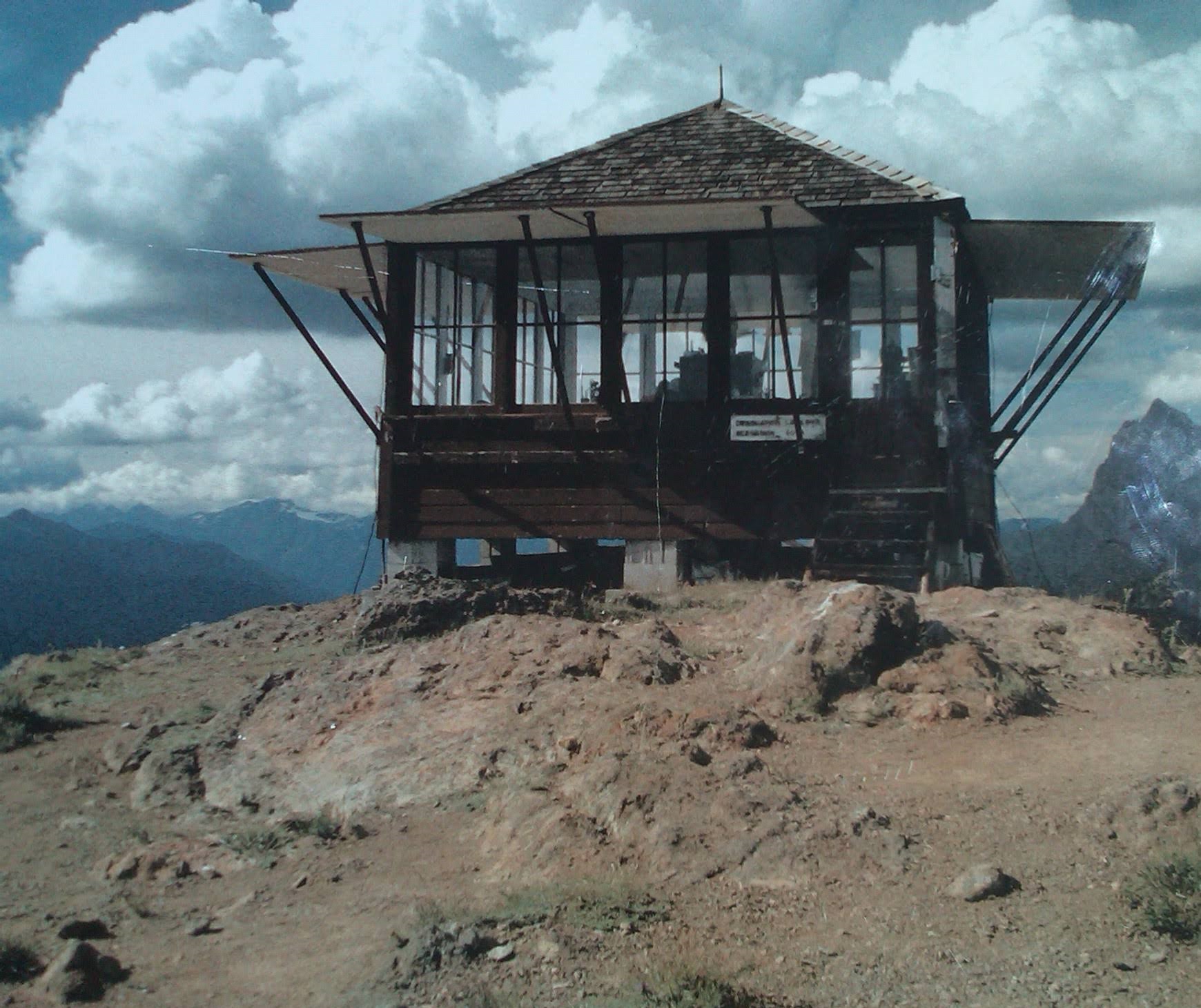
Fire lookouts in the North Cascades inspired a wave of beat generation poets whose withdrawal from societal expectations and literary musings inspired the birth of North American mountain culture. The influence of these poet-climbers has impacted generations of wilderness aficionados and reverberates in the hearts and minds of mountain people the word over.

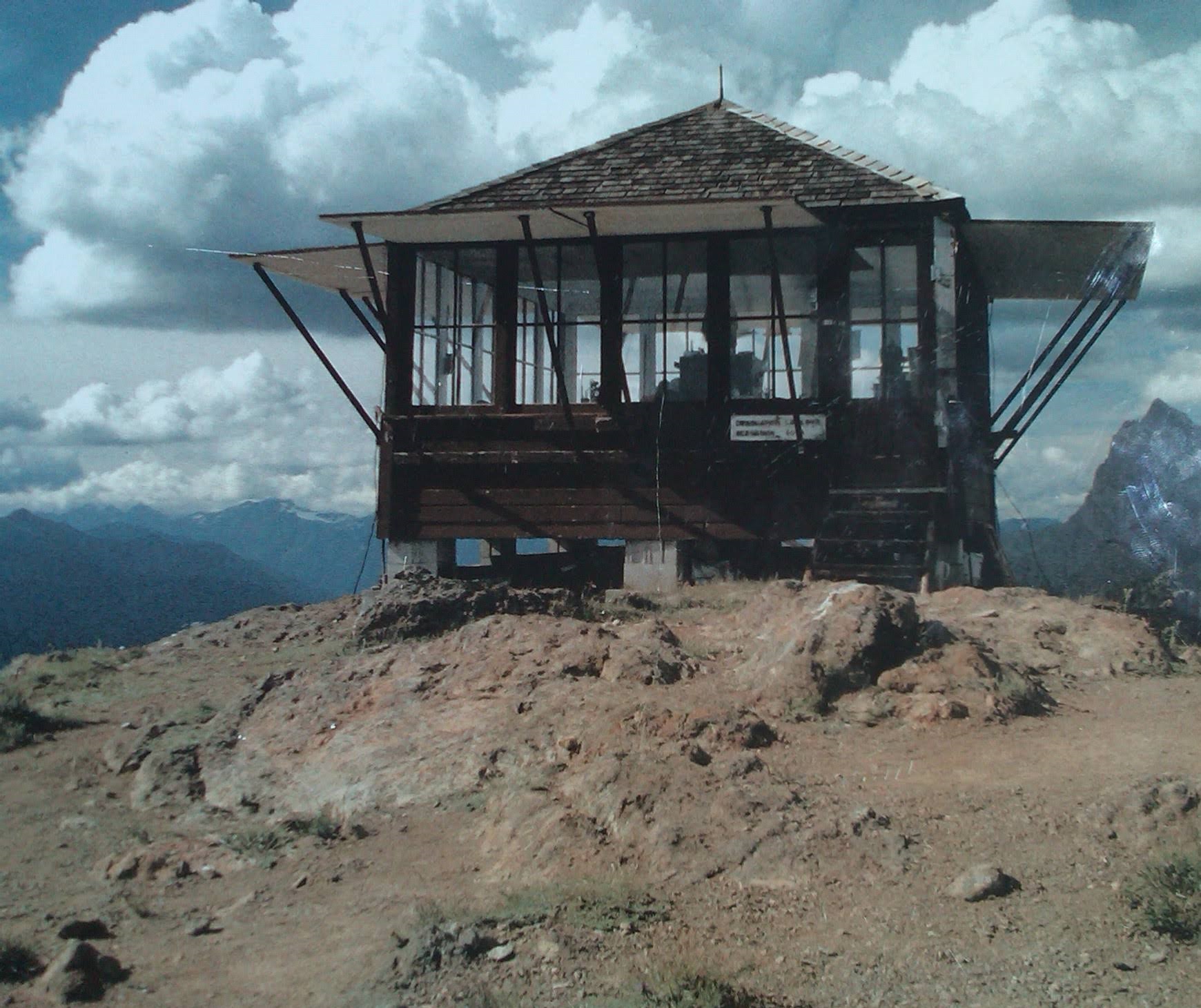
Fire lookout
Beat Generation era fire-lookout

In February of 1952, a twenty-one year old graduate of Reed College applied for a seasonal job with the US Forest Service as a North Cascades fire lookout, requesting the “highest, most remote, and most difficult-of access lookout” possible.  He received an assignment as the summer lookout on Crater Mountain, a severe 8000 foot peak in the North Cascades of Washington.

Due to excessive snow, he wasn’t able to get to the summit lookout cabin until late July, and even then equipment had to be winched up the steep cliffs to the small wood-and-glass hut. The new fire lookout woke on his first morning to five inches of fresh snow and inverted icicles on the guy wires.

Little did he know that his time as a lookout over the next two summers would be transformative not only for him, but for American culture,  inspiring two of his Beat Generation friends to undertake similar journeys, and pointing countless Americans in directions that would include meditation, backpacking, mountain culture and sports, and environmental activism. His name was Gary Snyder.


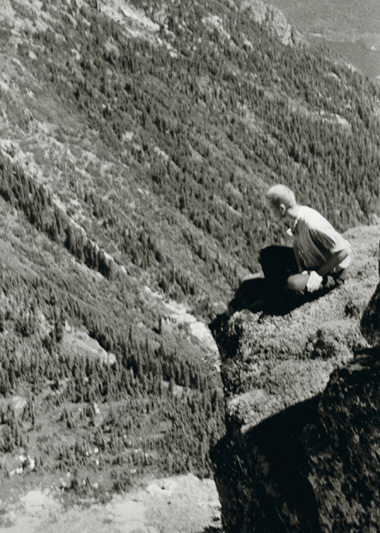
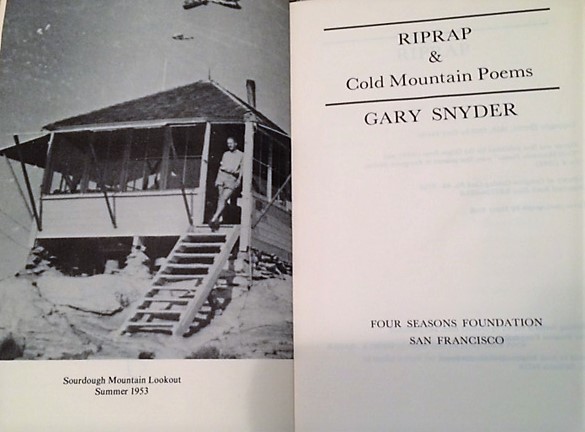
Gary Snyder on Sourdough Mountain
Snyder on Sourdough Mt.

Gary Snyder grew up in the Pacific Northwest during the Great Depression, in a working-class family with socialist union politics. As a kid seeing Chinese landscape paintings in the Seattle Art Museum, Snyder was struck by the similarities between the mountains of China and those of his native Cascades. Moreover, with lots of Japanese immigrant neighbors, he was intrigued by Asian culture, particularly Buddhism. 

As a teen, Snyder had started climbing mountains under the tutelage of the Mazamas mountaineering club, summiting Rainier, Hood and St Helens. At the intersection of these interests, he developed a deep and enduring interest in Zen Buddhism and its spiritual mountain traditions. During his time at Reed College, Snyder worked summers on trail crew, fire fighting and logging, and grew accustomed to rugged outdoor work and living. By early 1952 he was living in San Francisco, studying Asian languages at UC Berkeley and practicing Zen Buddhism. He knew that he wanted to explore Buddhist practice in the mountains, so he applied to be a lookout. 

Snyder spent his six weeks on top of Crater Mountain in a rhythm of fire watching, hiking and scholarship. Every day he would scan the surrounding ridges, using a device called an Osborne Fire Finder, to estimate precise locations of fires, and communicate via radio with the Ranger Headquarters. Beyond that, aside from daily tasks like splitting wood and melting snow for water, he was free to brew green tea, read Buddhist texts like the Diamond Sutra, meditate, practice calligraphy, and think deeply, inspired by the endless mountains around him.  The following summer he would work as a fire lookout on another peak, Sourdough Mountain. There he continued to study the Dharma and write poems influenced by ancient Asian poets. A perfect example is “Mid-August on Sourdough Mountain”:

Down valley a smoke haze
Three days heat, after five days rain   
Pitch glows on the fir-cones
Across rocks and meadows
Swarms of new flies.

I cannot remember things I once read   
A few friends, but they are in cities.   
Drinking cold snow-water from a tin cup   
Looking down for miles
Through high still air.”


Snyder would inspire two other writers to become fire lookouts: his Reed college roommate Phillip Whalen and Beat Generation icon Jack Kerouac. Whalen spent three seasons as a fire lookout and the time inspired many great poems and a lifelong dedication to Zen practice.

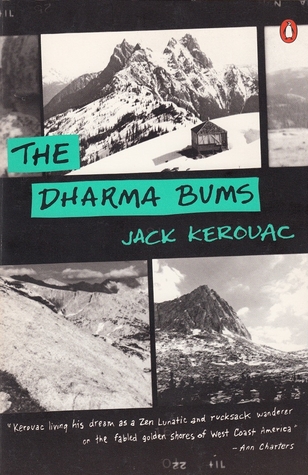
Cover of The Dharma Bums by Jack Kerouac

In the spring of 1954, Kerouac, still an unknown writer, moved to San Francisco, where he met and spent a great deal of time with Snyder, eventually writing the novel The Dharma Bums about their time together. These two, along with a broader band of misfit writers in San Francisco including Snyder, Kerouac, Allen Ginsberg, and Michael McClure, came to be known as the Beat Generation. This pivotal group sparked the beginning of the American counterculture that would eventually become the hippie movement.

Kerouac went on to spend a season as a fire lookout on Desolation Peak, the most remote lookout in the North Cascades. For Kerouac, who struggled his entire life with addiction and depression, it was the most peaceful time of his adult life. After his lookout season, he would return to civilization, and within a year become a celebrity after the publication of On The Road. In the ensuing years he would struggle with fame, never recapturing his mountain joy, and pass away in 1969 of alcohol-related issues.

Snyder went on to live in Japan for a decade, studying Zen, before returning to California and homesteading in the Sierra Nevada foothills, where he still lives today. He is last living member of the Beat Generation. He would go on to be at the forefront of the hippie movement, along with Ginsberg and Timothy Leary, and also to win the Pulitzer Prize for his poetry, which combined Asian Buddhist perspectives with the kind of ecological consciousness he had developed as a fire lookout.

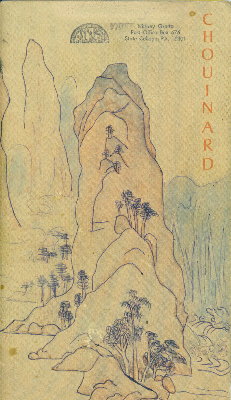
Chouinard Equipment catalog

The influence of Snyder and his lookout compatriots can be seen in myriad places, including the birth of modern American rock climbing and adventure culture (Yvon Chouinard’s first Chouinard Equipment Catalog features Chinese landscape paintings). The “Rucksack Revolution” that Snyder and Kerouac foretold was manifested as a 1970s explosion of interest in backpacking and hiking that has continued to today.  Snyder, Whalen and Kerouac all studied and practiced the kind of meditation that science and culture is increasingly recognizing as important for happiness and cognitive performance. Indeed, Phillip Whalen went on to the become a full lineage-holder Zen Roshi after decades of study and practice. They also laid the groundwork for a generation of PNW poets and translators of ancient Buddhist texts like Red Pine and Sam Hamill. As Snyder wrote about lineage in his poem “Axe Handles,”:

…Pound was an axe,
Chen was an axe,
I am an axe
And my son a handle, soon
To be shaping again, model
And tool, craft of culture, we go on.


Ian Ramsey is a writer, educator and ultrarunner. He directs the Kauffmann Program for Environmental Writing and Wilderness Exploration. You can find out more about him at www.Ianramsey.net.


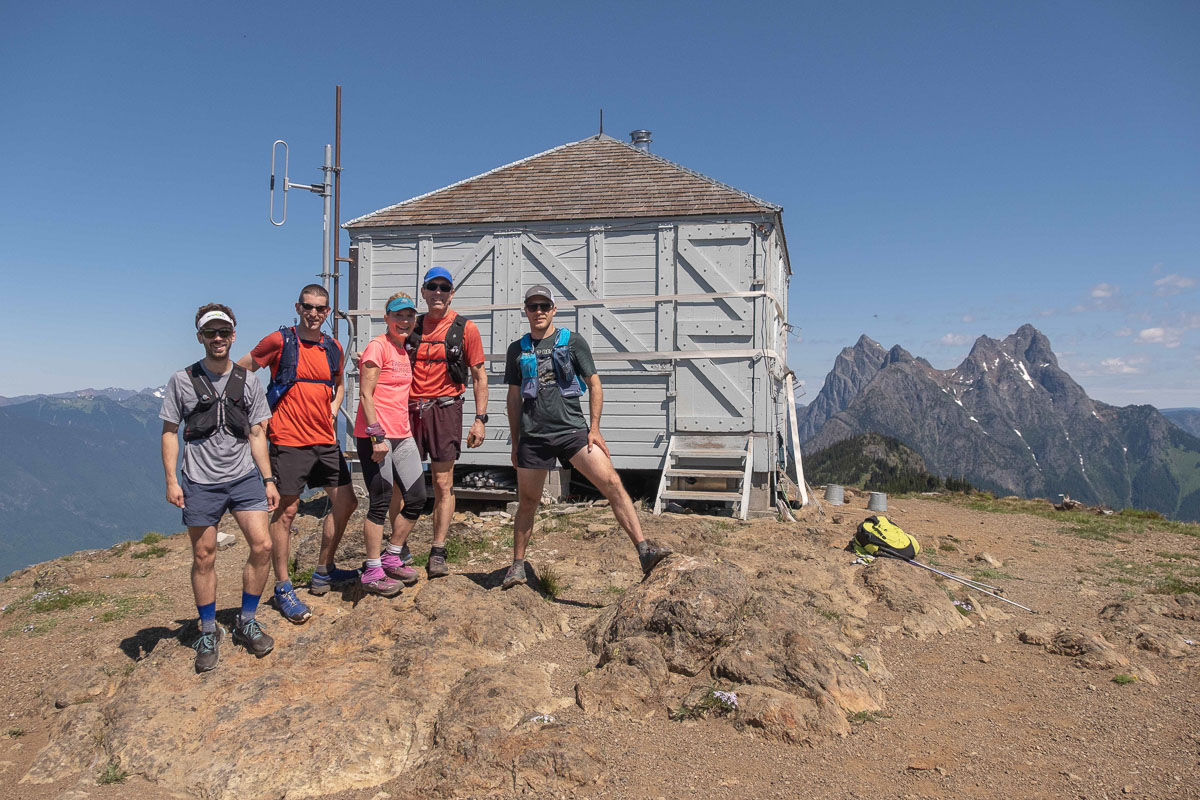
runners at fire lookout
Aspire runners in front of Desolation Peak, where Kerouac was stationed in 1956.


North Cascades fire lookouts are features of these Aspire trips:
Desolation Duo
Territory Run Camp
Stehekin
North Cascades Traverse


Categories
Aspire Culture Blog courses Culture Destinations Highlights Rendezvous Runner Resources Territory Run Camp Rendezvous TRC trip report Trip Reports and Trip Styles Trip Styles update

Re-Wilding: A Report from the Territory Run Camp

Every fall Aspire hosts the Territory Run Camp. Runners from across the country occupy the rustic Mount Baker Lodge for 5 days. By day we have our choice of trails on the glaciated and berry filled shoulders of Mount Baker. By night we gather around dining tables and fire places for meals and in-depth talks on the flora, fauna, ecology, and history of the North Cascades. This past year we were joined by Ian Ramsey, a Territory Ambassador, educator, and writer who shared his experience of camp, in this compelling trip report. All of the photos come from the lens and studio of Nick Danielson. 

Descending through Ruth Canyon with big views of Mt. Sefrit

Jakob, JD, Danielle, Nick and I bomb down the trail.  Muddy, grinning, and whooping we feel utterly alive. In the previous hours we had marched through drifts of knee-deep snow, navigated across jaw-dropping ridges in North Cascades National Park and glimpsed views of Mount Baker through passing clouds.  We’d huddled behind a fire lookout tower to eat snacks out of the wind, shared clothing to stay warm, and spent several suspended minutes in awestruck silence in the falling snow watching a black bear grazing in an alpine meadow.  

Black Bear

I thought of Alaskan writer Kim Heacox’s quote:

“Bear or no bear, it’s not the bear itself but the possibility of seeing one that makes us see everything else in greater detail.”

Kim Heacox

And the bear, the intensity of the weather, the steep mountains, and the commitment of traveling together by foot in a big wild place had all conspired to help us see and feel in greater detail, greater intensity.  What a joy, to feel so alive and to share it with others. 

We were at Territory Run Camp, a five-day running gathering for adults in Washington’s North Cascades, co-sponsored by Territory Run Co and Aspire Adventure Running.  With a small tribe of twenty people of all ages and experience levels gathered from around the United States, we spent our days running in big wild places, but also sharing food, sitting around the fireplace, laughing, looking out at light shifting on the glaciers of Mt. Shuksan, assembling puzzles, foam rolling and telling stories.  

Upward to Hannegan Peak

We were staying at the Baker Lodge, a historic bunkhouse high in the mountains.  Big windows looked out across an alpine lake at a horizon of mountains.  Wooden skis and old photographs hinted at the PNW’s rich history of mountain culture.  Each night a different speaker presented on a different mountain-running-related topic: the history of fire lookout poets in the surrounding North Cascades, glaciology in the Pacific Northwest, and the challenges of overcoming negative self-talk.  

After each day’s adventuring we were greeted with delicious food that accommodated a wide variety of dietary needs and preferences. Local beer and kombucha on tap.  Lots of coffee and tea. After ample breakfasts to prepare us for big days on the trails, we would make our lunches from a big spread that not only included sandwich and other makings, but gels, trail butter packets and electrolyte drink mixes. We ate well, which allowed us to run well.   

Dinner Crew with Veg, Vegan, Chicken Enchiladas, Hicima Salad, and Guacamole

And then each day we’d head out, organically self-selecting group routes that allowed each person to push their limits in whatever way felt authentic: steep, snowy twenty-mile mountain routes to equally beautiful 5 mile runs just out the door of the bunkhouse.  Each group had a local running guide with GPS communication to lead the route, and a van allowed more ambitious groups to head up bumpy fire roads to more remote trailheads. Deep in the North Cascades, surrounded by glaciated peaks, it was impossible to make a bad choice.  Here in “America’s Alps,”, you could take a different route every day for a month, and you’d always be surrounded by dramatic horizons, mountain goats, stunning alpine meadows, rocky spires, and distant glaciers. 

Best of all, there was no ego and no sense of superiority, just a respectful honoring of everyone’s different places, desires and needs.  The whole experience offered a chance to slow down, to meet like-minded trail runners and to learn from each other. Trails don’t run straight, and neither did our conversations. Our shared passion, along with the amount of time together and intensity of the activities allowed us all to slow down, share and listen in a way that is impossible in day-to-day life.  We talked about things that mattered. I have no doubt that I made life-long friends in those few days, sharing lasagna, big climbs, van rides, bad jokes, jaw-dropping sunsets and intimate life stories. 

Ruth Mountain looming on the horizon

We celebrated one runner’s 60th birthday with a cake and celebrated another runner’s recent record-setting multi-day run on a prominent northwest trail.  We volunteered to help with dishes and gathered each night to gape and giggle like children at the alpenglow on Mt. Shuksan’s glaciers, reflected in an alpine lake and framed by autumn colors.  Within a day or so, we had become a tribe and it was like we had always been at the camp, sharing these experiences. 

On the last morning, we all woke early to climb Table Mountain and watch the sunrise together before heading out to our various drives, flights and responsibilities.  We climbed together in the dark, talking and joking and wishing for coffee, our headlamps a tiny string of light up the dark ridge. By the time we reached the top, the dawn was lighting up the surrounding mountains. We huddled together, shivering and joking, looking out at Mt. Baker’s giant flanks, surrounded on all sides by big wild mountains and new friends.  

Early morning crew heading up Table Mountain

As I stood there, utterly familiar with these people I had only met a few days before, it occurred to me that not only was I feeling joy, but also that anything seemed possible. That the immeasurable wilderness that we had spent the last few days adventuring inside had adventured inside us and we’d be carrying it back into our everyday lives, a little stronger, a little happier, a little wilder. 

Ian Ramsey is a musician, writer, educator, and Territory Run Co. ambassador. Check out more of his work at ianramsey.net