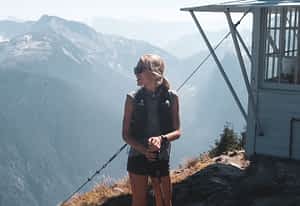
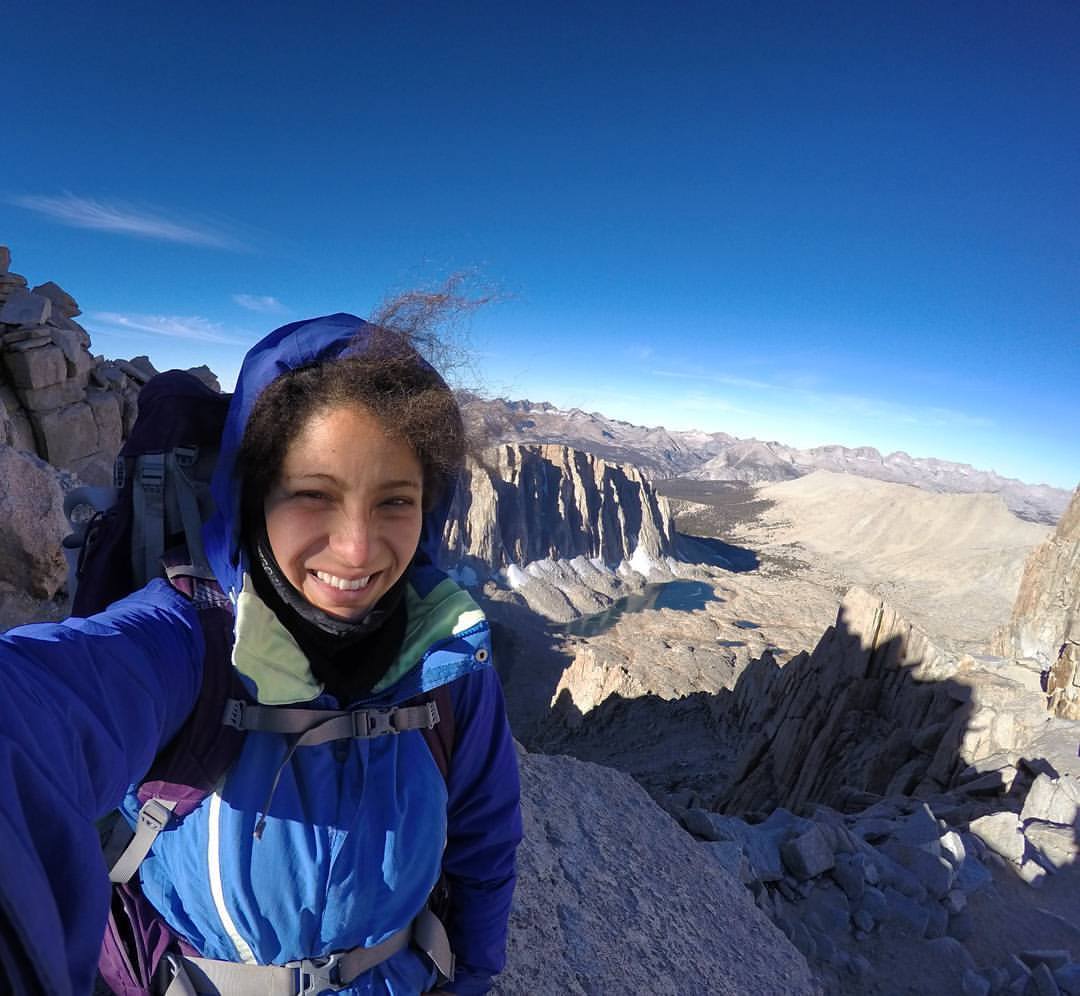
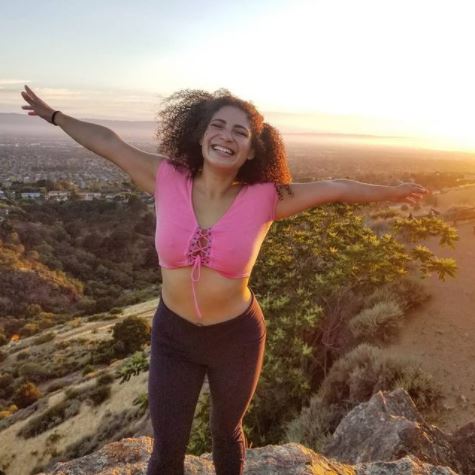
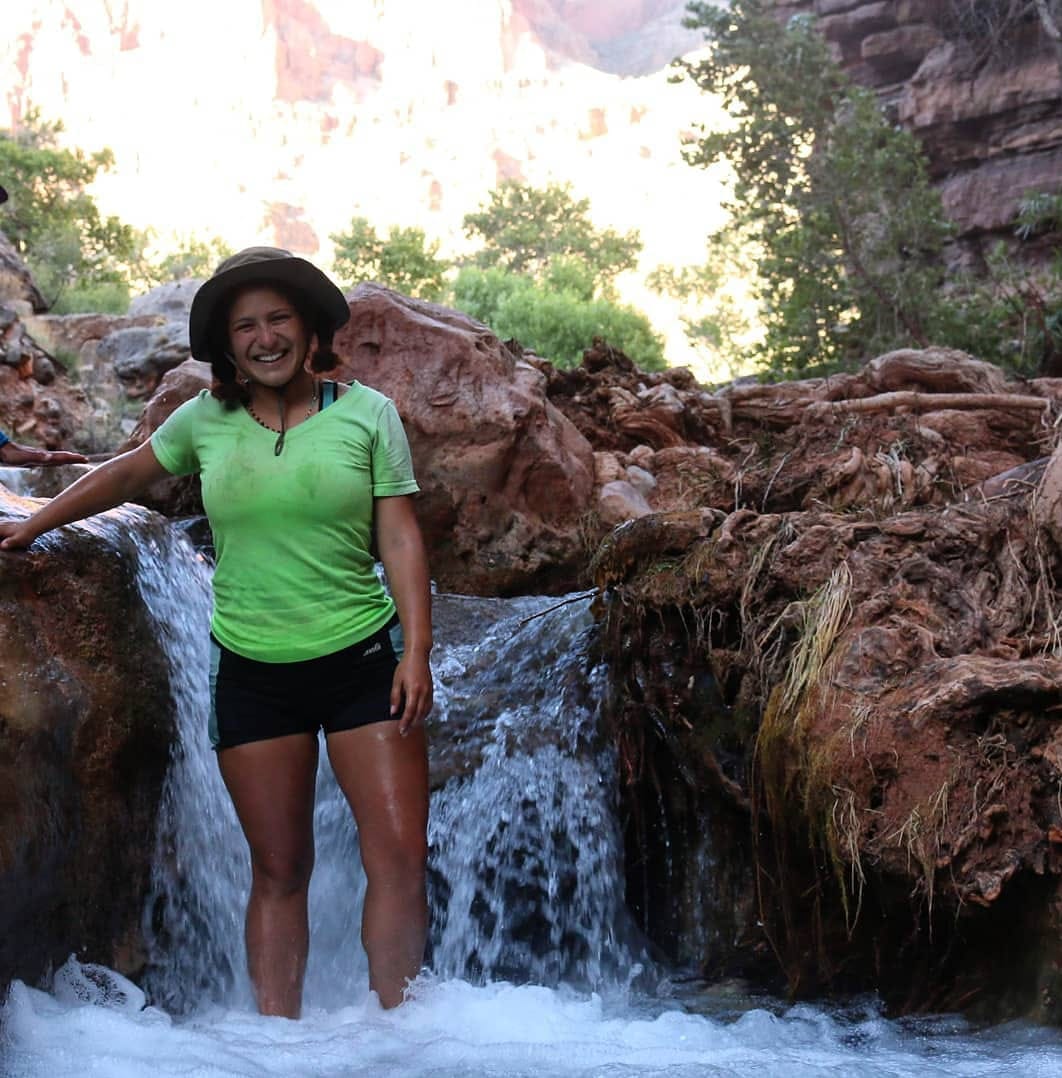
The Aspire team is honored to share Sharan Bir’s essay with you. Her perspective and relationship to trail running is personal, yet the universal notes of finding belonging carry through. May you be inspired by her words.
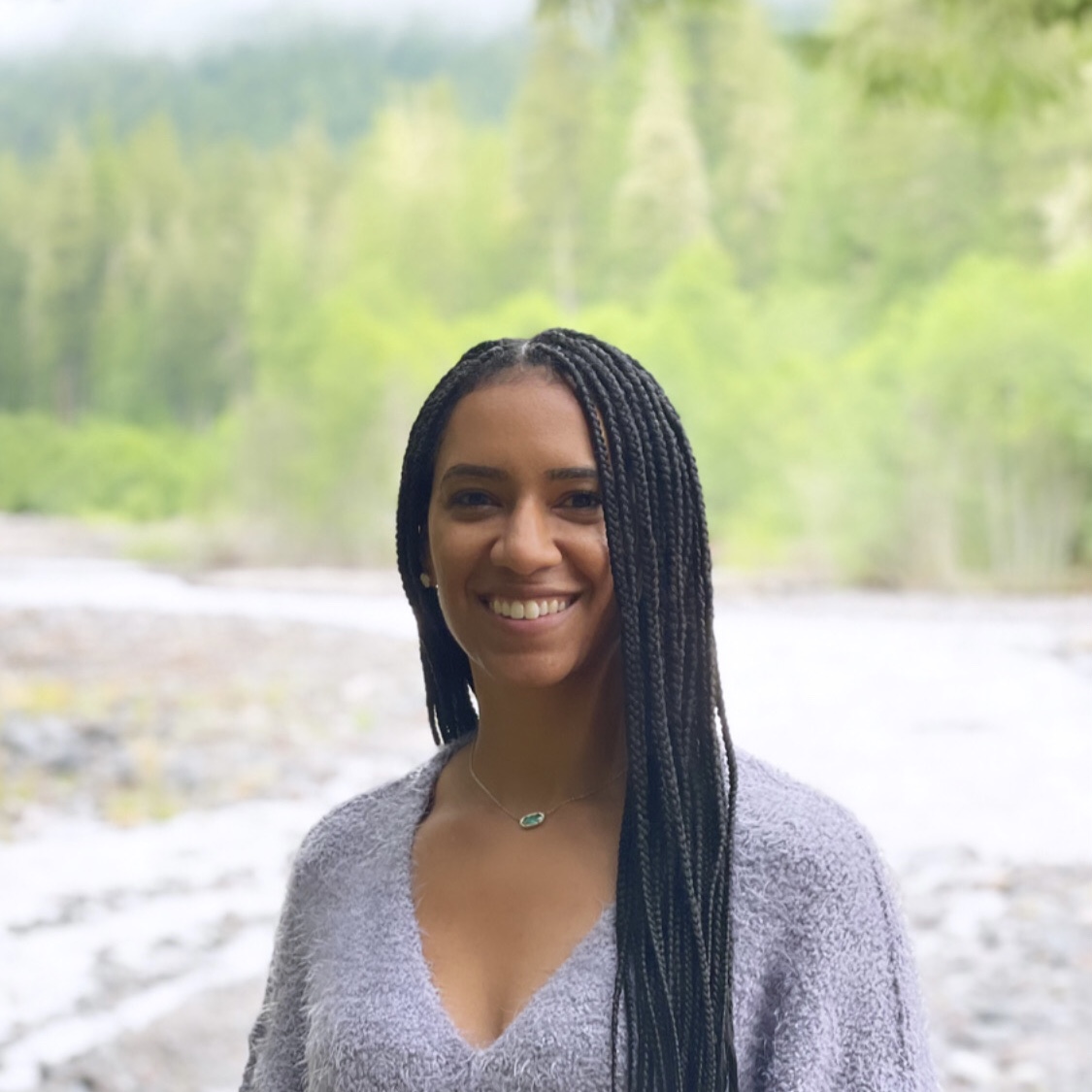
By Sharan Bir, Trail Mixed: North Cascades Scholarship Recipient
For as long as I can remember, I have struggled with belonging. I was born in a rural village in Punjab, India, at a time when female foeticide was so common that doctors and hospitals were banned from revealing the gender of the baby. In fact, our relatives sent sympathy letters to my mother when she gave birth to her second daughter (me). “You will get through this, don’t lose hope”, they said. Where I come from, daughters mean a big wedding, lots of gifts to in-laws as a payment to take the bride, and hence potential sale of ancestral land to fund the wedding. Families celebrated birth of a son and mourned the daughters. Daughters are taught to cook, clean, and care for others, as no one will marry them if they are bold, outspoken or have ambition. You cannot travel anywhere, or have fun, lest you let your ambitions run wild and bring disgrace to the family. “Travel? Study? Have Hobbies? You will get to do everything you want at your husband’s house”. Getting married is the only goal.
When my mother faced a similar fate, she decided that is not the future she wants for her daughters. She left our father, moved back into her parent’s house and worked as a single mother to raise us. We went to an English-speaking school two villages away. We participated in debates and read books that were outside of our syllabus.
Regardless, the cultural notion that a woman belongs with her husband loomed around in shadows all through the teenage years. When I moved to US, I no longer had the same fear of belonging. I was independent and could provide for my own self. However, a different fear (doubt) took its place. I was surrounded by people who did not look like me or speak in my accent. For the longest time, I felt I have to work twice as hard to earn my place. I do not understand my friends jokes about middle school or high school, or 90’s or 00’s trends. I do not understand board games, and I struggle to belong with ease everyone else does.
I started walking because it was cheap and the only hobby I could afford. Soon walking led to hiking and hiking lead to trail running. There is a certain sense of safety and comfort that comes with being in nature. Nature does not hold me against cultural notions. Nature does not judge my skin color, or where I come from, or where I will go. Nature opens its arms wide and accepts me as I am. With every step I take in the wild, I feel I belong. I feel welcomed by all the moss covered trees, reflecting five shades of green, shining as rays of sunlight hit them. I feel seen by each raindrop that falls on the leaves, the way they dance around to the beat of the wind. My legs seem to push themselves forward, my eyes are lit, and I could not help but smile at the view waiting for me in the meadows…….this is home.
The Aspire team is honored to share Maurya Lacey’s essay “Freedom Found” with you. We have been humbled, saddened, inspired, and so appreciative of the courage and clarity portrayed through these words.
“Freedom Found”
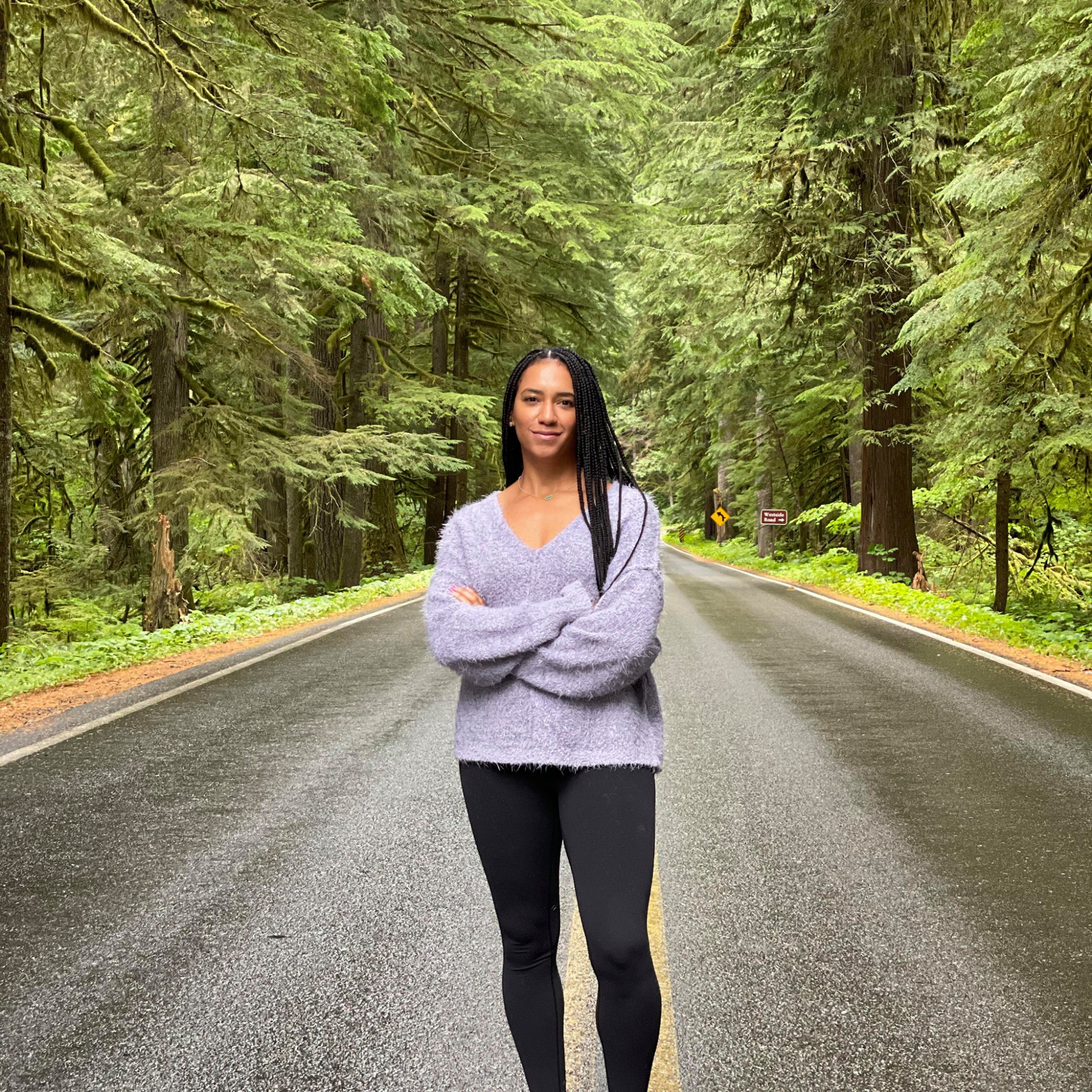
By Maurya Lacey, Trail Mixed: North Cascades Scholarship Recipient
I am a black female trail runner. Mic drop.
Ok, that’s not going to win me this amazing trip. But, in many ways that statement speaks to an autonomy, a strength, an overcoming of both personal and collective fears, a comfort with my own uniqueness, a peace with solitude and even loneliness that comes with moving in wild spaces as a black woman. There aren’t many of us. Social media has created a fledgling virtual community of black women trail runners. We follow each other from across the country, commenting on updates with the familiarity of old drinking buddies, giddy when we actually run intercept another one of ‘us’. Running, particularly trail running has given me the confidence to forge my own path, has altered the trajectory of my life really, but the greatest gift that it’s brought me is the ability to share this amazing, empowering act of running and moving in wild spaces with people that would otherwise miss out.
I fell in love with running in my late 20’s after making a bold goal to run my first race ever, a marathon. As someone who couldn’t run 2 consecutive miles it was probably a misguided goal, but I had found myself having checked many of the boxes of success set by society: had graduated from a good school, was engaged to be married, but I was running away from depression, weight gain, lack of direction, health issues and years of taking care of everyone else but myself.
I really had no model as I embarked on this new journey. I would later learn of Ted Corbitt and a few other great African-American distance runners, but certainly there is no significant acknowledged history of African-American runners in wild spaces. We know the story of the Athenian herald Pheidippides. We’ve read about the Tarahumara immortalized in Born to Run. We of course can see the Kalenjin people of Kenya that dominate long-distance road racing, but our knowledge and shared memory with wild spaces, is a tale of terror in the darkest hours in America. In our DNA is intergenerational trauma. The dread our ancestors carried as they moved through tall grass, fields and forests in the dark of night; wading in marsh waters to throw their scent from the slave catchers hounds. The real and present danger of being caught for no crime other than the color of your skin on a rural road in the American Apartheid known as the Jim Crow South is not far out of our consciousness. My grandmother witnessed the lynching of a young man who had thus moved out of bounds. That experience dictated her steps, and like the codified confines of separate-but-equal, there remained unwritten rules for generations for so many like her in this country. Her warnings to my mother are my mother’s and aunts’ warnings to me. Many of us have been able to convince ourselves that we avoid the trails, the woods, camping, etc. out of preference, but this trauma has shaped our present in ways that this country as a whole is just beginning to understand.
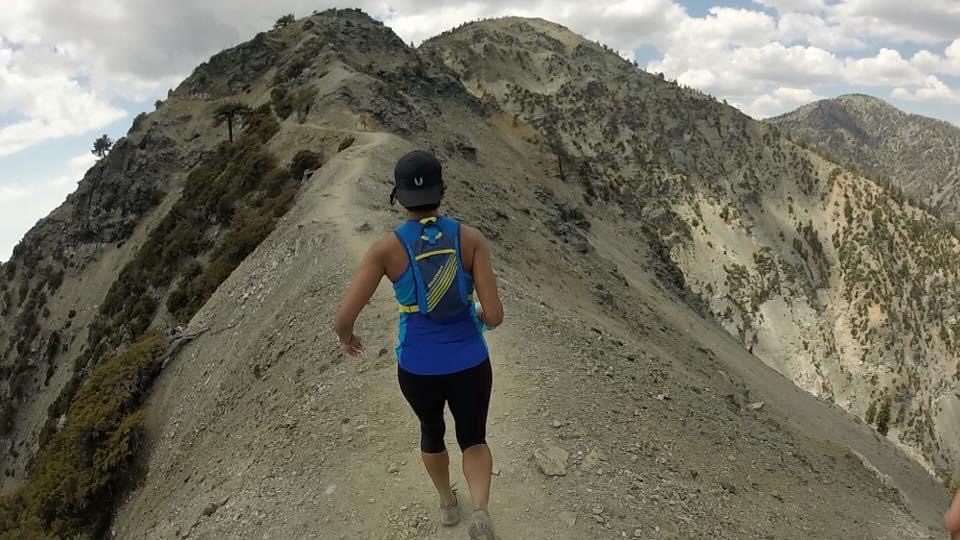
Maurya running Devil’s Backbone.
So, the fact that I fell in love with running on my first introduction to the trails is pretty remarkable. On a snowy long-run day in Cleveland where I lived at the time, I decided to run through the snow-covered grass on lawns and trails for my 15 miler. The wind gently lifted the snow off the trees creating an ethereal mist. The rhythmic crunch of each step seemed to be the only sound for miles at a time. I fell into that zone that we all seek, but that I had never experienced. The magic of the scenery, the feeling of freedom and a strength that had been locked away for so long were transformative. Over the years I’ve constantly been met with that magic, that awareness of my own strength, and for reasons that I can’t define, it only happens in nature. It was not long after that moment in the snow, that I decided to leave Ohio, my engagement and start a new life with this passion for running at the crux of everything.
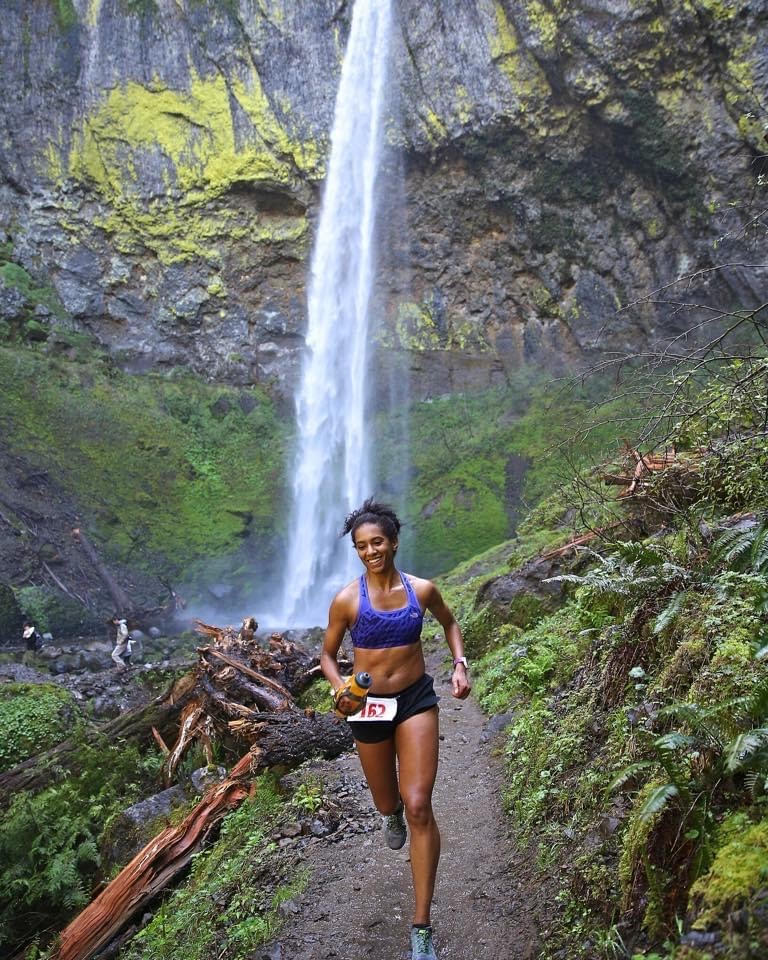
Gorge Waterfalls 50k
Many road races, trail runs and adventures later, I’d settled into this kinship with nature, this harmony within myself in the wild, but to my new group of predominantly Black running friends (and more than a few concerned family members), this enchanting world was a place of fear, unease and exclusion. So, I ran our local GA trails, the buttery ridgelines of Marin Headlands, the arid beauty of Utah, past lush forests and waterfalls in Oregon, up the exposed backbone of Mt. Baldy and over the root laden rolling hills of the Smokies alone.
Over the years, between work and relocations, adulting and a baby, I’ve managed to corral and convince some of my Black run buds to hit the trails in meetups I’ve called Urban Wanderers. This group is open to everyone, but was initiated with the very clear purpose of diversifying the outdoors. Forward movement has been slow and sporadic, but just like my own running journey, hard times have opened new doors. Covid-19 coupled with a national reckoning on race has driven us out of “quarantine”, unhealthy spaces, unhealthy mindsets and into the wild. After a furlough and job loss due to Covid-19, I again returned home to GA (baby and fiancé in tow) and have purposefully used the trails to regain my physical strength and inner peace. Again, I’ve been able to regain my voice in the community and am positioning our right, our need and our reclamation of wild spaces in ways that I would have never thought I could.
Because in many ways, the urgency of the wild itself speaks to me and those who will listen. It tells us that we disconnect or disrespect these spaces at our own peril; that to be excluded or deny ourselves their beauty is shameful. Running in the wild has shown me that the reward of running wasn’t in any specific achievement or accolade. The magic was in the empowerment found in resisting and overcoming my circumstances. I’ve often been wary of attempting to be some sort of influencer, but there is a great importance to owning our narrative. I run to hopefully spread joy and opportunities to my peers and to pass down more courage and less fear to my daughter. All of ‘us’ who carry the joy and the “burden” of representation these days cannot begin to imagine the struggles of our ancestors whose lives’ have shaped our current reality, yet there is a kinship in our common search for joy and freedom. We now have the power to shape our lives and our stories.
Ironically, out of the horrors of slavery came perhaps the greatest trail running story in American history- that of Harriet Tubman, an epic female hero if there ever was one. She made a 90 mile trek to freedom only to return to slave country over thirteen times to save others. This ain’t new for us. Tens of thousands of preserved runaway ads, tell a story of terror but also of courage. Men and women running with little more than the clothes on their body. They carried cornmeal cakes wrapped in cloth for sustenance, their shoes were stiff boots, tattered cloth or none at all.
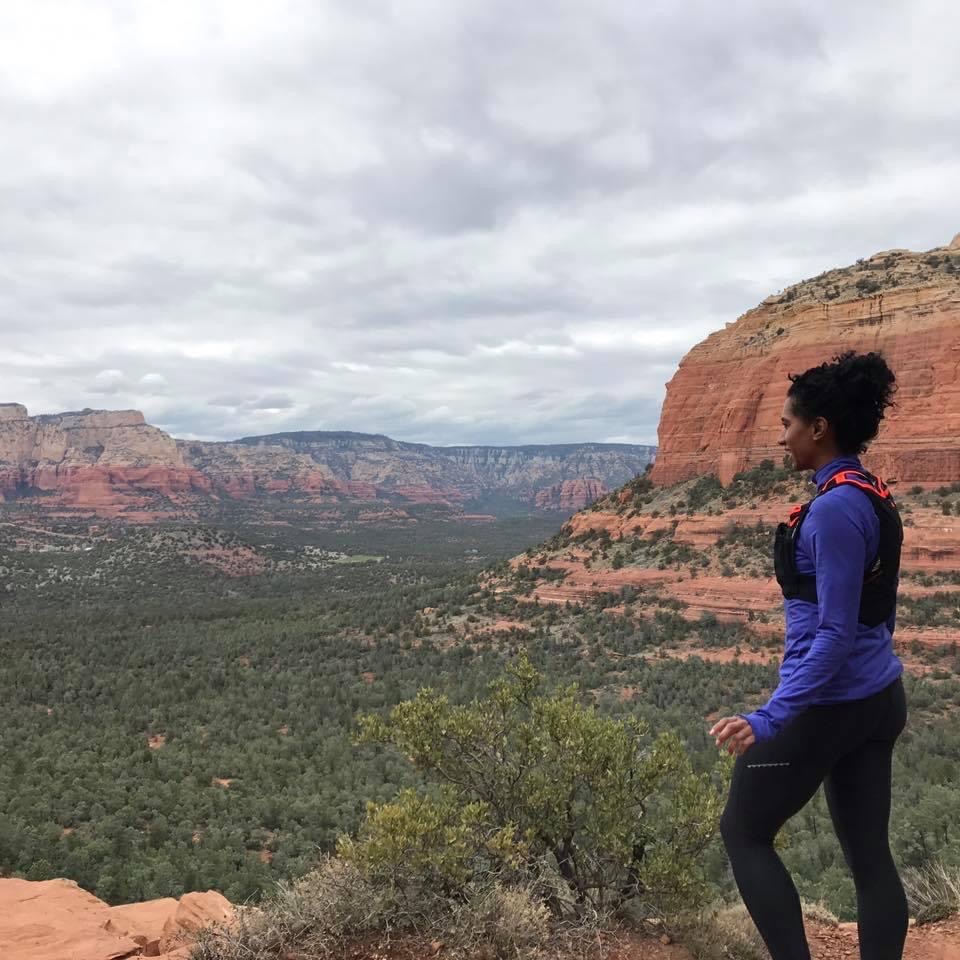
Overlooking Sedona, Arizona
I run the same Georgia red clay that my people’s ancestors self liberated on. Sweat ran down their breasts, past round thighs and strong legs like mine and into the dirt. Their gaze carried past endless rows of cotton, and maybe there was some small joy they dreamed about, the way that I dream of mountains. Something that made them also feel alive, happy…human. I am blessed beyond their wildest dreams largely because of what running has given to me. Though there was and will always be a fear factor, Ours is a triumphant story of freedom in wild spaces that we must own and build upon. I’m grateful for the opportunity to share my story and bring others toward that freedom.
Maurya Lacey (she/her/hers) is a mom, reformed road runner, and nature frolicker who spends way more time than she should behind her laptop working in communications & marketing. Maurya leads an Atlanta, GA meet-up, Urban Wanderers, which is welcome to all but is intentional in creating inviting, fun and safe spaces for BIPOC runners to get out on the trails.
What’s the driving force that motivates you to lace up your shoes and hit the dirt?
Ask a trail runner what gets them out there and you’ll hear a wide range of answers. Waking up in the early morning light while the rest of the world sleeps, taking the mid-day run break, or hitting the trails in the evening with the run crew – whatever the reason, we runners are motivated to intentionally carve out that time to move our bodies, breath the fresh air, and commit to a time of presence on the trails.
Connection with ourselves.
For many, running is the one moment of peace in their day amidst the norms of a go-go-go society full of deadlines, meetings, expectations, endless notifications, and responsibilities. It’s a simple moment to catch their breath, tune out the outer noise and take a moment to, hypothetically, slow down.
We seek solitude for the endless miles of reflection, a mindfulness practice, and a way to return back to ourselves. We take time on the trails to work through difficult emotions, life stressors, and personal challenges. We use the solitude to release, let go, explore new ideas, and simply be. It’s clear that the strength and determination developed during the physical and mental challenges trail running presents translate into other avenues of life.
Then comes running to push oneself – mentally, physically, emotionally and spiritually. In running, we break through self-imposed limitations, building greater resiliency and opening up the capacity for running limitless through the adventures of life. We train long and hard and continue when it’s easier to quit. We set lofty goals that are seemingly out of reach, but continuously challenging ourselves teaches us that with hard work and effort, anything can be achieved.
Connection to each other.
Along with a chance to connect to ourselves, running creates an opportunity for friends to come together. Having a strong foundation of like-minded friends built around a love for outdoor movement and the trails can also mean having a go-to crew for early morning weekend escapades, friends crazy enough to sign up for big races together or be a support crew – friends always game for an epic adventure!
Running can also be a vehicle for change. Through protest runs and fundraising, runners are using our sport as a stepping stone for activism and inclusivity. This work is helping bridge the gap between years of inequalities outdoors, incrementally changing that narrative in the outdoor industry and reality of what it means to recreate outside for marginalized people.
Connection to the Wilderness
For many, trail running is true exploration – a way to use the miracle of the body as a vehicle of discovery in new terrain. Our feet carry us to high peaks with jaw dropping vistas and deeper into pristine, wild places. This exploration generates an inner sense of playfulness, a way of seeing the world through curious and fresh eyes. The wild spaces we inhabit encourage a giddy, child-like sensation of joy, play, and wonder.
Hitting the trails is a great way to expand outdoor skills. Whether it’s a seasoned endurance athlete brushing up on mountaineering skills to travel faster through technical terrain, or someone starting at square one by learning navigation skills, fueling techniques and risk management in outdoor settings, expanding our skills increases confidence and our access to the places we love.
One of the most beautiful parts of each individual’s motivation to run, is that the same sense of wonder and exploration found in the long, expansive mountain trails, can also be found on the neighborhood trails you run each day. The same joy you find running with friends, can be just as meaningful and important on your solo runs. A 3-mile run through the same neighborhood can feel just as impactful as a big day out in the mountains.
That’s the true beauty in perspective, individuality, and finding a personal sense of meaning through trail running. Each experience and motive is unique, admirable, and profound.
It’s a healthy mix of all of these factors that bring us back to the trails time and time again. In a sport built on a communal love for the miraculous movement of our bodies through the wonder of the natural world, what matters isn’t why you run… only THAT you run.
Aspire’s trip calendar has every runner. What motivates you?
We look forward to sharing miles and motivation with you!
Kara Folkerts is a plant powered trail runner, sustainable travel advocate, yoga teacher, and passionate about all things sustainability, travel, health, and outdoor movement. Originally from Canada, Kara has spent the last few years exploring and living abroad in various countries across the globe before joining the Aspire crew in 2020. Kara has been guiding various trail running, sustainability, and health retreats internationally since completing her undergrad in Ecotourism and Outdoor Leadership. With all of these experiences, she seeks meaningful connections with others, loves to learn of new cultures, and fosters the mindset of a lifelong learner. With a big heart for trail running and exploring wild places, she’s always stoked to get out there with others.
For too long, wilderness narratives have focused on the lone (often white) maleexplorer pitting himself against the elements.
Through the Women’s Adventure Scholarship, we sought to elevate and amplify the stories of wild women. The essays written by the three recipients of the 2021 Scholarship set these experiences in stark relief, balancing the fears and challenges of their personal experience with celebration of what it is to be a woman in the wilderness . Take these words and go forth inspired!
Angie Madsen tried to take life seriously, but ended up laughing instead. By day, she creates programming that helps youth girls become brave and confident in the outdoors. In the 5 to 9, she’s your period hype girl, teaching you to fuel your adventures by harnessing the power of your menstrual cycle. Even when she’s working, she’s secretly playing! See what Angie’s up to at www.TheHormoneHacker.com.
Angie is the recipient of the Sawtooth Backcountry Women’s Trip scholarship. We are both excited and honored to share her words here. Read her essay below.
To be a woman moving through wild spaces is to carry a backpack of items you didn’t ask for. Sure, we squeeze in our Ten Essentials, anti-chafe salve and the best of the best snacks (cheese and chocolate, duh). But, stuffed in the gaps between all our tangible gear, you’ll find the invisible items that weigh our pack down more than you’d notice.
You know what you’ll find in my pack?
The echoing words of the man who took my parking fee and scolded, “I worry about seeing girls like you outdoors alone.” (Even though girls like me are more competent on the trails than boys like him.)
The glaring label of a “tease,” because I just wanted to be friends with the male guides.
The ache from the time a customer on my raft pulled me by my ponytail to dunk me in the water, after he told his group of boys that they didn’t actually have to listen to my safety rules.
The self-consciousness when I wonder whether a climber will see my hot pink nail polish and not trust me to hold the rope.
The jaded sigh of explaining, for the hundredth time, that a menstrual cup isn’t gross.
The silent fuming of attending a search and rescue meeting– indoors, in a classroom– and getting a lengthy explanation from a man about why I couldn’t wear those jeans if I ever went hiking.
The disappointment during a swiftwater rescue course scenario when, being the only woman, my higher-pitched commands were drowned out by the chatter of the men who decided we didn’t need a group briefing, after all.
Finally, there’s the worst weight of all that I carry in a male-dominated wild space: The pressure to represent all women. That if I mess up, it’s proof women don’t belong here. That if I have an off day, it’s just evidence that women and girls can’t be as strong, fast or worthy of the sport.
But you know what? All of those undesired items that I carry in my pack were created and put there by society. They’re not who I really am– who we really are, as women. The integrity of a woman in the outdoors is about what’s underneath the tanned (okay, burnt) skin and dirty fingernails. When I finally shrug off my dusty pack at the end of a long day, those burdens are cast aside and what I’m left with is my raw biology.
It’s a biology that holds nature’s secrets and whispers them to a select half of the population (shhh, don’t tell). A body whose rhythms and cycles parallel those of Mother Earth; just as the earth has four seasons, so does my hormonal ebb and flow. (And if that isn’t the coolest thing since zero-drop trail shoes, I don’t know what is.)
My innate nature gives me the superpower to tune so deeply into my connection with the planet that sometimes, I can’t tell where my body ends and the trail begins.
As a woman, when you shake out your well-worn pack and let the gear tumble to the floor, you discover the wild elements that you’re left with and can’t separate from yourself. To be a woman in the outdoors is to be the outdoors.
It took me far too long to realize that magic. I grew up thinking in terms of black and white as I attempted to learn my place in the world. In my naive eyes, you were girly, or you were a tomboy. You were tough, or you were weak. You could be shy or brave. You’d become an expert or never be good enough.
The comments and media I absorbed as a girl fueled the false dichotomies my brain forged. I came to believe that I could either be bossy and powerful, or quiet and submissive. Dresses and mascara, or jeans and bare face. Either/or, no Option C. So, I ignored my womanhood altogether, and for a while, I lost my path.
What brought me back to my inner wild was being in the literal wild. Through trail running, paddling and mountaineering, I reconnected with the part of me that I had stifled in my attempt to be taken seriously.
Now? I thrive in the beautiful in-between. I adore the feminine, intuitive, creative side of myself who pairs up with the masculine, direct, goal-driven side of myself when I head into the wild.
I wear sparkly earrings as my shoes pound singletrack and my sweat soaks my tank top. I bleed on my period as I tighten my crampons and grab my ice axe. I carry knives and matches alongside flowy skirts and that weird all-natural bright red lipstick I love. This in-between is my Happy Place.
When I’m outdoors, I feel a delicate ferocity in my soul. It’s to be a kaleidoscope of contradictions, a fluid collection of traits that changes daily, seasonally, and at times unpredictably. A shifting spectrum of all kinds of wonderful things that can’t be qualified, quantified or tamed, as much as 9-year-old me had thought otherwise.
So yeah, moving outdoors as a woman might mean that my pack is more cumbersome than expected. But the extra work for the glorious payoff? It’s worth it to me. I’ll carry this heavy pack for five thousand miles if it means future generations will bear a lighter load.
Read the other Women’s Adventure Scholarship winner’s essays and check out a month’s worth of conversations with badass women on our Women’s Adventure Scholarship 2021 page.
For too long, wilderness narratives have focused on the lone (often white) maleexplorer pitting himself against the elements.
Through the Women’s Adventure Scholarship, we sought to elevate and amplify the stories of wild women. The essays written by the three recipients of the 2021 Scholarship set these experiences in stark relief, balancing the fears and challenges of their personal experience with celebration of what it is to be a woman in the wilderness . Take these words and go forth inspired!
Bruna Moscol was born in Lima, Peru. Chasing the American dream, her family immigrated to Miami, Florida when she was 10. She then grew up under the Florida sun, calling the beaches home. At age 20, she moved north for college and discovered – and fell passionately in love with- the mountains. She has been running uphill ever since.
Bruna is the recipient of the Rendezvous scholarship. We are both excited and honored to share her words here. Read her essay below.
To be a woman athlete in the outdoors is to exist as a creature society has deemed an impossibility. “Women are like flowers,” they say. Beautiful. Delicate. Weak. Women must be kept inside- “like a gift”- they say, like something precious. Bound in a cocoon of protection, women were historically kept inside. Caged.
To be a woman in the outdoors- running, climbing, swimming, paddling her way through- is to break free from this cage. To be a woman moving swiftly on her own physical capabilities through the physical challenges of the very physical world around her, is to be a creature that lives life on her own terms. It is to claim her existence as her own. It is a way for her to find her power.
— If you would have told a 10-year old little girl version of me that by the time I turned 26, I would celebrate New Year’s Eve by camping, alone at 16,000 ft, on a way up a mountain that was 23,000 ft, in well under 0F weather and covered in snow, I would’ve stared at you like you were crazy and asked what snow even felt like.
I was born neither a natural athlete nor into an athletic or even outdoorsy family. And worse for any adventurous inclinations my little heart may have harbored, I was also born a girl. A shy, slightly overweight, and sickly asthmatic child, I spent months out of the year in the hospital- and when out of the hospital, was treated like glass. Breathing was a problem. So were sports. Out of breath quickly, I learned very early on to loathe all things physical: my P.E. class, dancing, a game of tag. The fact that I was a girl made this loathing even more convenient: better stay inside anyway lest I dirty up my dress. A life of adventure and athleticism was the last thing the cards seem to have in store for me. But as life would have it, a life of adventure and athleticism was exactly what became of mine.
— “We’ll run 6 miles around the river,” my friend explained nonchalantly.
“I can’t run 6 miles around the river,” I replied, alarmed.
I was 20 and had grown up the way I had been raised: far from even the slightest trace of adventure. I had never run 6 miles. I hadn’t even ran 2. It was winter and snowing outside and it was the first time I was seeing snow. “Why can’t you run 6 miles?” my friend insisted. Was he stupid? I couldn’t because I couldn’t. Because my body was not meant to. My legs not strong. My lungs not capable. My heart not made for it. And finally, I couldn’t because I was a woman, and my friend was a man. He was strong, I was delicate. He could, I couldn’t. But through a combination of peer pressure, a fear of missing out, and a dash of bravery I went. A couple of hours later, I had completed my first ever 6 mile run. No one more surprised than me.
What is it Like to be the Weaker Sex?
Up to very recently, they called us women the weaker sex. Our dreams of adventure brushed aside- “You don’t want to get hurt,” they’d said. Our accomplishments, belittled. “Well she ran, but it was slower.” Women are taught, from a very early age, that the outdoors and especially the world of adventuring, is a world that belongs exclusively to men. Women are delicate. Women are fragile. Women must be kept inside.
This is incorrect. As the outdoors would teach me in time, a snowy mountain does not care about your gender, neither does a swift river. The world cares only about bravery, and women are brave. Women are not weak.
More adventures followed that first snowy 6-mile run. Four years later, at age 24, I would sail 6,000 nautical miles across the Pacific Ocean; pulling lines (nautical for rope) with hands as rough as fisher-men’s. In five years, I would carry ⅓ of my body weight up 16,000 ft of altitude across the Andean mountains; my body carrying the same weight as my male companions, no need for extra help. Six years after that first run, I would attempt my first giant mountain, 23,000 ft, solo and unguided, in a 3-week mixed terrain climb. I was the only solo female climber on the mountain. Seven years, and I would paddle all 80 big water rapids across the Colorado River, 19 days on the water. My female arms thick from pushing the massive oars. By year 8, I would run my first 26.2 miles in a historic Spring-time hailstorm, the water way past up my ankles, the hail covering me cold.
— Women are not weak, but we have been taught (incorrectly) that we are. Together, we can break free from this false sense of weakness, from our own taught fears of inadequacy. And in breaking free from this cage, we find our power. And in finding that power, we help others break free from their own cages as well. To be a woman- running, and climbing, and swimming, and paddling- and jumping, and skipping, and rolling, and laughing, and falling, and crying, and persevering in the outdoors, is to be a creature that society, once, deemed impossible. It is to stand on your own capabilities, to claim your body as your own. To be a woman in the outdoors is to break out of that cage and live life bravely. It is to realize you’re not weak at all- what you are is courage.
Read the other Women’s Adventure Scholarship winner’s essays and check out a month’s worth of conversations with badass women on our Women’s Adventure Scholarship 2021 page.
For too long, wilderness narratives have focused on the lone (often white) maleexplorer pitting himself against the elements.
Through the Women’s Adventure Scholarship, we sought to elevate and amplify the stories of wild women. The essays written by the three recipients of the 2021 Scholarship set these experiences in stark relief, balancing the fears and challenges of their personal experience with celebration of what it is to be a woman in the wilderness . Take these words and go forth inspired!
Two women covering ground on the high ridges of the North Cascades Traverse.
The 2021 Women’s Adventure Scholarship application period launches Saturday, March 6th.Well over 200 women applied for the scholarship in 2019, and we were overwhelmed with the power of their inspiring words, stories, and experiences. Over three blogs, we’re sharing answers to some of the application questions to raise the stoke and inspire our next round of applicants.
One of our leading questions in the application was “What is your proudest running accomplishment?” The responses covered a lot of territory, highlighting personal and communal relationships with fitness and celebrating everything from simply lacing up and getting out the door to long distance ultra accomplishments. Read their words and get inspired.
“I completed my first trail ultra, the Bryce 50k Ultra 2 years in a row. The 1st time was with two other ladies and we were able to support each other throughout the day. The next year I did it alone a week after my dad died. That was a tough day! I felt completely drained emotionally at the start of the race, but throughout the day running alone I was able to emotionally process all the things my dad had done for me and taught me which was extremely therapeutic.”
“Coaching middle school runners so that they are able to experience that feeling of accomplishment, and being a role model to them, especially to the girls with low self-esteem. They learn they are strong, worthwhile and can make a positive contribution to a team effort.”
“I think almost every run has its own challenges and honestly I’m proud whenever I step outside and get going!”
“Realizing that my running is an inspiration to others. This makes me so happy.”
“Someone once told me that I would never be a ‘runner’. They claimed that I didn’t have “it” in me. I’m proud to say I have proved them wrong for over 10 years now… running (and winning a few), 5k’s, 10K’s, half marathons, a 25K, and even a full marathon!”
“My proudest running accomplishment is nothing noteworthy, but it has a lot of personal meaning. Last September, for the first time in nearly three years, I ran one mile. That mile was incredibly difficult, but finishing the run was a proud and freeing moment for me. I was nine months post-op from hip surgery to repair a labral tear. Years prior to that, I stopped running because of hip pain. I shifted my focus towards hiking, climbing, and weight lifting instead. Even after finally having surgery on my hip, I didn’t think I would ever start running again. I worked very hard throughout my recovery from surgery and by the time I was healed I felt better than ever. I built my strength and endurance back up, and in doing so I regained confidence I needed to start running again. I’ve run many miles since then, but I’m most proud of that first run because of the work it took to get me there.”
“This March I crossed the finish line of my first 50 miler with my mom by my side. She was an amazing pacer that helped me push through being sick the entire race from a good intolerance. She is now inspired to do her own trail race. She is signed up for her first ever marathon this fall. It feels amazing to inspire her. There was nobody else I would have rather shared that moment with. “
“Qualifying and Running the Boston Marathon in 2015 and 2016. This may seem like a short answer, but It would take a lot of space to actually describe why this meant so much to me. A lifetime of overcoming different obstacles and struggles made these two runs some of my proudest yet.”
“I have completed two 50 milers, seven 50k, and eight marathons but my proudest moment is actually watching my son become an awesome little runner himself. Passing on my love of fitness and the outdoors outshines all else.”
“I help coach an after school trail running program for elementary students and watching my trailblazers cross the finish line of their first 5k is my proudest running accomplishment.”
“Overcoming anxiety and trauma through running has been healing and inspirational. Running has been a snowball effect of accomplishing new goals, conquering old fears, and becoming a stronger, more confident woman.”
“1st place overall at Warrior Rush 24 hour obstacle race and my first 50 miler I finished first female and 8th overall”
“Every year for the last eight years I have run my age in miles near my birthday. I feel so lucky to have been healthy and strong enough to be able to keep up this tradition for so many years. I plan to continue as long as I can.”
“Deciding to join my rad lady friends for an impromptu ultra marathon on the Pacific Crest trail from Harts to Rainy Pass during larch season! I hadn’t been back to that stretch in a while and it’s one of my favorites. It was great to see all the fall colors, nibble blueberries off of blood red bushes and run through golden larches with some of my favorite people in one of my favorite places!”
“Running a 24hr ultra, and my distance PR! It was my first 24 hour event, and though my previous distance PR was 34 miles, my goal was to see if I could hit 50 miles. With the encouragement from friends and wonderful strangers at the event, I ran 73 miles! I’m currently training for a non technical 100 mile race, and just the training alone is a huge accomplishment for me.”
“My daughter placing my medal around my neck after completing my first Ironman”
“Every single day, getting out and pushing my two year old in the jogging stroller. Sacrificing the trail runs I want to do for what’s available to me, and still finding joy in it.”
“Completed the Appalachian mountains first 200 mile race this January.”
“So far, my greatest accomplishment is that I’ve been able to run so well and increase my pace Running safely and happily through my entire pregnancy, including just hours before giving birth to a healthy baby boy!”
Our hope is that the words and experiences shared here inspire 2021 applicants who are ready to share their stories and embrace the friendship and community that comes from backcountry miles.
Thinking of applying for our 2021 Women’s Adventure Scholarship?!
Scholarships are intended to support individual female athletes venturing into wild spaces. Our hope is that as scholarship recipients share their stories of adventure, they will contribute to inspire and grow the culture of female-focused wilderness exploits.
The 2021 Women’s Adventure Scholarship application period will open on March 6th. More details to com soon!
Aspire’s All Women’s Trips
All Women’s Trips are a celebration of community and connection shared among women who love and aspire to play in the mountains. Each stunningly beautiful trip is enhanced by the uniquely awesome vibe of ladies-only adventures.
THE 2021 WOMEN’S ADVENTURE SCHOLARSHIP APPLICATION PERIOD LAUNCHES SATURDAY, MARCH 6TH.WELL OVER 200 WOMEN APPLIED FOR THE SCHOLARSHIP IN 2019, AND WE WERE OVERWHELMED WITH THE POWER OF THEIR INSPIRING WORDS, STORIES, AND EXPERIENCES. OVER THREE BLOGS, WE’RE SHARING ANSWERS TO SOME OF THE APPLICATION QUESTIONS TO RAISE THE STOKE AND INSPIRE OUR NEXT ROUND OF APPLICANTS.
One of our leading questions in the application was “What fears, barriers, or challenges make it difficult for women to venture into wilderness spaces?” The answers were dynamic, yet clear themes emerged. Read on for reflections on empowerment, clarity, community, freedom and processing emotion.
Being Alone on the Trails:
“Honestly, being alone on a trail run terrifies me. I have done it, but I’m always nervous and never relaxed. I’m not so much scared of wildlife, but of being alone and injured on the trails or being attacked by someone while I’m somewhere remote. Therefore, I just avoid too remote or long trails when I’m alone.”
“I am a survivor of sexual assault and have spent years working through that trauma and pushing past my own fear barriers. Fear of sexual assault is a real fear for many women and a big reason why I have not done solo wilderness adventuring. It’s something I want to challenge myself to work through.”
“I think society places fears in many women’s heads that it isn’t safe for us to venture outside, especially alone. There are animals, dangerous people and other things lurking around every corner. I think safety is always a priority but fear shouldn’t stop us from doing something we love.”
“The perception that women are not safe when they are venturing into wilderness spaces alone. This can create fear in women that prevents them from venturing into the wilderness. I am often scrutinized when I go off hiking or running in the wilderness, while a man going out on the same solo venture is not. This obstacle doesn’t always exist, but when it does it can be very difficult to overcome. It undermines a woman’s confidence and can discourage her from venturing out at all.”
Feeling You Don’t Belong:
“Fear, humiliation, rejection, inaccessibility — for so long this has been seen as “man’s” domain, and there are still many barriers that keep women from accessing outdoor education and experience. To build change begins with a community that gives women a safe place to go knowing that we’ll not only be accepted, but empowered, supported, educated, and inspired.”
“There is also that feeling that you have to look a certain way, or run super fast to be able to accomplish the terrain and the distances. The more I run with women the more I realize that these are misconceptions. We come in different shapes and sizes, our ability to conquer the trails comes from within as much as it does from physical exertion. We need to continue to build each other up and remember that confidence comes before competence!”
“I think there’s an incorrect line of thinking that suggests women don’t enjoy being in the wild. And fear of judgement is a real thing. If a woman believes she is going to be judged by her ventures into the wilderness, despite an ache to be in the outdoors, she may not go.”
Societal Expectations and Barriers:
“Breaking societal stereotypes as a woman in the wilderness, particularly from a minority group, is difficult.”
“Social pressures to conform to gender roles, and assumptions that the outdoor space is not safe for women, creates a gendered geographic fear limiting female participation.”
“Women (especially women of colour) already have so many other worries – we are constantly worried about our safety, well-being, what the intentions of those around us are, how we are going to feed our children. Wild spaces are supposed to be a break from this, but in order to access those wild spaces we must deal with these constant barriers and prejudices in our daily life (i.e., at the grocery store getting food for the trip, going to the outdoor store where we get mansplained about buying a tent even though we’ve already bought several). Any additional barriers can make it impossible to overcome.”
Women Mentorship and Finding other Female Running Buddies:
Wilderness spaces can make it seem harder for women without the proper training and preparedness. The only way to get this is by trying, going with someone more knowledgeable and learning. If you don’t have a mentor it can be extremely challenging, daunting. As a woman it can be hard to find a woman mentor and male mentoring relationships are very difficult: avoiding romantic advances or spouses not getting the wrong idea are just a few of the difficulties. Finding a respectful mentoring relationship is the holy grail”
“Difficulty finding a woman buddy who wants to adventure, explore and run with me!”
“One massive problem is that many adventure-minded women lack other women to adventure with and learn from. We end up relying on romantic partners to learn the skills to be self sufficient in the outdoors. Our adventures rely on continued positive relationships with these persons, and if a relationship ends, it can compromise access to the outdoors”
Other Commitments and Time:
“I think for me the biggest obstacle is time, both logistically finding the time for it and feeling like it’s okay for me to make time for it given my other roles in life (especially being a parent).”
“As a runner and a mom with two young children the biggest obstacle is time. Long gone are the days from my twenties when a beautiful empty Saturday stretched out before me. Now there are soccer games and birthday parties and laundry that needs to get done. There is negotiation that needs to take place with my husband for who gets what time when. There are conversations that continually take place with my family and MYSELF reminding all of us that the time out on the trail makes me a better mom, a better wife, a better friend. It’s what makes me feel whole and happy, and able to handle the inevitable chaos of parenthood with a little more equanimity”
“A barrier is being willing to prioritize my running over other commitments in my life, such as caring for and playing with my two little boys.”
“Time is the biggest challenge. As a mom of 3 with a full time career, it can be hard to take time for myself and to find someone else free to go with.”
“One of my challenges is not feeling guilty of the time I spend away from home. I find that on days when I know my family is home that I may cut my run short or change my plans to run closer to home. Being a wife, mother, and grandmother you occasionally have to put the needs of others above your own.”
Lack of Representation:
“There are so many trail running films out there about dudes setting FKTs or running races, and comparatively much fewer about women doing similarly amazing things. Because “regular” women don’t have as many highly visible role models to get into trail running or mountaineering or other wilderness pursuits, we may be more hesitant to try, and can be intimidated by the “white boys’ club” that the outdoors has historically been.”
“Historically, running has been a male-dominated sport and I believe this still poses an influence. This is why supportive female-based groups are so important!”
“One of the barriers that makes it difficult for women to venture into wilderness spaces is the lack of female representation in outdoor sports and wilderness activities. It can be more difficult for women to envision themselves venturing into wilderness spaces if they do not have female role models to look up to.”
“Role models can come from media representation, local wilderness guides, and peers. It can also be intimidating to venture into these spaces because they are often dominated by men. It can seem like you don’t belong because you are a woman in a group of all men or because it’s something that you don’t typically see other women doing.”
Lack of Backcountry Experience:
“For many women, a barrier or challenge to venturing into wild places is probably the knowledge and information about how to safely and respectfully be in those remote locations. I feel fortunate that I have had solid experiences and past mentors who taught me those lessons, but it’s not the same for everyone.”
“I feel like boys are more often taught about the wilderness and how to interact with it. This knowledge is less often provided to girls while they are growing up.”
“I think women are often brought up with less opportunity to go into the wilderness from a young age. I feel very fortunate that my family took me camping throughout my childhood but I think too often, girls aren’t exposed to such adventure and later in life don’t see how wonderful being in the wilderness can be from lack of knowing how to just get out there and get started.”
“I think the major barriers to women venturing into wild spaces include lack of confidence in orienteering forest trails and a fear of wild animals. I believe that with more guided runs through these wild spaces, more women will get comfortable with these adventures. With education and increased exposure to wild spaces, the fear of critters may abate. A little.”
“Lack of skill sets, comfort level with terrain or exposure, fear of taking risk or perceived risk.”
OUR HOPE IS THAT THE WORDS AND EXPERIENCES SHARED HERE INSPIRE 2021 APPLICANTS WHO ARE READY TO SHARE THEIR STORIES AND EMBRACE THE FRIENDSHIP AND COMMUNITY THAT COMES FROM BACKCOUNTRY MILES.
Thinking of applying for our 2021 Women’s Adventure Scholarship?!
Scholarships are intended to support individual female athletes venturing into wild spaces. Our hope is that as scholarship recipients share their stories of adventure, they will contribute to inspire and grow the culture of female-focused wilderness exploits.
THE 2021 WOMEN’S ADVENTURE SCHOLARSHIP APPLICATION PERIOD WILL OPEN ON MARCH 6TH. MORE DETAILS TO COME SOON!
Aspire’s All Women’s Trips
All Women’s Trips are a celebration of community and connection shared among women who love and aspire to play in the mountains. Each stunningly beautiful trip is enhanced by the uniquely awesome vibe of ladies-only adventures.
Last year Aspire gave away 3 Women’s Adventure Scholarships, a place on each of our 3 women’s trips. Each winner agreed to write and reflect on their experience and personal journey. Bobbi was selected as the winner for our Sawtooth Backcountry trip. Read her winning essay here.
Running is a nearly universal experience. Whether it was playing tag in elementary school, knocking out 5km for a charity or chasing after the bus this morning, most of us have run at least a few steps in our lives.
This universality is also why running makes a good metaphor: many people have some familiarity with what it feels like to run, whether or not they like it. I completed the Sawtooth Backcountry Women’s Retreat with Aspire as the culmination of a year of pushing through mental and medical barriers. Fittingly, Sawtooth was rife with metaphorical opportunities. Here are my top three musings from a long, challenging and totally gratifying journey:
We’re all in this together. I consider running a solitary endeavor and it indulges my introverted insecurities. Alone, I cannot compare my perceived weaknesses to others. Although I signed up for a group running trip with Aspire, I did so to feel comfort in a new landscape, without the obligation of running with others.
However, a few days prior to the trip Abram sent us a message: the trail would be snow covered and to stay safe, we would need to stay together. Alarm bells screamed through my head. I would frantically try to keep up, then I’d bonk, and everyone would be annoyed with me.
Instead, our guide gave us the lead and together, we settled into a pace to manage the challenging terrain. We commiserated together through miles of frozen post-hole footsteps from a previous hiker, and skidded down an icy luge a dirt bike had left on the trail. Many times I swore as I caught myself from falling on my butt. Yet in hearing others’ near misses, I realized this was as difficult for them as it was for me. And somehow, that made it better. Had I been alone, I would have thrown down my poles in a tantrum and walked out of there. Instead, after a comical eternity, we were back on dirt and elated, laughing at what a disaster we’d just ran through.
One step at a time. There’s no greater truth while running long distances. You can stand still and stay where you are, or you can take one more step and get a little closer to where you’re going. Because of the snow we rerouted to another trail and had planned on a shuttle to get back to camp. Later during the day, we opted to cancel the shuttle and just run back to camp. We weren’t sure how far from camp we were, but it seemed close
The road descended out of the subalpine for not two or three, but seven unexpected miles. This was the furthest several of us had ever run, and without the comfort of camp in sight, we’d have to keep running. My legs were rubber and the naysayers in my head yelled at me to stop. But as the sun disappeared behind the mountain, cool shadow drifted over my shoulders, and we kept moving. The world suddenly felt very simple. I could keep running, or I could stay right where I was. I could push through this challenge, or give up and have someone come save me. Without a word, we chose to keep moving. And eventually, inevitably, we returned to camp. Cheers from the crew, copious salty snacks and a warm fire greeted us. I was exhausted, but with an unexpected confidence in what my body was capable of doing. I’d run the furthest of my life simply by taking another step.
Where there’s pain, there’s growth. The first time I ever went running, I managed to go about 200 metres. It was the longest I had ever run at once. And it hurt like hell. I was crying and sweating and full of agony. I had wanted to run beyond the horizon, so I vowed to keep running those 200 until I could run 400. Then it was a mile. When I ran my first marathon, I almost didn’t toe the line because that would be the furthest ever. Four kilometres from the finish line, when I could barely muster the next step, a woman near me kept repeating, “Anyone can run 4km.” I knew I could do that, so I did. Running my first ultra, I thought I would die after a bad reaction to caffeine and poor nutrition. But I somehow made it and now I was running in the Backcountry of the Sawtooth mountains. In every pain cave is an opportunity to get stronger.
My weekend at the Sawtooth Women’s Retreatwas the furthest I’d ever run, with people I’d never met and beyond any comfort level I’d encountered. I’m more comfortable and confident with discomfort… And the journey is just getting started.