Categories
Aspire Culture Blog courses Culture Destinations Goat Rocks Stage GR Highlights Wild

Goat Rocks: Running Through Deep Time

Running through evidence of deep time in the Goat Rocks

The first thing you notice in the Goat Rocks Wilderness is the alpine scenery that takes your breath away. The way you’re almost entirely above treeline. The iconic and endless views of Cascade peaks. The endless glittery snowfields flanked by craggy ridges. The alpine meadows embroidered with a ragout of bursting color: glacier lilies, bottlebrush, cinquefoil, and alpine timothy. The deep, resonant blue of glacial lakes. You run through steep, wild drainages that open into basins etched with ice-cold streams. You probably see mountain goats, and definitely see marmots and pikas. Maybe at lower elevations you see mule deer, black-tailed deer, and elk. As you marvel at sliding down snowfields that are still ample in mid-July, looking out across at Mt. Adams, this seems like some kind of wild wonderland that you have to yourself. Maybe you see a PCT hiker or a mountaineer, but probably you only encounter solitude amid all this beauty.

But as you spend more time here, you start to recognize that there is more to the story than blazing pink Indian paintbrush and views of Mt. St. Helens. You notice the talus fields, the boulders made of lava that were shattered and re-welded over a million years. As you trot along the side of a ridge, you notice the way the land has been burst apart and scraped down, the way water and ice have etched textures into rocks, the starkness of the peaks. You see that the eastern sides of the peaks are drier and less forested.

You realize that you’re in a big-shouldered mountainscape of raw mineral. You enter into a deeper, longer, more powerful story.


You’re in Goat Rocks, a time capsule of geologic transformation. A testament to the power of deep time, but also to the power of modern conservation. In the PNW-a region that is rich in wild places, mountains and beautiful drainages-Goat Rocks Wilderness may be not only the best-kept secret, but also a place that helps tell the story of all of the better known backcountry destinations. It helps us imagine what Mt. Baker might look like in a million years, to comprehend the geologic arc of the Cascades, and also why modern wilderness conservation is important to protect such a rare place, not only for humans, but for other species as well.

Remnants of a Giant

The Goat Rocks Wilderness, along the Klickitat River basin, is in the eastern part of the volcanic Cascade Mountain Range in Southwestern Washington. The Goat Rocks are remnants of a large stratovolcano that was once similar in size to Mt Hood. Where that volcano once stood in similar prominence to nearby Rainier, St Helens and Adams, glaciation and erosion have worn down cone to a series of moderate summits like Gilbert Peak (8,201 feet) and Old Snowy Mountain (7,881 feet).

Being in this place allows you to sink into a sense of deep time, where you realize that, in the context of deep time, even giants like Rainier and Mt Adams are impermanent, growing and then weathering away within a few million years. Of course, in the PNW, Mt St Helens’ 1980 eruption was an intense reminder of this life cycle of volcanism. For now, St Helens, Rainier, Adams, and Baker are our giants, but in another million or so years, they will be replaced by other volcanoes.

Goat Rocks teaches you that, and as you scramble across talus and old lava flows, that geologic truth moves into your body, bruises your shins, embeds under your fingernails.

Three million years ago, the Goat Rocks volcano began to build after an explosive caldera-forming rhyolite eruption, and was active in four major pulses until eruptions ceased around half a million years ago.

Here in the Cascadia subduction zone, the volcano was produced by the subduction of the oceanic Juan de Fuca plate under the western edge of the continental North American plate. After eruptions stopped, the layers of volcanic ash and lava flows were worn away by glaciers, and today the area is still covered in glaciers, despite a relatively low elevation and southern position in the Cascades. Conrad
Glacier, McCall Glacier, Meade Glacier and Packwood Glacier are still carving and shaping this landscape today, as well as a number of smaller permanent snowfields. It still feels like a land in the act of creation.

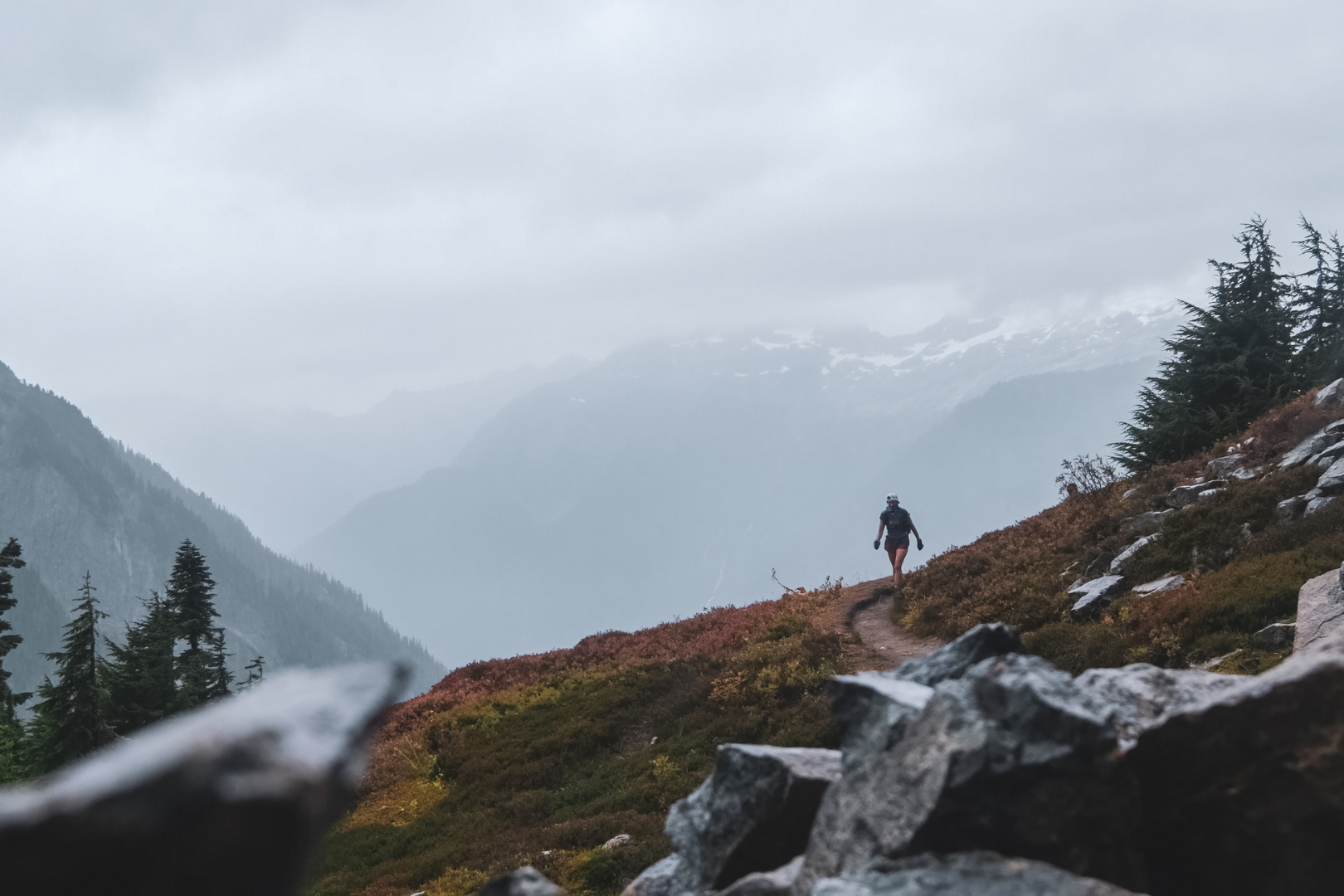
On the PCT North of Old Snowy Mountain.

Conservation at Work

And the important history isn’t limited to geology. While this land was inhabited for thousands of years by native peoples, including the Yakama Nation, it was originally protected for conservation in 1931-
around the same time that miners were starting stake claims for the bountiful mineral resources- and in the ensuing decades more land was set aside for preservation, until the US Congress created the Goat
Rocks Wilderness as part of the Wilderness Act that had originally been proposed by conservation leaders like Aldo Leopold, Bob Marshall, Sigurd Olson, Wallace Stegner, and Olaus and Mardie Murie.

And that Wilderness designation, in 1964, was once of the first anywhere in the world, protecting this volcano-scape from development of any kind. In a place like this, rich in gold, silver, coal, molybdenum, copper and zinc, if it weren’t for protection, we’d be looking pit mines and tailings instead of Roosevelt elk and sun-etched glaciers.

What’s more, with the Wilderness sharing borders with the Gifford Pinchot National Forest and the Okanogan-Wenatchee National Forest, and being near countless other wilderness areas, national forest and parks, it is an important link in unbroken conservation land that creates migration corridors for animals and even flora, allowing greater biological resilience during climate change. For every wildfire that moves through, every average temperature that increases, every species that goes extinct, places like Goat Rocks put a little more extra margin in the system to absorb those changes in an adaptive way that supports biodiversity and ecosystem services.


To travel in the Goat Rocks wilderness is to touch the deepest, rawest, most powerful currents of time. You literally run through geologic epics as you cross what were once active magma flows and grinding glaciers. You also realize what a gift it is to have a place like this, not only for the runners, Yakama tribe members, PCT hikers, climbers and scientists who love this place, but also for the mountain goats, migratory birds, elk, and other animals who are adapting to our modern world that is changing just as intensely as the ancient earth underneath our feet

Run our 2-day Stage Trip through the Goat Rocks!


With three decades spent exploring the PNW and Alaska, Ian is based in Maine, where he directs the Kauffmann Program for Environmental Writing and Wilderness Exploration, and teaches writing, ecology, brain science, music and mindfulness to high school students. With over two decades leading trips and expeditions across the US, Alaska and internationally, he loves empowering people to take agency in their lives and discover new places. Ian is a poet and graduate of the Rainier Writing Workshop, and his writing has been featured in places like Terrain.org, Orion and High Desert Journal.  He also directs a community steelband, loves kayaking big water, drinks copious amounts of coffee, geeks out around nutrition, literature and fitness, and was once a member of an Inuit Dance Troupe.

Check out his website at Ianramsey.net
Categories
Aspire Culture Blog Campaigns Culture Highlights Women's Adventure Scholarship Women's Adventure Scholarship Blogs

Women’s Adventure Scholarship Highlights: “What fears, barriers or challenges make it difficult for women to venture into wilderness spaces?”

THE 2021 WOMEN’S ADVENTURE SCHOLARSHIP APPLICATION PERIOD LAUNCHES SATURDAY, MARCH 6TH. WELL OVER 200 WOMEN APPLIED FOR THE SCHOLARSHIP IN 2019, AND WE WERE OVERWHELMED WITH THE POWER OF THEIR INSPIRING WORDS, STORIES, AND EXPERIENCES. OVER THREE BLOGS, WE’RE SHARING ANSWERS TO SOME OF THE APPLICATION QUESTIONS TO RAISE THE STOKE AND INSPIRE OUR NEXT ROUND OF APPLICANTS.

One of our leading questions in the application was “What fears, barriers, or challenges make it difficult for women to venture into wilderness spaces?”  The answers were dynamic, yet clear themes emerged. Read on for reflections on empowerment, clarity, community, freedom and processing emotion.


Being Alone on the Trails:

“Honestly, being alone on a trail run terrifies me. I have done it, but I’m always nervous and never relaxed. I’m not so much scared of wildlife, but of being alone and injured on the trails or being attacked by someone while I’m somewhere remote. Therefore, I just avoid too remote or long trails when I’m alone.”

“I am a survivor of sexual assault and have spent years working through that trauma and pushing past my own fear barriers. Fear of sexual assault is a real fear for many women and a big reason why I have not done solo wilderness adventuring. It’s something I want to challenge myself to work through.”

“I think society places fears in many women’s heads that it isn’t safe for us to venture outside, especially alone. There are animals, dangerous people and other things lurking around every corner. I think safety is always a priority but fear shouldn’t stop us from doing something we love.”

“The perception that women are not safe when they are venturing into wilderness spaces alone. This can create fear in women that prevents them from venturing into the wilderness. I am often scrutinized when I go off hiking or running in the wilderness, while a man going out on the same solo venture is not. This obstacle doesn’t always exist, but when it does it can be very difficult to overcome. It undermines a woman’s confidence and can discourage her from venturing out at all.”

Feeling You Don’t Belong:

“Fear, humiliation, rejection, inaccessibility — for so long this has been seen as “man’s” domain, and there are still many barriers that keep women from accessing outdoor education and experience. To build change begins with a community that gives women a safe place to go knowing that we’ll not only be accepted, but empowered, supported, educated, and inspired.”

“There is also that feeling that you have to look a certain way, or run super fast to be able to accomplish the terrain and the distances. The more I run with women the more I realize that these are misconceptions. We come in different shapes and sizes, our ability to conquer the trails comes from within as much as it does from physical exertion. We need to continue to build each other up and remember that confidence comes before competence!”

“I think there’s an incorrect line of thinking that suggests women don’t enjoy being in the wild. And fear of judgement is a real thing. If a woman believes she is going to be judged by her ventures into the wilderness, despite an ache to be in the outdoors, she may not go.”

Societal Expectations and Barriers:

“Breaking societal stereotypes as a woman in the wilderness, particularly from a minority group, is difficult.”

“Social pressures to conform to gender roles, and assumptions that the outdoor space is not safe for women, creates a gendered geographic fear limiting female participation.”

“Women (especially women of colour) already have so many other worries – we are constantly worried about our safety, well-being, what the intentions of those around us are, how we are going to feed our children. Wild spaces are supposed to be a break from this, but in order to access those wild spaces we must deal with these constant barriers and prejudices in our daily life (i.e., at the grocery store getting food for the trip, going to the outdoor store where we get mansplained about buying a tent even though we’ve already bought several). Any additional barriers can make it impossible to overcome.”

Women Mentorship and Finding other Female Running Buddies:

Wilderness spaces can make it seem harder for women without the proper training and preparedness. The only way to get this is by trying, going with someone more knowledgeable and learning. If you don’t have a mentor it can be extremely challenging, daunting. As a woman it can be hard to find a woman mentor and male mentoring relationships are very difficult: avoiding romantic advances or spouses not getting the wrong idea are just a few of the difficulties. Finding a respectful mentoring relationship is the holy grail”

“Difficulty finding a woman buddy who wants to adventure, explore and run with me!”

“One massive problem is that many adventure-minded women lack other women to adventure with and learn from. We end up relying on romantic partners to learn the skills to be self sufficient in the outdoors. Our adventures rely on continued positive relationships with these persons, and if a relationship ends, it can compromise access to the outdoors”

Other Commitments and Time:

“I think for me the biggest obstacle is time, both logistically finding the time for it and feeling like it’s okay for me to make time for it given my other roles in life (especially being a parent).”

“As a runner and a mom with two young children the biggest obstacle is time. Long gone are the days from my twenties when a beautiful empty Saturday stretched out before me. Now there are soccer games and birthday parties and laundry that needs to get done. There is negotiation that needs to take place with my husband for who gets what time when. There are conversations that continually take place with my family and MYSELF reminding all of us that the time out on the trail makes me a better mom, a better wife, a better friend. It’s what makes me feel whole and happy, and able to handle the inevitable chaos of parenthood with a little more equanimity”

“A barrier is being willing to prioritize my running over other commitments in my life, such as caring for and playing with my two little boys.”

“Time is the biggest challenge. As a mom of 3 with a full time career, it can be hard to take time for myself and to find someone else free to go with.”

“One of my challenges is not feeling guilty of the time I spend away from home. I find that on days when I know my family is home that I may cut my run short or change my plans to run closer to home. Being a wife, mother, and grandmother you occasionally have to put the needs of others above your own.”

Lack of Representation:

“There are so many trail running films out there about dudes setting FKTs or running races, and comparatively much fewer about women doing similarly amazing things. Because “regular” women don’t have as many highly visible role models to get into trail running or mountaineering or other wilderness pursuits, we may be more hesitant to try, and can be intimidated by the “white boys’ club” that the outdoors has historically been.”

“Historically, running has been a male-dominated sport and I believe this still poses an influence. This is why supportive female-based groups are so important!”

“One of the barriers that makes it difficult for women to venture into wilderness spaces is the lack of female representation in outdoor sports and wilderness activities. It can be more difficult for women to envision themselves venturing into wilderness spaces if they do not have female role models to look up to.”

“Role models can come from media representation, local wilderness guides, and peers. It can also be intimidating to venture into these spaces because they are often dominated by men. It can seem like you don’t belong because you are a woman in a group of all men or because it’s something that you don’t typically see other women doing.”

Lack of Backcountry Experience: 

“For many women, a barrier or challenge to venturing into wild places is probably the knowledge and information about how to safely and respectfully be in those remote locations. I feel fortunate that I have had solid experiences and past mentors who taught me those lessons, but it’s not the same for everyone.”

“I feel like boys are more often taught about the wilderness and how to interact with it. This knowledge is less often provided to girls while they are growing up.”

“I think women are often brought up with less opportunity to go into the wilderness from a young age. I feel very fortunate that my family took me camping throughout my childhood but I think too often, girls aren’t exposed to such adventure and later in life don’t see how wonderful being in the wilderness can be from lack of knowing how to just get out there and get started.”

“I think the major barriers to women venturing into wild spaces include lack of confidence in orienteering forest trails and a fear of wild animals. I believe that with more guided runs through these wild spaces, more women will get comfortable with these adventures. With education and increased exposure to wild spaces, the fear of critters may abate. A little.”

“Lack of skill sets, comfort level with terrain or exposure, fear of taking risk or perceived risk.”

OUR HOPE IS THAT THE WORDS AND EXPERIENCES SHARED HERE INSPIRE 2021 APPLICANTS WHO ARE READY TO SHARE THEIR STORIES AND EMBRACE THE FRIENDSHIP AND COMMUNITY THAT COMES FROM BACKCOUNTRY MILES.

Thinking of applying for our 2021 Women’s Adventure Scholarship?!

Scholarships are intended to support individual female athletes venturing into wild spaces. Our hope is that as scholarship recipients share their stories of adventure, they will contribute to inspire and grow the culture of female-focused wilderness exploits.

THE 2021 WOMEN’S ADVENTURE SCHOLARSHIP APPLICATION PERIOD WILL OPEN ON MARCH 6TH. MORE DETAILS TO COME SOON!

Aspire’s All Women’s Trips

All Women’s Trips are a celebration of community and connection shared among women who love and aspire to play in the mountains. Each stunningly beautiful trip is enhanced by the uniquely awesome vibe of ladies-only adventures.

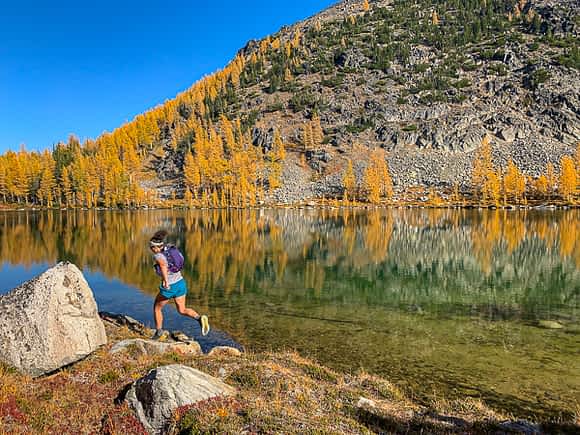
Larches, blue sky, and alpine lakes in the Sawtooth Backcountry