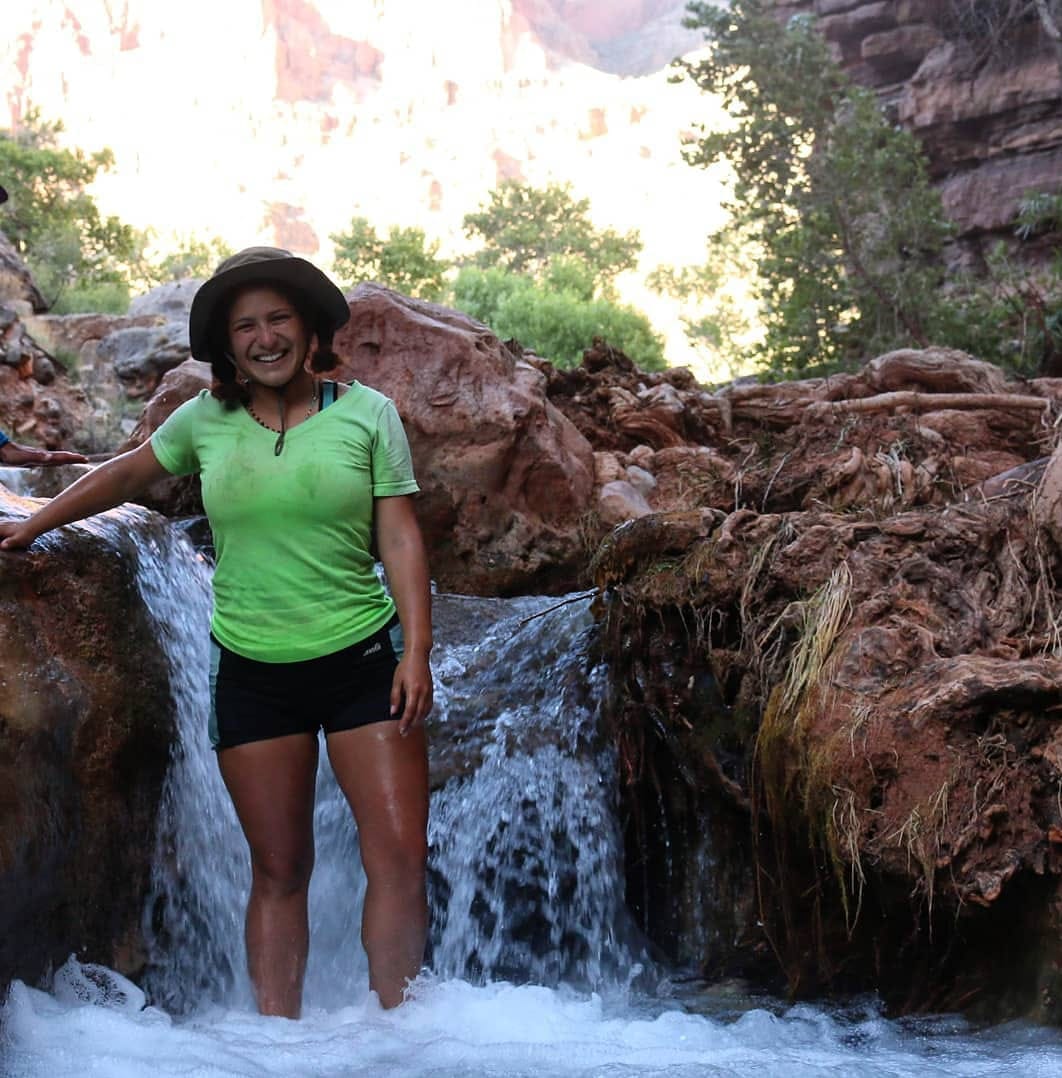
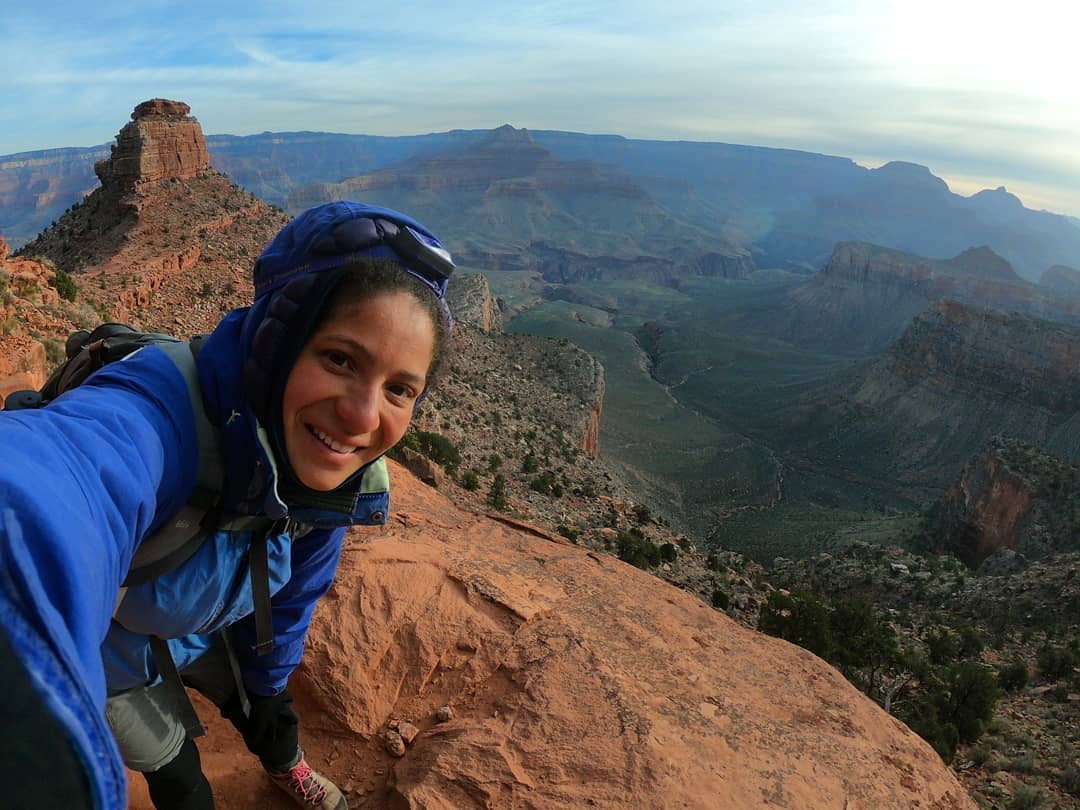
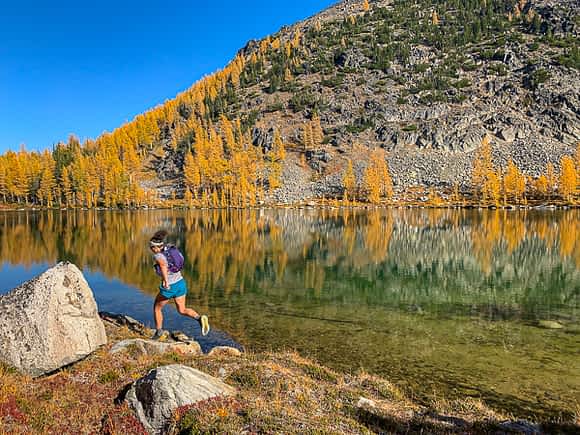
The Aspire team is honored to share Sharan Bir’s essay with you. Her perspective and relationship to trail running is personal, yet the universal notes of finding belonging carry through. May you be inspired by her words.
By Sharan Bir, Trail Mixed: North Cascades Scholarship Recipient
For as long as I can remember, I have struggled with belonging. I was born in a rural village in Punjab, India, at a time when female foeticide was so common that doctors and hospitals were banned from revealing the gender of the baby. In fact, our relatives sent sympathy letters to my mother when she gave birth to her second daughter (me). “You will get through this, don’t lose hope”, they said. Where I come from, daughters mean a big wedding, lots of gifts to in-laws as a payment to take the bride, and hence potential sale of ancestral land to fund the wedding. Families celebrated birth of a son and mourned the daughters. Daughters are taught to cook, clean, and care for others, as no one will marry them if they are bold, outspoken or have ambition. You cannot travel anywhere, or have fun, lest you let your ambitions run wild and bring disgrace to the family. “Travel? Study? Have Hobbies? You will get to do everything you want at your husband’s house”. Getting married is the only goal.
When my mother faced a similar fate, she decided that is not the future she wants for her daughters. She left our father, moved back into her parent’s house and worked as a single mother to raise us. We went to an English-speaking school two villages away. We participated in debates and read books that were outside of our syllabus.
Regardless, the cultural notion that a woman belongs with her husband loomed around in shadows all through the teenage years. When I moved to US, I no longer had the same fear of belonging. I was independent and could provide for my own self. However, a different fear (doubt) took its place. I was surrounded by people who did not look like me or speak in my accent. For the longest time, I felt I have to work twice as hard to earn my place. I do not understand my friends jokes about middle school or high school, or 90’s or 00’s trends. I do not understand board games, and I struggle to belong with ease everyone else does.
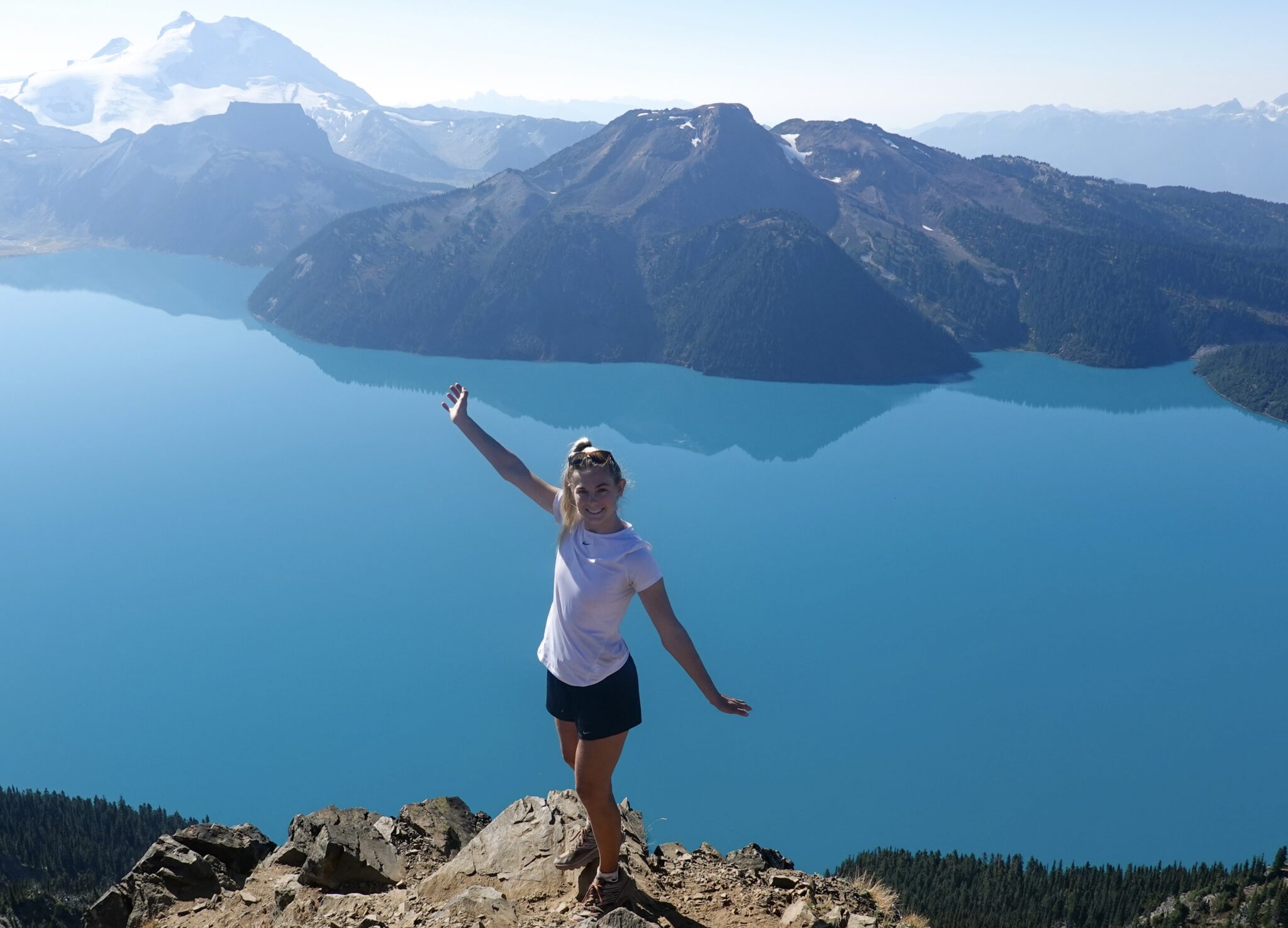
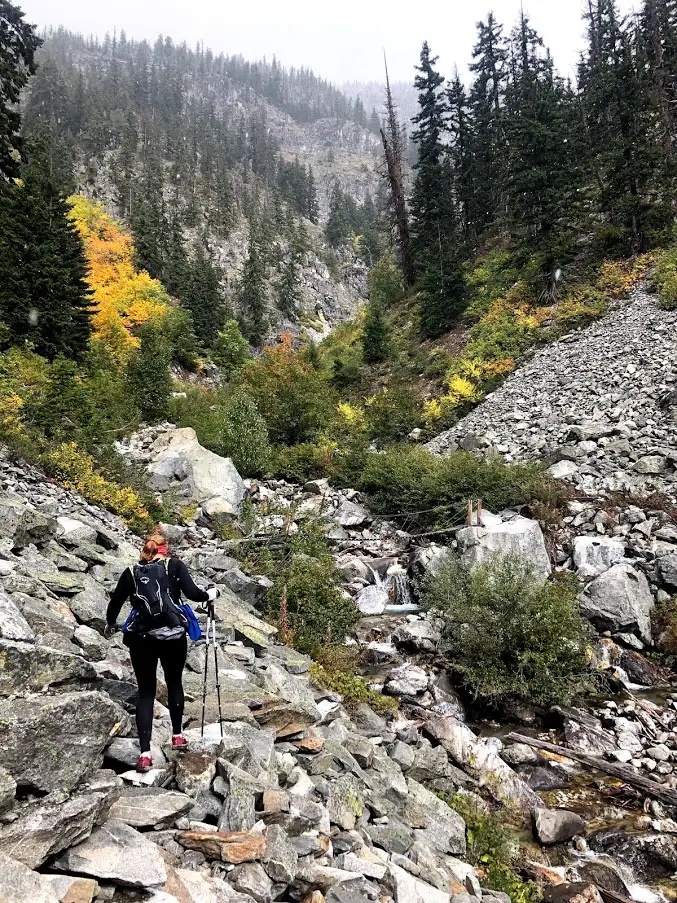
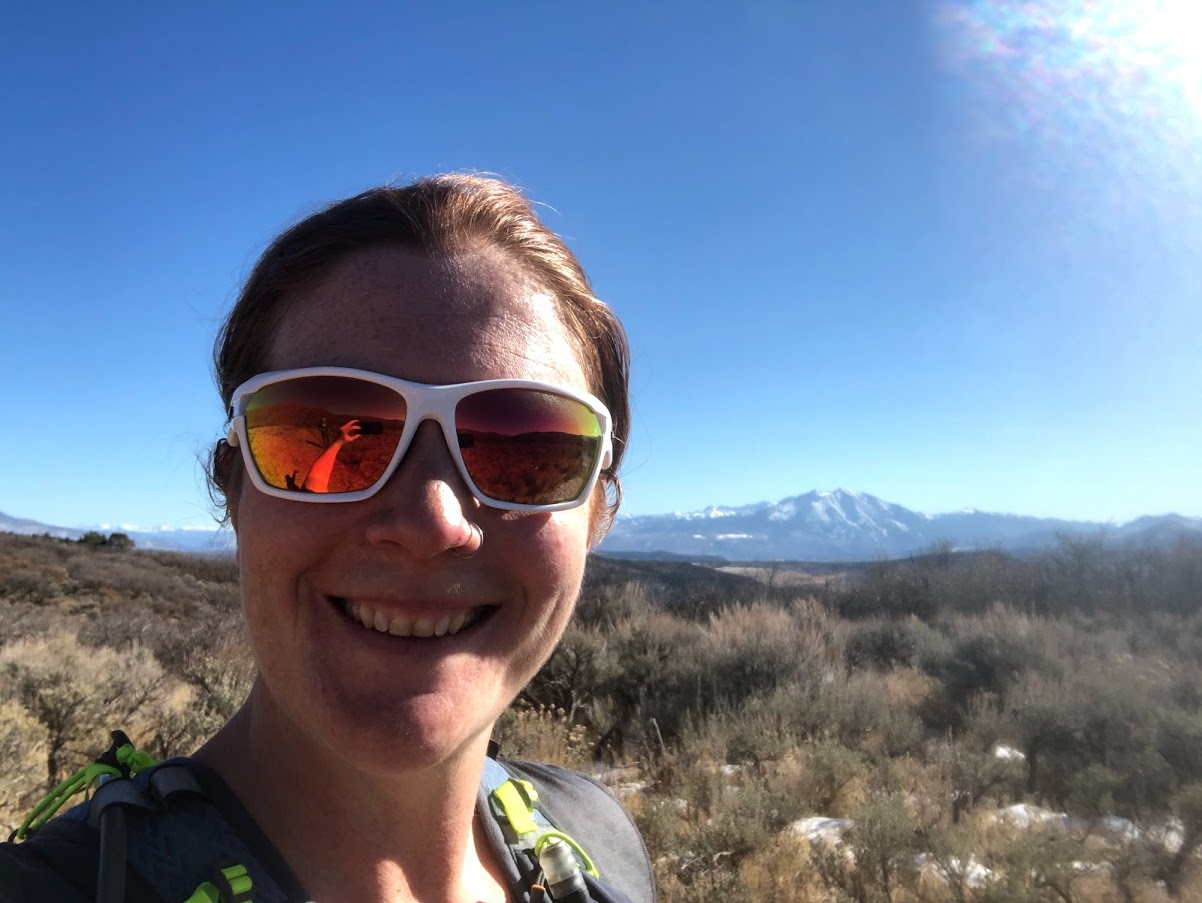
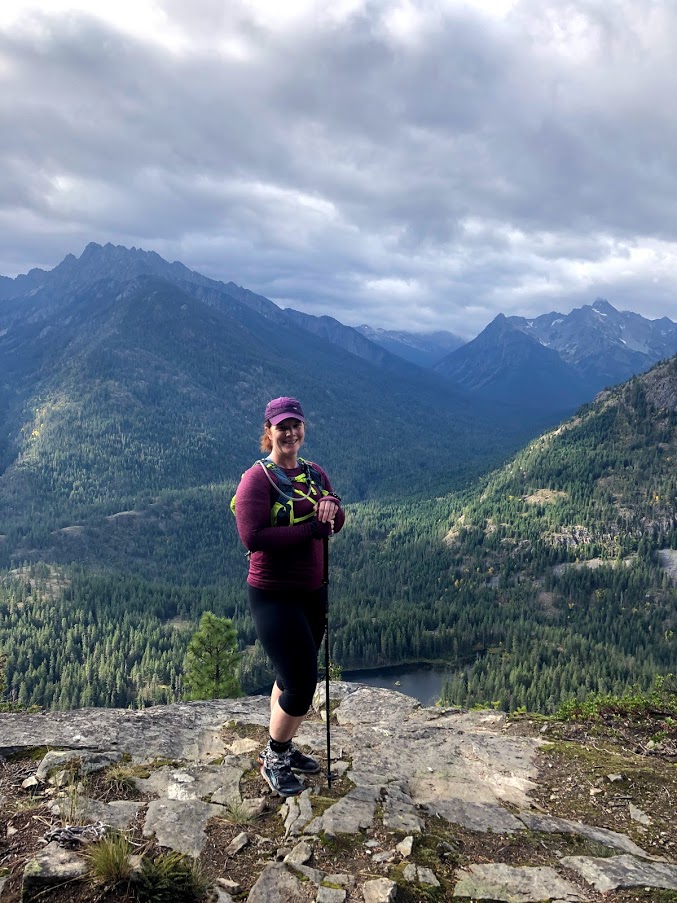
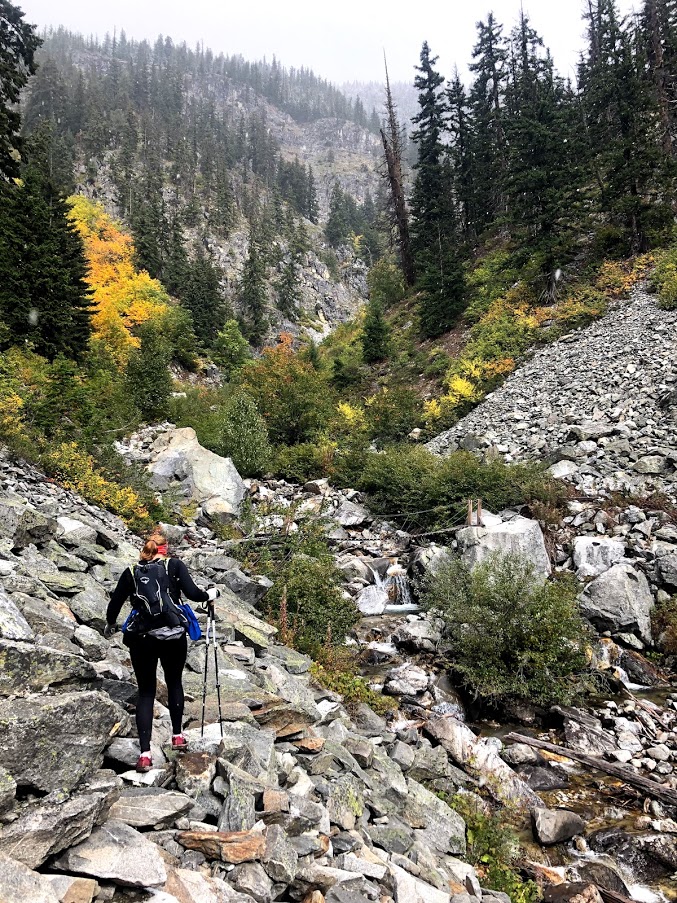
I started walking because it was cheap and the only hobby I could afford. Soon walking led to hiking and hiking lead to trail running. There is a certain sense of safety and comfort that comes with being in nature. Nature does not hold me against cultural notions. Nature does not judge my skin color, or where I come from, or where I will go. Nature opens its arms wide and accepts me as I am. With every step I take in the wild, I feel I belong. I feel welcomed by all the moss covered trees, reflecting five shades of green, shining as rays of sunlight hit them. I feel seen by each raindrop that falls on the leaves, the way they dance around to the beat of the wind. My legs seem to push themselves forward, my eyes are lit, and I could not help but smile at the view waiting for me in the meadows…….this is home.
The Aspire team is honored to share Makena Rutledge‘s winning essay for the Sawtooth Backcountry Women’s Trip. We’re confident her story will find it’s resonance within you, as it did with us.
When I walked for the first time in a year, it didn’t feel like freedom. My dad picked up his phone to film my first steps through the sliding doors of the hospital into the Seattle winter. He quickly sent the video to our family members, who wept tears of joy. The nightmare was over. The year of infuriating conversations with doctors who refused to believe my pain was real, the late night trips to the children’s emergency room as I screamed for the pain to stop. In their eyes, it was all behind us the moment I walked outside and stepped into the car that would take me towards a normal life. For me, it felt temporary. I viewed my recovery as something fleeting, which could disintegrate into nothing as suddenly as it began. When I walked for the first time in a year, I yearned for the safety and simplicity of the wheelchair that had imprisoned me.
After I reached this turning point, I was left in a bizarre sort of limbo. My body was steadily recovering, ready to chase the ambitions of the future, while my brain was still wallowing in the traumas of the past. Amplified musculoskeletal pain syndrome, the severe neurological syndrome that took my ability to walk and nearly my life, was finally in remission. But my brain would not let me go that easy. A crippling case of PTSD soon settled in, a remnant from the exceptionally painful treatments administered by my doctors. Plagued by vivid nightmares, I was not myself, and I mourned her. I spent much time in my own head, reflecting on who I was before. From a young age, I always had the urge to be wild. I dreamed of remote places in which I could be free from expectations, in which I could take up space unapologetically. It often weighed on me that as free as I felt outside, the world questioned whether I belonged in those spaces. I could not have been fully aware of it at the time, but this was the world getting to me.
There is a specific point in every girl’s life where she becomes her own doubter. Up to this point, the voices telling her she isn’t good enough are solely external. But very quickly, those voices take on a life of their own within her head. The years of negative comments and encounters pile up, leaving her questioning whether there is room for her in the very thing she loves. My moment, when I became my own doubter, was when I was fifteen, just months before I came down with my pain syndrome.
I became aware of this when I was in the worst of my PTSD, and it ushered in the next phase of my life. The harder phase. I was ready to reclaim the wild spirit within me that I thought I had lost. And so, having never run farther than 10k, I had the urge to do something big. Something that would prove to me that I was stronger than my illness, and help me feel like myself again. I signed up for my first 50k in March of 2022, and I instantly felt more powerful than I had in years. I was ready to take a chance on myself, to make a place for myself on the trails that did not exist before. During my illness, my identity was stripped away over and over until I felt small and powerless. Now, all I wanted to do was move through the mountains to feel my power once more. As I trained throughout the summer for my September 50k, I began to feel true, unfiltered joy for the first time in recent memory. I ran along endless ridges and frolicked through alpine meadows, taking in otherworldly views. I allowed myself to be authentic and joyous in these wild spaces and, slowly, they began to heal me. The barriers that used to prevent me from spending time on trail— being too young, too vulnerable, too female— melted away, and I was able to accept them as a part of my experience as a female runner. To embrace these aspects of me meant undoing some of the damage the world had inflicted, and even allowing me to feel strong within my body after such devastation.
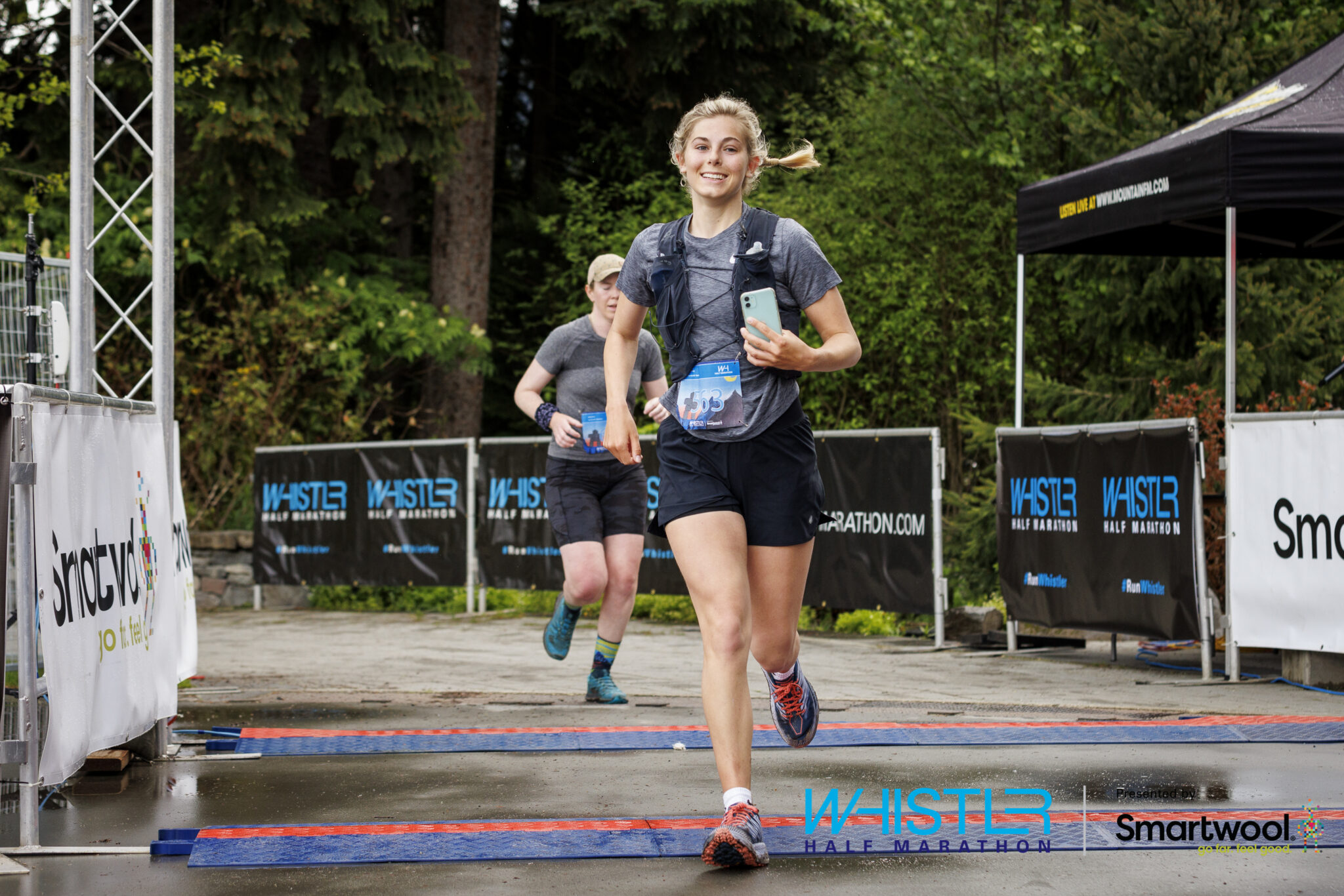
As I toed the line of my first ultra in September, I wondered whether the strength and joy I’d found outdoors would be enough to carry me through. The race began in the predawn hours of the morning, and the smoke from faroff forest fires gave the woods an ethereal, dream-like feeling. From the first climb, a relentless 14 kilometer suffer-fest up Whistler Mountain’s rugged slopes, to a spectacular trail fall during which I sliced my lip on a rock, I simply could not contain my joy. I was taking up space on my home trails in a grueling ultramarathon, only two years out of a wheelchair. I felt my own raw power, of both body and mind, and reveled in the experience of it all. I was home. As alpine meadows changed to rainforest on my descent, I could not hold back any longer. I cried tears of sorrow for the pain I had endured, which soon became tears of joy for the gratitude I felt. I did not feel shame. During the descent, I let go of my ideas of how finishing a 50k would heal me. Because in that moment I felt as whole as I ever have. I was out on the trails, finally feeling as though I had the right to challenge myself in that space. Finish or no finish, I was doing exactly what I had set out to do. In that moment, and even today, that feeling of true freedom was enough for me.
1st Annual Women’s Adventure Scholarship Winner: Anna Brown
With growing anticipation and excitement for our Second Annual Women’s Adventure Scholarshipfor the 2021 season, we wanted to highlight the incredible women who were chosen from our first scholarship round. With over 250 women sharing their insights, experiences and motivations as runners, it was deeply humbling and inspiring to read the applications for women all across the globe who have found a great sense of meaning and connection to lacing up their runners and hitting the trails!
One of three Women’s Adventure Scholarship winners was awarded to Anna Brown from Spokane, Washington. Anna joined us for four big mountain days exploring the trails leading to the magical backcountry village of Stehekin.
For Anna, what started as a negative self-image to bring her to running, blossomed into something so much more.
“I love to run because it continually allows me to rediscover who I am. I used to joke, “I will only run if something ugly is chasing me.” After the birth of my daughter in 2007, that something “ugly” was my own self-image. I started running almost as a way to punish myself for not living up to the perfect societal ideal of a woman. However, somewhere along the way, running allowed me to accept myself for who I am, and I no longer use running as a countermeasure for habits that were more harmful than good. Running allows me to be me, and it allows me to discover who I am as I age and change. I have run marathons, trail runs, half iron-mans, 5Ks, 10ks, and more. I have felt amazing after a run, and I have cried and crawled my way to the finish line. I don’t finish first, I often finish last, but I finish. And that is more than enough – just like me. I run because running has taught me so much about living”
With women facing many fears, challenges and obstacles to get out and explore wild places, Anna touches on the fear of the unknown.
“I think one thing that contributes to women fearing wilderness spaces is the unknown. Many of us are raised to be apprehensive of what we don’t know, and we are taught to protect ourselves from what we can’t control. In spaces continually inhabited by others, we have social norms we can follow to guide our way through situations. If we were not exposed to the wilderness, especially the backcountry, I think many women are unsure of how to navigate it. It’s peculiar if you think about it. In many ways, the rules of nature are more general and simpler than the ones we follow in social situations with other human beings, yet many women are uncomfortable with wild spaces. Exposure to the backcountry, to those pristine and alone places, is key in changing our stories and in empowering us to take back what I truly believe is natural and needed – our connection to the earth in a very real and intimate way. To be present and alone in nature is not the same as being with others in the wilds of society. Crowded city spaces often create isolation, but the vast space of the wilds can heal and bond us all together. This is true for me. I think it can be true for others.”
Throughout Anna’s life she has continued to inspire others with the power of consistency and a persistent passion to get out on the trails and show up!
This may sound trite, but honestly, I am most proud that I am still running. As I have gotten older, my body has been more prone to injury. I have found myself continually challenged by not only injury, but demands from life in general – family, work, and so on. I have had to give myself the grace and space to put running on hold for days, weeks, and even a month or two. I am not very competitive with others when it comes to running, but with myself, I am relentless. I used to be so irritated that I couldn’t break my personal records, but I have come to learn that it is ok. It is ok to allow my body and my mind to take care of me. Running supports me in these endeavors; I used to think my body and mind needed to support my running, but that is not really true. Running is therapy – physical and mental. And when I am 80+, I hope that my greatest running accomplishment will yet be that I am still running.
With Anna’s inspiration, insight and experience we share her final essay submission from our Adventure Scholarship.
Whether it is through social conditioning that is deeply rooted in the norms of our culture or whether it is perpetuated by the generational rituals of our families of origin, we learn from a young age our “place” in society. It’s a way for our collective brains to categorize individuals as part of our tribe and to “other” those who are not; evolutionarily speaking, this is how societies survived famines, wars, religious persecution, etc. My earliest memories of being “othered,” was in kindergarten. My family lived on the edge of the wealthiest school district in the city. We were working class. In addition, my mother was a large woman and did not look like the other moms. My fellow 6-year-olds would laugh at our old, ugly, yet reliable car, my gently used clothing, my made-with-love sack lunches, and my beautifully fat mother. It broke my young heart. I would experience this “othering” continually as a child, young adult, and even now – snide remarks on my weight, on my lack of wealth, on my family name, and on being a woman. This is part of the human condition; the price we pay for living in societal groups, but I believe women experience some of the harshest forms of criticism; as such, we fade away, break, or develop unbending backbones. Personally, I am the latter; I learned how to be tough, independent, and resilient.
I once had a yoga teacher say to me that the goal of yoga was not to be perfect but to breathe ourselves through the stuck spaces around our lives so that we could reveal our tender hearts hidden under layers of protective armor and to finally make peace with who we are. For me, an overheated studio with 50 strangers is not the place for me to find this type of vulnerable self-discovery; I would rather embark on this endeavor in the wilds of the pacific northwest. Here is the thing about being tough, it serves a much-needed purpose in the moment of surviving, but it does little for building true strength and creating the vital connection we all need to live with meaning. In my experience, the most empowering thing I have done as a woman is to be vulnerable, to lay my heart bare for others, and to reach for the light of human connection. I could not have learned how to do this with others, if the mountain trail hadn’t first taught me how to do it with myself.
There is a raw honesty that one finds among the dusty July mountain paths of Eastern Washington – a truth that is realized once you force yourself to breathe in deeply the smell of hot pine needles. There is a feeling of connectedness and belonging that one can only get from standing alone on an alpine mountain top in October while looking at the newly turned colors of the larch blazing like wildfire below. Getting to these places requires something more than physical strength and sheer will. It requires the ability to find those supposed human weaknesses that many women have buried deeply – vulnerability, reliance on others, and ultimately, self-love. I have experienced the depth and breadth of human emotion on the mountain trail; I once screamed until my throat was sore because of sheer panic at basecamp in the Pasayten Wilderness; I have cried the heaving sobs of grief on the hard packed earth of an ultra-race course on the high-desert outside of Ellensburg; I have shared in the side-splitting laughter that comes after sheer exhaustion with other women under the shadow of the Sawtooth range; and, I have stood in stunning awe looking down at the mist shrouded valleys on a mountaintop in the North Cascades. For me, the most empowering experience I have had and continue to have in nature is giving in to my need to be connected to this earth and others; I have to breathe into those spaces of vulnerability, and in doing so, I am learning to live a life of meaning and not just survival.
The Aspire team is honored to share Elena Mora’s winning essay for the Sawtooth Backcountry Women’s Trip with you. We are certain that the boldness with which Elena shares both her challenges and stoke for life and running will inspire readers as it did our panel and staff.
I have been labeled as a problem for much of my life. I learned from an early age that this is what happens to women and girls who dare to deviate. I remember being scolded as a little girl when I protested rules that applied to me but not my brothers. It felt right, almost courageous to talk back when I knew the rules were unjust. If staying home after dark made a woman decent, then I wanted to run through a thousand nights until all of the decency purged from my body. I wish I could say traditional Latin American values were the only restrictions I faced, but life had placed loss and displacement in our path like landmines. Still, I never gave up on my dream of becoming a wild woman. I pictured a life where I could run, bike, swim, board, and backpack toward absolute freedom. Today, I feel intense pride in prioritizing this sense of exploration and discovery, and I can’t imagine anything more powerful than living by these values.
For years I mourned the loss of a family, a home, and a childhood. The last thing I had in these situations was control or empowerment. What I did have was the comfort of concrete. I ran to rebel against the hand that life had dealt me, and I found power and agency in simply moving through my neighborhood with intensity. This holds true today because in outdoor places I test my limits on my own terms, and my deepest, most guarded memories become fuel to push harder and faster. Come on girl, you got it. Maybe I’ll smile or maybe I’ll scowl, but what’s certain is that when I’m working toward the next mile or skill, I feel incredible power in knowing I’m a woman who takes her own direction and trusts her own decisions.
In addition to the time actually spent in these spaces, I can’t underestimate the power I have in being able to access them. Last year I bought a previously owned, basic model, manual transmission Subaru Impreza. It may not seem like anything special, but in my eyes it’s the most souped up ride you’ll ever see. Loading my snowboard, bike, or trail running gear feels like an immense privilege because as of six months ago this was not possible. It saddens me to know that the U.S. Bureau of Labor Statistics reports that Latin American women are the lowest paid demographic in the United States. I have been in the restaurant industry my entire working career, and I can confirm that we are often forgotten about and disrespected. My household also reflected this reality. One of the many sacrifices my mother made was to give up English classes in order to care for us, and her own hobbies and interests were never prioritized. I am a Latin American woman—and unlike so many of us—I am in charge of my finances and my time. When I’m lost in the flow of my movement, I remind the world and myself that we are strong and capable. In return, these spaces grant me a spiritual and physical power that I bring with me into all aspects of my life.
View from Angel’s Landing at Zion National Park
I spend time in the outdoors to shed the weight of what it means to be a woman, but also to feel the strength within it. I love listening to my reggaeton playlist while I braid my long, curly hair and contemplate which sports bra better matches my shorts. This past January I was so pretty and strong in my pink and purple outfit while I flew down my first black diamond. I just want to thank Bad Bunny for believing in me. I felt a rush of confidence in finally connecting all of my turns. All of the times I have fallen have led me to this. I felt powerful in persevering and in doing it while looking and feeling cool. This is because women in sports that dare to care about the way they look have often been perceived as superficial or incompetent. I am neither.
I recall a time when existing in the outdoors was only a daydream. Only those that have been starved can understand the intense hunger that consumes me. I find empowerment in our wild spaces through the hope it gives me and through the knowledge that I have made—and continue to make—a better life for myself. In these spaces, I am powerful when I represent myself as resilient and determined, as a woman with style and swag, and as a figure that’s beautiful and free. Do you see it yet? I want the world to witness that women can do it all. You can catch me pulling up to our outdoor spaces in my bright blue ride with my frizzy mane and Latin beats, feeling empowered to finally take my place as a wild, powerful woman.
Elena Moragrew up exploring north Jersey’s urban sprawl and currently resides in Boston. She loves cycling through the city, running the trails, and daydreaming of her next backpacking trip. Whether it’s hammocking near the river or heading toward the mountains, she is always ready for the next adventure.
The Aspire team is honored to share Maurya Lacey’s essay “Freedom Found” with you. We have been humbled, saddened, inspired, and so appreciative of the courage and clarity portrayed through these words.
“Freedom Found”
By Maurya Lacey, Trail Mixed: North Cascades Scholarship Recipient
I am a black female trail runner. Mic drop.
Ok, that’s not going to win me this amazing trip. But, in many ways that statement speaks to an autonomy, a strength, an overcoming of both personal and collective fears, a comfort with my own uniqueness, a peace with solitude and even loneliness that comes with moving in wild spaces as a black woman. There aren’t many of us. Social media has created a fledgling virtual community of black women trail runners. We follow each other from across the country, commenting on updates with the familiarity of old drinking buddies, giddy when we actually run intercept another one of ‘us’. Running, particularly trail running has given me the confidence to forge my own path, has altered the trajectory of my life really, but the greatest gift that it’s brought me is the ability to share this amazing, empowering act of running and moving in wild spaces with people that would otherwise miss out.
I fell in love with running in my late 20’s after making a bold goal to run my first race ever, a marathon. As someone who couldn’t run 2 consecutive miles it was probably a misguided goal, but I had found myself having checked many of the boxes of success set by society: had graduated from a good school, was engaged to be married, but I was running away from depression, weight gain, lack of direction, health issues and years of taking care of everyone else but myself.
I really had no model as I embarked on this new journey. I would later learn of Ted Corbitt and a few other great African-American distance runners, but certainly there is no significant acknowledged history of African-American runners in wild spaces. We know the story of the Athenian herald Pheidippides. We’ve read about the Tarahumara immortalized in Born to Run. We of course can see the Kalenjin people of Kenya that dominate long-distance road racing, but our knowledge and shared memory with wild spaces, is a tale of terror in the darkest hours in America. In our DNA is intergenerational trauma. The dread our ancestors carried as they moved through tall grass, fields and forests in the dark of night; wading in marsh waters to throw their scent from the slave catchers hounds. The real and present danger of being caught for no crime other than the color of your skin on a rural road in the American Apartheid known as the Jim Crow South is not far out of our consciousness. My grandmother witnessed the lynching of a young man who had thus moved out of bounds. That experience dictated her steps, and like the codified confines of separate-but-equal, there remained unwritten rules for generations for so many like her in this country. Her warnings to my mother are my mother’s and aunts’ warnings to me. Many of us have been able to convince ourselves that we avoid the trails, the woods, camping, etc. out of preference, but this trauma has shaped our present in ways that this country as a whole is just beginning to understand.
Maurya running Devil’s Backbone.
So, the fact that I fell in love with running on my first introduction to the trails is pretty remarkable. On a snowy long-run day in Cleveland where I lived at the time, I decided to run through the snow-covered grass on lawns and trails for my 15 miler. The wind gently lifted the snow off the trees creating an ethereal mist. The rhythmic crunch of each step seemed to be the only sound for miles at a time. I fell into that zone that we all seek, but that I had never experienced. The magic of the scenery, the feeling of freedom and a strength that had been locked away for so long were transformative. Over the years I’ve constantly been met with that magic, that awareness of my own strength, and for reasons that I can’t define, it only happens in nature. It was not long after that moment in the snow, that I decided to leave Ohio, my engagement and start a new life with this passion for running at the crux of everything.
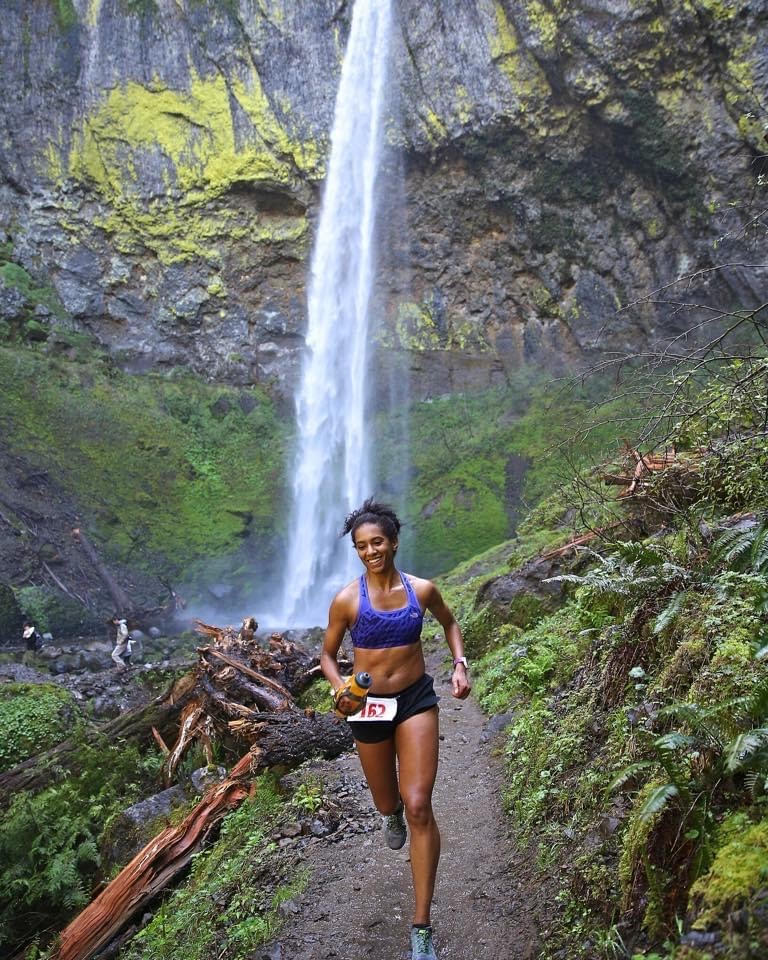
Gorge Waterfalls 50k
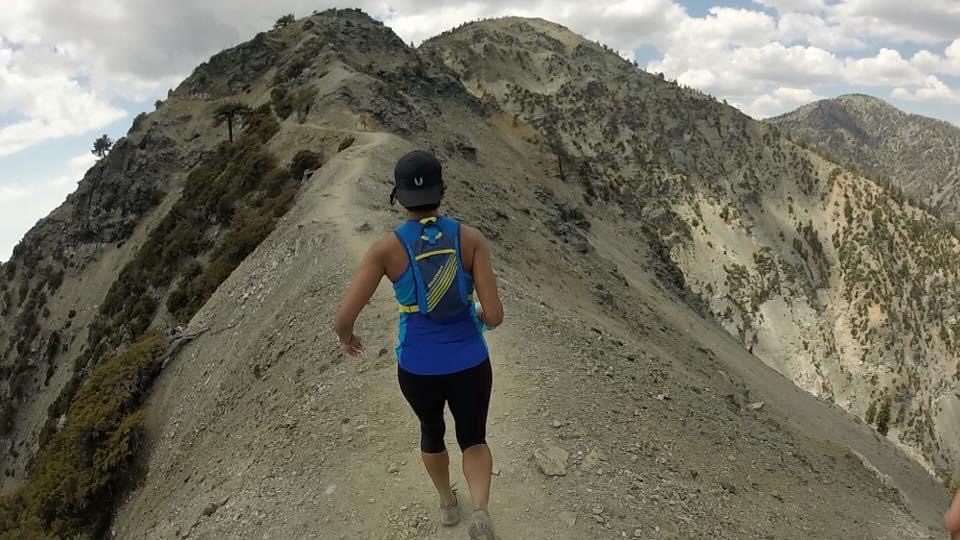
Many road races, trail runs and adventures later, I’d settled into this kinship with nature, this harmony within myself in the wild, but to my new group of predominantly Black running friends (and more than a few concerned family members), this enchanting world was a place of fear, unease and exclusion. So, I ran our local GA trails, the buttery ridgelines of Marin Headlands, the arid beauty of Utah, past lush forests and waterfalls in Oregon, up the exposed backbone of Mt. Baldy and over the root laden rolling hills of the Smokies alone.
Over the years, between work and relocations, adulting and a baby, I’ve managed to corral and convince some of my Black run buds to hit the trails in meetups I’ve called Urban Wanderers. This group is open to everyone, but was initiated with the very clear purpose of diversifying the outdoors. Forward movement has been slow and sporadic, but just like my own running journey, hard times have opened new doors. Covid-19 coupled with a national reckoning on race has driven us out of “quarantine”, unhealthy spaces, unhealthy mindsets and into the wild. After a furlough and job loss due to Covid-19, I again returned home to GA (baby and fiancé in tow) and have purposefully used the trails to regain my physical strength and inner peace. Again, I’ve been able to regain my voice in the community and am positioning our right, our need and our reclamation of wild spaces in ways that I would have never thought I could.
Because in many ways, the urgency of the wild itself speaks to me and those who will listen. It tells us that we disconnect or disrespect these spaces at our own peril; that to be excluded or deny ourselves their beauty is shameful. Running in the wild has shown me that the reward of running wasn’t in any specific achievement or accolade. The magic was in the empowerment found in resisting and overcoming my circumstances. I’ve often been wary of attempting to be some sort of influencer, but there is a great importance to owning our narrative. I run to hopefully spread joy and opportunities to my peers and to pass down more courage and less fear to my daughter. All of ‘us’ who carry the joy and the “burden” of representation these days cannot begin to imagine the struggles of our ancestors whose lives’ have shaped our current reality, yet there is a kinship in our common search for joy and freedom. We now have the power to shape our lives and our stories.
Ironically, out of the horrors of slavery came perhaps the greatest trail running story in American history- that of Harriet Tubman, an epic female hero if there ever was one. She made a 90 mile trek to freedom only to return to slave country over thirteen times to save others. This ain’t new for us. Tens of thousands of preserved runaway ads, tell a story of terror but also of courage. Men and women running with little more than the clothes on their body. They carried cornmeal cakes wrapped in cloth for sustenance, their shoes were stiff boots, tattered cloth or none at all.
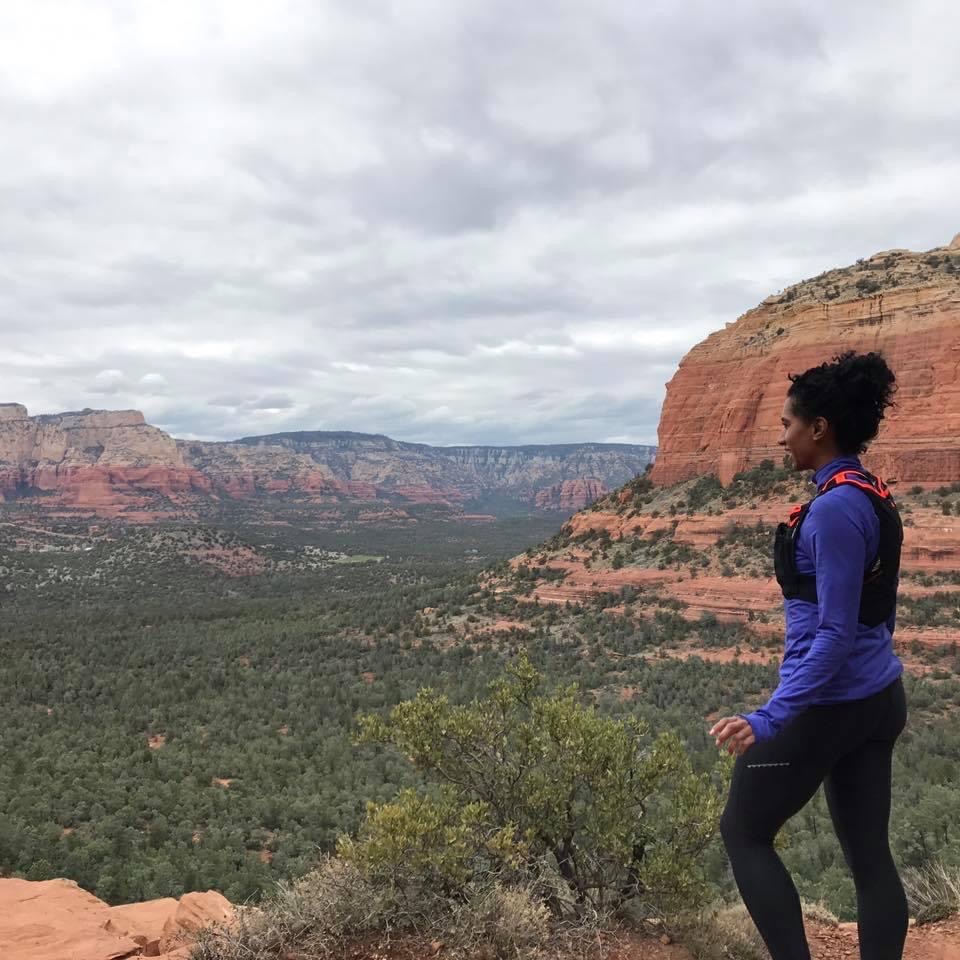
Overlooking Sedona, Arizona
I run the same Georgia red clay that my people’s ancestors self liberated on. Sweat ran down their breasts, past round thighs and strong legs like mine and into the dirt. Their gaze carried past endless rows of cotton, and maybe there was some small joy they dreamed about, the way that I dream of mountains. Something that made them also feel alive, happy…human. I am blessed beyond their wildest dreams largely because of what running has given to me. Though there was and will always be a fear factor, Ours is a triumphant story of freedom in wild spaces that we must own and build upon. I’m grateful for the opportunity to share my story and bring others toward that freedom.
Maurya Lacey (she/her/hers) is a mom, reformed road runner, and nature frolicker who spends way more time than she should behind her laptop working in communications & marketing. Maurya leads an Atlanta, GA meet-up, Urban Wanderers, which is welcome to all but is intentional in creating inviting, fun and safe spaces for BIPOC runners to get out on the trails.
For too long, wilderness narratives have focused on the lone (often white) maleexplorer pitting himself against the elements.
Through the Women’s Adventure Scholarship, we sought to elevate and amplify the stories of wild women. The essays written by the three recipients of the 2021 Scholarship set these experiences in stark relief, balancing the fears and challenges of their personal experience with celebration of what it is to be a woman in the wilderness . Take these words and go forth inspired!
Angie Madsen tried to take life seriously, but ended up laughing instead. By day, she creates programming that helps youth girls become brave and confident in the outdoors. In the 5 to 9, she’s your period hype girl, teaching you to fuel your adventures by harnessing the power of your menstrual cycle. Even when she’s working, she’s secretly playing! See what Angie’s up to at www.TheHormoneHacker.com.
Angie is the recipient of the Sawtooth Backcountry Women’s Trip scholarship. We are both excited and honored to share her words here. Read her essay below.
To be a woman moving through wild spaces is to carry a backpack of items you didn’t ask for. Sure, we squeeze in our Ten Essentials, anti-chafe salve and the best of the best snacks (cheese and chocolate, duh). But, stuffed in the gaps between all our tangible gear, you’ll find the invisible items that weigh our pack down more than you’d notice.
You know what you’ll find in my pack?
The echoing words of the man who took my parking fee and scolded, “I worry about seeing girls like you outdoors alone.” (Even though girls like me are more competent on the trails than boys like him.)
The glaring label of a “tease,” because I just wanted to be friends with the male guides.
The ache from the time a customer on my raft pulled me by my ponytail to dunk me in the water, after he told his group of boys that they didn’t actually have to listen to my safety rules.
The self-consciousness when I wonder whether a climber will see my hot pink nail polish and not trust me to hold the rope.
The jaded sigh of explaining, for the hundredth time, that a menstrual cup isn’t gross.
The silent fuming of attending a search and rescue meeting– indoors, in a classroom– and getting a lengthy explanation from a man about why I couldn’t wear those jeans if I ever went hiking.
The disappointment during a swiftwater rescue course scenario when, being the only woman, my higher-pitched commands were drowned out by the chatter of the men who decided we didn’t need a group briefing, after all.
Finally, there’s the worst weight of all that I carry in a male-dominated wild space: The pressure to represent all women. That if I mess up, it’s proof women don’t belong here. That if I have an off day, it’s just evidence that women and girls can’t be as strong, fast or worthy of the sport.
But you know what? All of those undesired items that I carry in my pack were created and put there by society. They’re not who I really am– who we really are, as women. The integrity of a woman in the outdoors is about what’s underneath the tanned (okay, burnt) skin and dirty fingernails. When I finally shrug off my dusty pack at the end of a long day, those burdens are cast aside and what I’m left with is my raw biology.
It’s a biology that holds nature’s secrets and whispers them to a select half of the population (shhh, don’t tell). A body whose rhythms and cycles parallel those of Mother Earth; just as the earth has four seasons, so does my hormonal ebb and flow. (And if that isn’t the coolest thing since zero-drop trail shoes, I don’t know what is.)
My innate nature gives me the superpower to tune so deeply into my connection with the planet that sometimes, I can’t tell where my body ends and the trail begins.
As a woman, when you shake out your well-worn pack and let the gear tumble to the floor, you discover the wild elements that you’re left with and can’t separate from yourself. To be a woman in the outdoors is to be the outdoors.
It took me far too long to realize that magic. I grew up thinking in terms of black and white as I attempted to learn my place in the world. In my naive eyes, you were girly, or you were a tomboy. You were tough, or you were weak. You could be shy or brave. You’d become an expert or never be good enough.
The comments and media I absorbed as a girl fueled the false dichotomies my brain forged. I came to believe that I could either be bossy and powerful, or quiet and submissive. Dresses and mascara, or jeans and bare face. Either/or, no Option C. So, I ignored my womanhood altogether, and for a while, I lost my path.
What brought me back to my inner wild was being in the literal wild. Through trail running, paddling and mountaineering, I reconnected with the part of me that I had stifled in my attempt to be taken seriously.
Now? I thrive in the beautiful in-between. I adore the feminine, intuitive, creative side of myself who pairs up with the masculine, direct, goal-driven side of myself when I head into the wild.
I wear sparkly earrings as my shoes pound singletrack and my sweat soaks my tank top. I bleed on my period as I tighten my crampons and grab my ice axe. I carry knives and matches alongside flowy skirts and that weird all-natural bright red lipstick I love. This in-between is my Happy Place.
When I’m outdoors, I feel a delicate ferocity in my soul. It’s to be a kaleidoscope of contradictions, a fluid collection of traits that changes daily, seasonally, and at times unpredictably. A shifting spectrum of all kinds of wonderful things that can’t be qualified, quantified or tamed, as much as 9-year-old me had thought otherwise.
So yeah, moving outdoors as a woman might mean that my pack is more cumbersome than expected. But the extra work for the glorious payoff? It’s worth it to me. I’ll carry this heavy pack for five thousand miles if it means future generations will bear a lighter load.
Read the other Women’s Adventure Scholarship winner’s essays and check out a month’s worth of conversations with badass women on our Women’s Adventure Scholarship 2021 page.
For too long, wilderness narratives have focused on the lone (often white) maleexplorer pitting himself against the elements.
Through the Women’s Adventure Scholarship, we sought to elevate and amplify the stories of wild women. The essays written by the three recipients of the 2021 Scholarship set these experiences in stark relief, balancing the fears and challenges of their personal experience with celebration of what it is to be a woman in the wilderness . Take these words and go forth inspired!
Bruna Moscol was born in Lima, Peru. Chasing the American dream, her family immigrated to Miami, Florida when she was 10. She then grew up under the Florida sun, calling the beaches home. At age 20, she moved north for college and discovered – and fell passionately in love with- the mountains. She has been running uphill ever since.
Bruna is the recipient of the Rendezvous scholarship. We are both excited and honored to share her words here. Read her essay below.
To be a woman athlete in the outdoors is to exist as a creature society has deemed an impossibility. “Women are like flowers,” they say. Beautiful. Delicate. Weak. Women must be kept inside- “like a gift”- they say, like something precious. Bound in a cocoon of protection, women were historically kept inside. Caged.
To be a woman in the outdoors- running, climbing, swimming, paddling her way through- is to break free from this cage. To be a woman moving swiftly on her own physical capabilities through the physical challenges of the very physical world around her, is to be a creature that lives life on her own terms. It is to claim her existence as her own. It is a way for her to find her power.
— If you would have told a 10-year old little girl version of me that by the time I turned 26, I would celebrate New Year’s Eve by camping, alone at 16,000 ft, on a way up a mountain that was 23,000 ft, in well under 0F weather and covered in snow, I would’ve stared at you like you were crazy and asked what snow even felt like.
I was born neither a natural athlete nor into an athletic or even outdoorsy family. And worse for any adventurous inclinations my little heart may have harbored, I was also born a girl. A shy, slightly overweight, and sickly asthmatic child, I spent months out of the year in the hospital- and when out of the hospital, was treated like glass. Breathing was a problem. So were sports. Out of breath quickly, I learned very early on to loathe all things physical: my P.E. class, dancing, a game of tag. The fact that I was a girl made this loathing even more convenient: better stay inside anyway lest I dirty up my dress. A life of adventure and athleticism was the last thing the cards seem to have in store for me. But as life would have it, a life of adventure and athleticism was exactly what became of mine.
— “We’ll run 6 miles around the river,” my friend explained nonchalantly.
“I can’t run 6 miles around the river,” I replied, alarmed.
I was 20 and had grown up the way I had been raised: far from even the slightest trace of adventure. I had never run 6 miles. I hadn’t even ran 2. It was winter and snowing outside and it was the first time I was seeing snow. “Why can’t you run 6 miles?” my friend insisted. Was he stupid? I couldn’t because I couldn’t. Because my body was not meant to. My legs not strong. My lungs not capable. My heart not made for it. And finally, I couldn’t because I was a woman, and my friend was a man. He was strong, I was delicate. He could, I couldn’t. But through a combination of peer pressure, a fear of missing out, and a dash of bravery I went. A couple of hours later, I had completed my first ever 6 mile run. No one more surprised than me.
What is it Like to be the Weaker Sex?
Up to very recently, they called us women the weaker sex. Our dreams of adventure brushed aside- “You don’t want to get hurt,” they’d said. Our accomplishments, belittled. “Well she ran, but it was slower.” Women are taught, from a very early age, that the outdoors and especially the world of adventuring, is a world that belongs exclusively to men. Women are delicate. Women are fragile. Women must be kept inside.
This is incorrect. As the outdoors would teach me in time, a snowy mountain does not care about your gender, neither does a swift river. The world cares only about bravery, and women are brave. Women are not weak.
More adventures followed that first snowy 6-mile run. Four years later, at age 24, I would sail 6,000 nautical miles across the Pacific Ocean; pulling lines (nautical for rope) with hands as rough as fisher-men’s. In five years, I would carry ⅓ of my body weight up 16,000 ft of altitude across the Andean mountains; my body carrying the same weight as my male companions, no need for extra help. Six years after that first run, I would attempt my first giant mountain, 23,000 ft, solo and unguided, in a 3-week mixed terrain climb. I was the only solo female climber on the mountain. Seven years, and I would paddle all 80 big water rapids across the Colorado River, 19 days on the water. My female arms thick from pushing the massive oars. By year 8, I would run my first 26.2 miles in a historic Spring-time hailstorm, the water way past up my ankles, the hail covering me cold.
— Women are not weak, but we have been taught (incorrectly) that we are. Together, we can break free from this false sense of weakness, from our own taught fears of inadequacy. And in breaking free from this cage, we find our power. And in finding that power, we help others break free from their own cages as well. To be a woman- running, and climbing, and swimming, and paddling- and jumping, and skipping, and rolling, and laughing, and falling, and crying, and persevering in the outdoors, is to be a creature that society, once, deemed impossible. It is to stand on your own capabilities, to claim your body as your own. To be a woman in the outdoors is to break out of that cage and live life bravely. It is to realize you’re not weak at all- what you are is courage.
Read the other Women’s Adventure Scholarship winner’s essays and check out a month’s worth of conversations with badass women on our Women’s Adventure Scholarship 2021 page.
For too long, wilderness narratives have focused on the lone (often white) maleexplorer pitting himself against the elements.
Through the Women’s Adventure Scholarship, we sought to elevate and amplify the stories of wild women. The essays written by the three recipients of the 2021 Scholarship set these experiences in stark relief, balancing the fears and challenges of their personal experience with celebration of what it is to be a woman in the wilderness . Take these words and go forth inspired!
Aspire crew member Kara Folkerts running on Emerald Ridge, Mt. Rainier
THE 2021 WOMEN’S ADVENTURE SCHOLARSHIP APPLICATION PERIOD LAUNCHES SATURDAY, MARCH 6TH.WELL OVER 200 WOMEN APPLIED FOR THE SCHOLARSHIP IN 2019, AND WE WERE OVERWHELMED WITH THE POWER OF THEIR INSPIRING WORDS, STORIES, AND EXPERIENCES. OVER THREE BLOGS, WE’RE SHARING ANSWERS TO SOME OF THE APPLICATION QUESTIONS TO RAISE THE STOKE AND INSPIRE OUR NEXT ROUND OF APPLICANTS.
One of our leading questions in the application was “Why do you love to run?” The answers were dynamic, yet clear themes emerged. Read on for reflections on empowerment, clarity, community, freedom and processing emotion.
Empowerment:
“Running makes me feel embodied; I can turn off the mental chatter and drop into something that feels more primal, empowered, and life affirming. I am in touch with my needs in a more intuitive way, and I feel free to be myself.”
“I am often moved to tears after a tough race because I’ve pushed myself beyond what I thought possible and can’t put into words the feeling I have when surrounded by other inspiring runners.”
“It frees my soul! While I am running, it is just me and my thoughts, pushing my body, feeling how capable I really am. Running boosts my confidence and makes me feel like I can do anything.”
“The challenge of running proves to me that if I don’t give up on myself I can do hard things and I am enough.”
“In a world that tells women they are wrong or not enough, I run, and the sound of my feet on dirt quiets the noise. When I run, I see clearly who I am. Lost pieces of myself are found. When what is lost can’t be retrieved, I run, and discover a new facet of myself that settles in and takes up the empty space”
“There are so many times I think, “You can’t do this,” and every time I do it! It makes me feel so proud of myself.”
Mental Clarity:
“I love to run because it creates a flow state where I can experience joy, solve problems, deeply present-time connect, and create a stronger more relaxed version of myself. Running is a portal that can give entry into new states of physical and mental wellness. It is a gift to be able to run.”
“I love running because it is a form of meditation. When I’m running, there are no other distractions, the busyness of life falls away. The euphoria of running is long lasting; running represents a life long lesson of endurance and accomplishment.”
“Running frees my inner spirit. Keeps me grounded and is my personal time.”
“Running is my therapy, my reset button. No matter what else is going on in my life, I always feel better after a run. It has allowed me to continuously test my physical and mental limits, something I continue to push one race at a time.”
“I love the way it calms my anxiety and centers my soul like a moving meditation.”
Connection to the Natural World
“I go to the trails like one would go to church– I go to find meaning, purpose– to absolve my sins, to give thanks, to be renewed, reborn, to celebrate the Earth, and the joy of being alive”
“When I run, I connect to the world around me. My body calms, my brain quiets, and I understand life in a more intimate and empathetic way. I feel a rhythm simultaneously grounding and energizing..
“I love to run because it’s an exciting, challenging, and fun way to explore all types of outdoor spaces from mountains to local trails.”
“I love the fresh air and seeing the world in new ways as though every run is an opportunity to explore.”
Processing Difficult Emotions:
“It makes me feel free. Three years ago I left an abusive relationship. Trail running healed me. Those long runs forced me to work through some tough moments. They showed me I was strong. I can do whatever I put my mind to.”
“I grew up with alcoholic and verbally abusive parents. Running granted me a safe mental space and a healthy platform to foster my entire life. As I got older I saw my sister turn to drugs and alcohol. I turned to my running to deal with the same issues. When we both lost our little sister to drugs and alcohol, I was able to survive, grieve, and grow through running. I love running because a long run can break me down to my lowest self and at the same time allow me to rise above to my most resilient being. Running has made me who I am today and for that I love it most.”
“It has kept me sane through my mom’s cancer, my husband’s addiction, having a baby, my divorce, and now my life as a single mom.. Running has always been there for me.”
“I discovered trail running last year during an especially dark time in my life when I was battling my anxiety and OCD demons. I felt powerless and trapped. Seeing a therapist began to help, as did medication. But it was still enveloping my life in a constant darkness and dread. That was exactly when my trail running brother suggested I try it out and just sign up for a race. I was desperate, exhausted by this battle. So on a whim, I decided to thrust myself head-first into the unknown world of trail running. Since then, I have not only become acquainted with the ins and outs of this crazy beautiful sport, but I have learned so much about myself. I LOVE running because it makes me feel free, it makes me feel alive. It heals my soul and quiets the demons in my mind. Trail running has become such an integral part of who I am, and where I find great peace and happiness.”
Community:
“Running brings people together with this weirdly deep and instant bond. It exposes us to each other in ways we wouldn’t on our own, and opens us up to understanding people we may not have otherwise. Weirdly, it also divides. It separates the world into “runners” and those who think we are crazy, but it is through this division I find a place where I belong.”
“Sharing time with each and every runner, learning their dreams and struggles have allowed me to connect to a world beyond measure. Many of these runners have become close friends as we share stories of our lives as we run through trails, ascend mountain tops and cross finish lines together. We cheer each other on and become each other’s confidants.”
“Running is where I’ve met the strongest and most compassionate women, who love hard trails as much as cold beers afterwards.”
“Running brings out something in all of us. Something that pulls us together, something that helps us mourn together, something that helps us feel joy together. I love running because it has shown me just how easy it is to learn about others–just how easy it is to be kind and love others.”
“I love and appreciate the inclusive community around trail running – and how we all have moments of digging deep and discovering something within ourselves to motivate and inspire us – but we also don’t take ourselves too seriously; we enjoy high fives and silliness on the trails while encouraging each other to do what feels impossible at the time. We celebrate each other’s successes – no matter how seemingly small – and take care of one another when something gets in the way of running.”
“I run to be part of a community because I know that the pain, joy, boredom and triumph I experience are equally felt by the people I share the trails with. Our differences are superficial. Our capacity for growth is equal and immense”
“The people I have met and spent time with on the trail have changed my life for so much the better.”
Freedom:
“Running is a way for me to feel alive. With all the challenges and pain in the end I always feel euphoric. I run because it helps me feel everything.”
“It’s my time to run around “off-leash,” to escape the desk, the chains of responsibilities, and be free.”
“It is the one thing I do that makes me feel free and present. Life is filled with obligations and expectations, but when I am running, there is nothing looming ahead- all I’m thinking about is the rhythm of my steps and the motion forward. The power running produces has totally changed my life in this way.”
“I love to run because running is life to me. It is when I feel the most free and alive. One foot in front of another, deep breaths, a hundred thoughts going through my mind every minute. I feel invincible and vulnerable all at the same time.”
OUR HOPE IS THAT THE WORDS AND EXPERIENCES SHARED HERE INSPIRE 2021 APPLICANTS WHO ARE READY TO SHARE THEIR STORIES AND EMBRACE THE FRIENDSHIP AND COMMUNITY THAT COMES FROM BACKCOUNTRY MILES.
Thinking of applying for our 2021 Women’s Adventure Scholarship?!
Scholarships are intended to support individual female athletes venturing into wild spaces. Our hope is that as scholarship recipients share their stories of adventure, they will contribute to inspire and grow the culture of female-focused wilderness exploits.
THE 2021 WOMEN’S ADVENTURE SCHOLARSHIP APPLICATION PERIOD WILL OPEN ON MARCH 6TH. MORE DETAILS TO COME SOON!
Aspire’s All Women’s Trips
All Women’s Trips are a celebration of community and connection shared among women who love and aspire to play in the mountains. Each stunningly beautiful trip is enhanced by the uniquely awesome vibe of ladies-only adventures.
Two women covering ground on the high ridges of the North Cascades Traverse.
The 2021 Women’s Adventure Scholarship application period launches Saturday, March 6th.Well over 200 women applied for the scholarship in 2019, and we were overwhelmed with the power of their inspiring words, stories, and experiences. Over three blogs, we’re sharing answers to some of the application questions to raise the stoke and inspire our next round of applicants.
One of our leading questions in the application was “What is your proudest running accomplishment?” The responses covered a lot of territory, highlighting personal and communal relationships with fitness and celebrating everything from simply lacing up and getting out the door to long distance ultra accomplishments. Read their words and get inspired.
“I completed my first trail ultra, the Bryce 50k Ultra 2 years in a row. The 1st time was with two other ladies and we were able to support each other throughout the day. The next year I did it alone a week after my dad died. That was a tough day! I felt completely drained emotionally at the start of the race, but throughout the day running alone I was able to emotionally process all the things my dad had done for me and taught me which was extremely therapeutic.”
“Coaching middle school runners so that they are able to experience that feeling of accomplishment, and being a role model to them, especially to the girls with low self-esteem. They learn they are strong, worthwhile and can make a positive contribution to a team effort.”
“I think almost every run has its own challenges and honestly I’m proud whenever I step outside and get going!”
“Realizing that my running is an inspiration to others. This makes me so happy.”
“Someone once told me that I would never be a ‘runner’. They claimed that I didn’t have “it” in me. I’m proud to say I have proved them wrong for over 10 years now… running (and winning a few), 5k’s, 10K’s, half marathons, a 25K, and even a full marathon!”
“My proudest running accomplishment is nothing noteworthy, but it has a lot of personal meaning. Last September, for the first time in nearly three years, I ran one mile. That mile was incredibly difficult, but finishing the run was a proud and freeing moment for me. I was nine months post-op from hip surgery to repair a labral tear. Years prior to that, I stopped running because of hip pain. I shifted my focus towards hiking, climbing, and weight lifting instead. Even after finally having surgery on my hip, I didn’t think I would ever start running again. I worked very hard throughout my recovery from surgery and by the time I was healed I felt better than ever. I built my strength and endurance back up, and in doing so I regained confidence I needed to start running again. I’ve run many miles since then, but I’m most proud of that first run because of the work it took to get me there.”
“This March I crossed the finish line of my first 50 miler with my mom by my side. She was an amazing pacer that helped me push through being sick the entire race from a good intolerance. She is now inspired to do her own trail race. She is signed up for her first ever marathon this fall. It feels amazing to inspire her. There was nobody else I would have rather shared that moment with. “
“Qualifying and Running the Boston Marathon in 2015 and 2016. This may seem like a short answer, but It would take a lot of space to actually describe why this meant so much to me. A lifetime of overcoming different obstacles and struggles made these two runs some of my proudest yet.”
“I have completed two 50 milers, seven 50k, and eight marathons but my proudest moment is actually watching my son become an awesome little runner himself. Passing on my love of fitness and the outdoors outshines all else.”
“I help coach an after school trail running program for elementary students and watching my trailblazers cross the finish line of their first 5k is my proudest running accomplishment.”
“Overcoming anxiety and trauma through running has been healing and inspirational. Running has been a snowball effect of accomplishing new goals, conquering old fears, and becoming a stronger, more confident woman.”
“1st place overall at Warrior Rush 24 hour obstacle race and my first 50 miler I finished first female and 8th overall”
“Every year for the last eight years I have run my age in miles near my birthday. I feel so lucky to have been healthy and strong enough to be able to keep up this tradition for so many years. I plan to continue as long as I can.”
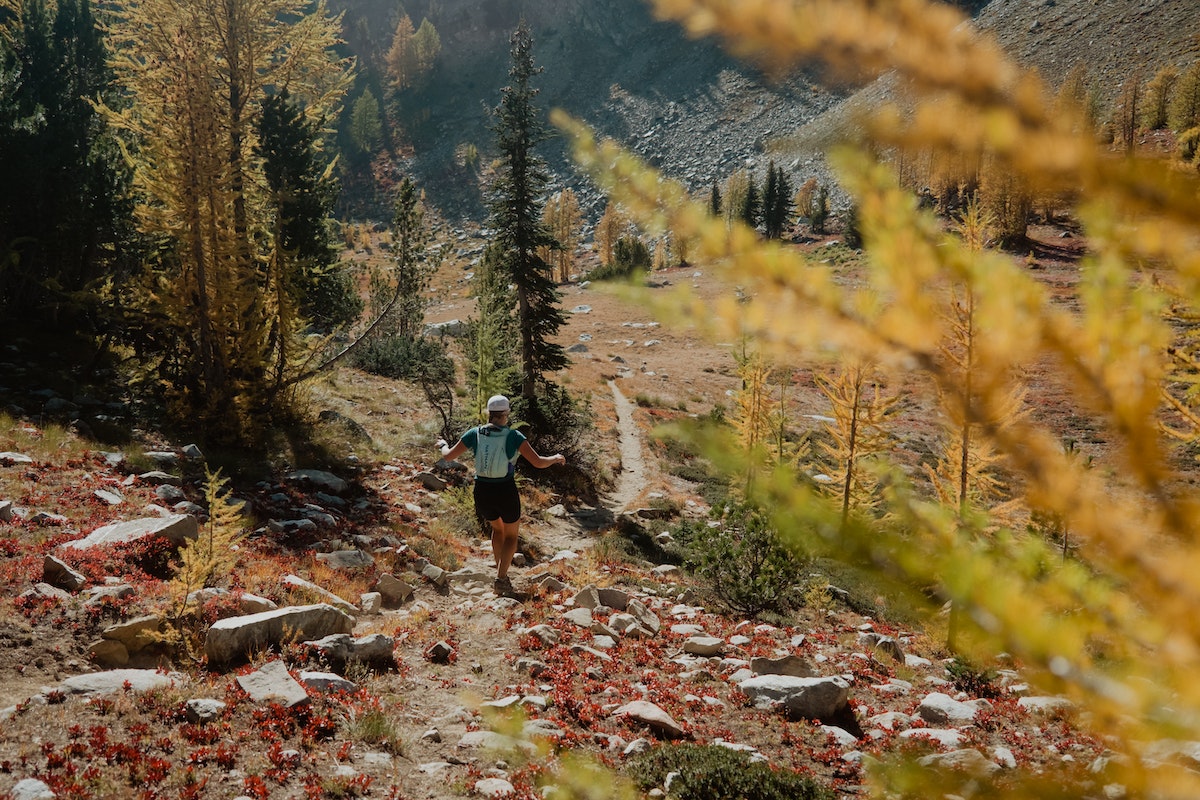
“Deciding to join my rad lady friends for an impromptu ultra marathon on the Pacific Crest trail from Harts to Rainy Pass during larch season! I hadn’t been back to that stretch in a while and it’s one of my favorites. It was great to see all the fall colors, nibble blueberries off of blood red bushes and run through golden larches with some of my favorite people in one of my favorite places!”
“Running a 24hr ultra, and my distance PR! It was my first 24 hour event, and though my previous distance PR was 34 miles, my goal was to see if I could hit 50 miles. With the encouragement from friends and wonderful strangers at the event, I ran 73 miles! I’m currently training for a non technical 100 mile race, and just the training alone is a huge accomplishment for me.”
“My daughter placing my medal around my neck after completing my first Ironman”
“Every single day, getting out and pushing my two year old in the jogging stroller. Sacrificing the trail runs I want to do for what’s available to me, and still finding joy in it.”
“Completed the Appalachian mountains first 200 mile race this January.”
“So far, my greatest accomplishment is that I’ve been able to run so well and increase my pace Running safely and happily through my entire pregnancy, including just hours before giving birth to a healthy baby boy!”
Our hope is that the words and experiences shared here inspire 2021 applicants who are ready to share their stories and embrace the friendship and community that comes from backcountry miles.
Thinking of applying for our 2021 Women’s Adventure Scholarship?!
Scholarships are intended to support individual female athletes venturing into wild spaces. Our hope is that as scholarship recipients share their stories of adventure, they will contribute to inspire and grow the culture of female-focused wilderness exploits.
The 2021 Women’s Adventure Scholarship application period will open on March 6th. More details to com soon!
Aspire’s All Women’s Trips
All Women’s Trips are a celebration of community and connection shared among women who love and aspire to play in the mountains. Each stunningly beautiful trip is enhanced by the uniquely awesome vibe of ladies-only adventures.