A runner passes through meadows on the Wonderland Trail.
9,000: The estimated number of years Indigenous communities have been living in regions surrounding Mount Tahoma (settler name: Mount Rainier).
6: The number of regional tribes that experience Tahoma as kin: Puyallup, Nisqually, Cowlitz, Squaxin Island, Muckleshoot, and Yakama.
6: The different Indigenous naming variations of the mountain: Tahoma (“mother of waters” or “the place where the water begins”), Tacoma, Tacobeh, Pooskaus, Ti’Swaq. Tahol, “Mother of Waters. “Snowy Peak.” “The source of nourishment from the many streams coming from the slopes.” (There are more.) Myths surrounding the mountain include floods, Coyote running to the peak for refuge from encroaching gush of water (there are more).
1792: The spring during which Captain George Vancouver sailed into the Puget Sound and named the large mountain in the distance after his comrade, Peter Rainier, an “unremarkable eighteenth-century rear admiral” who fought in the Revolutionary War, fought actively to squash the revolution. This man would not be mistaken as a god.
0: The number of times Peter Rainier, colonizer namesake of Mount Rainier, ever stepped foot in the Pacific Northwest, ever saw Tahoma with his own eyes, ever cried at its majesty, ever dropped to his knees in trembling prayer, humbled by its glaciated heft. Ever. Never.
2 out of 100: The rating for Rainier Beer on RateBeer.com, a cheap, forgettable lager that, until recently, was brewed in Irwindale, California, still named Rainier, still named after a sorry red coat counterrevolutionary who, lest we repeat, never stepped foot in the Pacific Northwest.
0: The number of times Indigenous peoples are acknowledged in the “Origins” section of Irwindale, California’s city government website, a city that brewed for decades with stolen water this unexciting lager improperly named after a stolen mountain in the Pacific Northwest, a name of a counterrevolutionary who never even saw the mountain, never smelled the land, never met or listened to any of the many tribes living there, never knew the rich tapestry of human and nonhuman communities calling this mountain home, its surrounding bounty of land, air, and water, for thousands of years before his royalist birth.
1833: The year Dr. William Fraser Tolmie, a Scot working for the Hudson’s Bay Company, decided he’d travel inland to the base of Tahoma for a “botanist excursion,” which he did, making him the first European ever to reach the mountain’s base, successful only due to the deft guidance of two Indigenous huntsman, Lachalet (Nisqually) and Nuckalkat (Puyallup).
1870: The year of the first known summit of Rainier, August 17. Hazard Stevens and Philemon Beecher Van Trump. Sluiskin, a Yakama hunter living with the Upper Cowlitz, guided the men, thinking them fools for wanting to summit. Mountains are gods meant to be left alone, to be respected. Sluiskin was not happy with their intentions of conquest, as this peak housed a lake of fire at the top where a demonic spirit resided. He begged them not to scale the mountain, but the mountaineers continued, unabated, and conquer they did.
400+: The estimated number of bodies, hikers and climbers, held dead on Tahoma’s slopes since the first summit.
1899: The year, on March 2, when President McKinley established Mount Rainier National Park, America’s fifth park. (1: Yellowstone, 1872, STOLEN; 2: Sequoia, 1890, STOLEN; 3: Yosemite, 1890, STOLEN; 4: Rock Creek, 1890, STOLEN).
1907: The year workers broke ground on the Wonderland Trail.
130-140: The number of miles planned when building the original Wonderland Trail.
1915: The year the Wonderland Trail was finished, just in time for the Mountaineers Annual meeting.
1917: The year the US government, through eminent domain, demanded Nisqually land for Fort Lewis, Washington, fifty miles west of Tahoma.
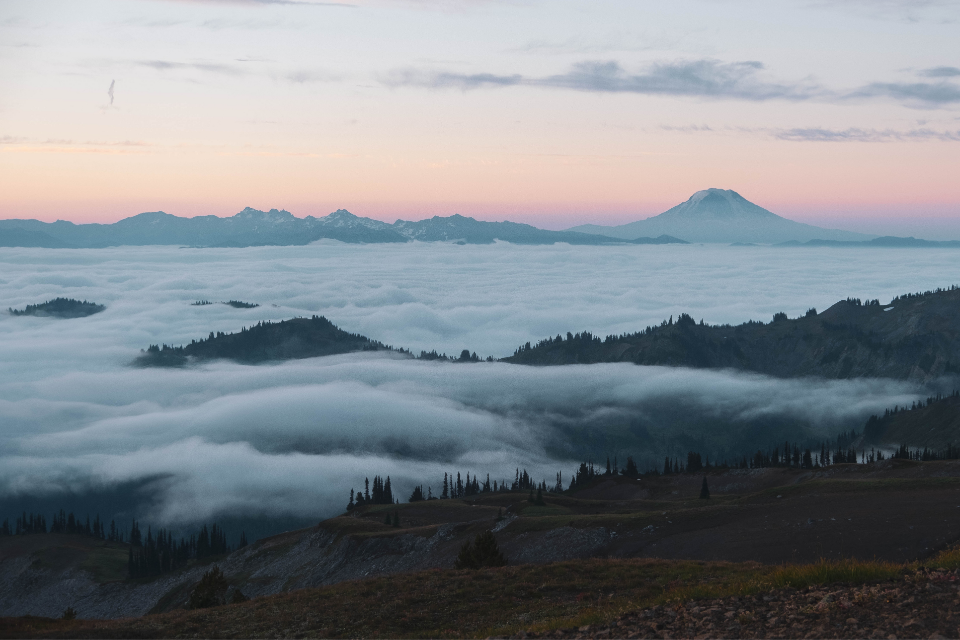
Looking out from the shoulder of Tahoma (Rainier) at Pahto (Mt. Adams)
1920: Year the Wonderland Trail was officially branded by the park’s superintendent, mainly for marketing purposes to position Rainier as a tourist destination.
32: The number of Marines killed in 1946 when their plane crashed into the South Tahoma Glacier. They remain entombed to this day.
9: Number of shiny UFO objects witnessed by the pilot Kenneth Arnold zinging through the sky on June 24, 1947, the first of many extraterrestrial accounts that now surround the volcano.
2 million: Visitors to Mount Rainier Park annually.
10,000: Number of average Tahoma summit attempts.
50%: Percentage of successful summit attempts.
1.9%: Percentage, in 2019, of Washington (another colonizer naming convention) residents who identify as American Indian.
29: federally recognized tribes in Washington State.
1,122 inches: total snowfall on Mount Tahoma in 1972.
266 inches: total snowfall on Mount Tahoma in 2014.
105: degrees Fahrenheit recorded this June in Longmire, a record.
2015: The year Mount McKinley was returned to its traditional Koyukon Athabascan name, Denali.
0: The number you will find on East Rutherford, New Jersey’s city government website any mention of the Indigenous Munsee Lenape, who originally inhabited this area of New Jersey now colonized and established in 1894 as East Rutherford, about the same time Mount Rainier became a national park, 2,885 miles west.
43 – 8: The final score of the 2014 Super Bowl, held at the Metlife Stadium in East Rutherford, New Jersey, between the Seattle Seahawks and the Denver Broncos, the year the Washington State Senate temporarily changed the colonizer name of Mount Rainier not to one of several Indigenous names of the volcano, but to this:
Mount Seattle Seahawks.
Nicholas Triolo is a writer, long-distance runner, and Wonderland guide for Aspire (2016-2018). He holds a master’s of science in environmental studies from the University of Montana, where he was senior editor for Camas Magazine. Triolo currently works as Digital Strategist for Orion Magazine, and is based in western Massachusetts. He is former associate director for the Todos Santos Writing Workshop and co-facilitator for the Freeflow Wilderness Writing Institute. His writing, films, and photography have been featured in Orion, Terrain.org, Best American Poetry Blog, Juxtaprose, Trail Runner Magazine, Patagonia’s Dirtbag Diaries, and others. More at: nicholastriolo.net
“Who goes on Aspire trips?” It’s a question we hear often. The truth is, the runners who show up for our trips come from diverse backgrounds and bring a wide range of running and mountain experience with them to the trails. We all relate to mountain spaces in unique and personal ways. We are excited to add some depth to our response to the “Who?” question with the Aspire trail runner profile series. We’ve enjoyed hitting the dirt and building friendships with these runners on our trips, and we think you’ll enjoy hearing their stories!
Name: Rachel Beda Age: 45 Hometown: Seattle, WA
Thanks for sharing your story with us for the Aspire Trial Runner Profile!Which Aspire Trips have you participated in?
Stehekin 2018 and Wonderland 2020
Describe your experience, background, and enthusiasm for running and/or wilderness and backcountry experiences?
I started trail running during medical residency 17 years ago and it never, ever gets old. Wilderness is my meditative, sacred place, and I feel the most at peace and alive while I’m moving through it on my own two feet. A busy work and family schedule means running is the most efficient way to get the most views in the shortest amount of time.
I’m not fast – I hike the uphills and then love to bomb the downhills. I am typically mid-to-back-of-the-pack at trail races and on Aspire trips. What I lack in speed, I make up for in enthusiasm!
I don’t have many running buddies – my friends are either short-distance hikers, or genetically gifted speed demons that I can’t keep up with, so I’m typically running alone. I’m comfortable running alone, but I really appreciate the safety net Aspire provides. It’s allowed me to go deeper into the wilderness than I would be comfortable doing by myself.
What questions, concerns, or unknowns did you have going into your trip? How were they resolved?
I was afraid I wouldn’t be fast enough for the group. I shouldn’t have worried. It’s not a race and there’s no pressure.
For Wonderland, I was concerned I wouldn’t be able to do 3 long days back-to-back-to-back, and Abram worked with me to make a modified itinerary that worked for me.
I was afraid it would be all young gunners and I would be too old. It was actually a great mix of all ages.
How did you prepare for your trip? Given your experience would you prepare differently, if so how? This can be answered in terms of fitness and/or gear.
For Stehekin: I did long trail runs of up to 16 miles with plenty of vert, and weekly mileage of about 20-25mi and it worked great since there is a day of rest at the Ranch between run days.
For Wonderland: I increased my mileage to 30-35 mile weeks including some long trail runs of up to 18 miles with vert, peaking at a 40mi week. Spoiler: it was NOT enough, and I rode ahead in the van on day 2. For next time (oh yeah, I want to go back and get it all next time!!!), I would aim for more 40 mile weeks, and I would schedule a back-to-back trail weekend of at least 15-20 mi/day + 4000ft of gain on both Sat and Sun. If you are a shorter-distance runner like I am (25k races are my favorites), do not make the mistake I did of underestimating the legitimacy of that amount of vert on day one (9700ft of gain from Longmire to Mowich).
I highly recommend using hiking poles for the climbs and bringing a lightweight water filtering method so that you can minimize water weight.
What story or description would you give to represent the group dynamic on your trip?
Encouraging, supportive, and ego-free!
What was the most difficult moment and/or a surprising episode from your trip?
I was so excited as we started out on day 1 of Wonderland that I forgot to keep up with my nutrition and hydration in the first few miles, and I started to battle nausea around mile 7. By mile 21 I was dry heaving, and by mile 24 I had to lie down on the side of the trail. Kara, who was the sweep on the Aspire Team, was so incredibly patient, positive, and supportive. She GPS-texted ahead to camp and Ian from Aspire started out towards us with supplies in case I really couldn’t make the last few miles. Thanks to their help and encouragement, I was able to rally and make it 10 more miles to Mowich Lake and the rest of the group. Although I could have done without the dry heaving, it taught me that my strength and endurance is bigger than I thought. I also was blown away by the kindness, patience, and encouragement of the Aspire Team. If they could believe in me after only knowing me for one day, I could certainly believe in myself. That lesson is going to help me whenever the miles get tough in the future.
What info/advice/thoughts would you offer to someone considering signing up for an Aspire trip?
All the things I was worried about – ego, speed, pressure to perform, competition – none of that exists on an Aspire trip, clearly by design. Abram sets up the most supportive, chill, happy adventures.
As runners of wild spaces, trail runners boast an impressive repertoire of skills. One that seems to be missing? Sitting still. Following the lockdown and the initial host of “around my block” projects, many runners looked to the mountains for a sense of freedom and turned to Fastest-Known-Time (FKT) lists for a sense of competition and motivation. Enter Mt. Rainier and a season of “fastest known time” attempts on the Wonderland Trail.
A runner cruising towards Mt. Rainier on the Wonderland Trail
At 14,410′, Mt. Rainier’s dominating visage is both inspiring and intimidating. The tallest Cascade volcano boasts over 35 square miles of rock and snow with 26 glaciers, seven glacial rivers, and endless alpine meadows. While most known for its 150 years of recorded climbing history and an estimated 200,000 successful summit climbs, for trail runners, it is the trip around the mountain which beckons. 2020 saw an unprecedented season of time bending circumnavigations by trail runners as eight new records were set across varying categories of fastest known times on the Wonderland Trail.
Every August, the Aspire Adventure Running crew runs laps around Mt. Rainier, leading weekly trips of runners on a three day stage run of the Wonderland Trail. Our staff grows intimate with the mountain and deeply familiar with each curve of the trail; happy to share this knowledge with all those run, play, dance, and test their mettle on its rugged flanks. In 2020, that included not just trail runners, backpackers, and hikers but a number exceptionally fast runners with record breaking circumnavigation dreams.
Dawn at Panhandle Gap
North Face runner Dylan Bowman functions better with a goal to keep himself accountable. Bowman grew up in CO and spent time living and running in California before settling down in Portland only about a year ago. ” I’ve been blown away in general with how good the running is in the PNW. It’s really an amazing place to run and to train.”
When the pandemic hit and races were cancelled across the globe, he turned his attention to a fastest known time attempt on the Wonderland Trail. “With Hard Rock cancelled, the Wonderland made perfect sense. I’ve always wanted to do it… I would classify the Wonderland is the single greatest North American adventure run there is, basically. I’ve done Timberline, Rim2Rim2Rim, Ultra Trail Mont-Blanc, Western States. The sheer magnitude and beauty of the route; I don’t think there’s anything that compares. ” Bowman exudes.
Prior to this year, the supported Wonderland FKT was held by Ryan Ghelfi at 18 hours 27 minutes and 42 seconds, as reported on FastestKnownTime.com. But when Aspire’s course director Abram Dickerson rolled up to Longmire ready to send runners off on Day 1 of the season’s first Wonderland trip, he bumped into filmmaker Ryan Thrower. Later that day, at Mowich Campground, Abe ran into him again. Over the course of dinner, it came to light that Ryan was doing preliminary shot scouting to film Bowman’s upcoming FKT attempt. Three weeks later, on August 19th, Bowman rolled into his finish at Cougar Rock with a new record time of 16:58:41, knocking almost 90 minutes off of Ghelfi’s 2018 time.
Jeff Mogavero is a Missoula based trail runner and friend of Aspire with some quick legs. Earlier this year, he contributed a piece on his Lost Coast FKT for the Aspire blog. In 2018, he followed Dylan Bowman’s FKT on California’s Lost Coast Trail by knocking ~60 minutes off his time on the 57.6 mi stretch of remote coastline. In July of this year, Jeff set a since usurped FKT on Wyoming’s Teton Crest Trail. The first time I met Mogavero was in 2015, when I gave him a ride back to Bozeman, MT from a trailhead in the Bridger Mountains. We’d connected for a few runs through the sweeping Montana landscape, but I was surprised to receive a phone call from him in early August. Jeff would be out in a few weeks to gather beta on the Wonderland, preparing for a FKT attempt. Serendipitously, his schedule would overlap with ours. I assured him that if needed, we’d be happy to make room for his bivy at Aspire camp.
Trail beta and good food flows freely at Aspire camp at Mowich lake.
By the time Mogavero and I met up during his preliminary run, Bowman’s had been dethroned from his Wonderland FKT record. “[It’s] my claim to fame: set an FKT–it gets broken immediately. I did the Lost Coast, the Loowit, 3 Sisters, all broken just a few days later,” Bowman half laments, half jokes. Just five days after Bowman set a supported record, Tyler Green, a Portland area runner with 12 postings on fastestknowntime.com, dropped Dylan’s time by 18 minutes. This brought the time to beat to 16:40:55.
Preparing for his next day of beta in Aspire’s camp at Mowich Lake, Jeff asserted cautious confidence towards the 10:45/mi average pace required to best Tyler’s new record. We dished him up a plate of spaghetti as a thanks for help schlepping gear and wished him all the speed God could give. Hardly the only person to have his plans interrupted by the unforeseen in 2020, Mogavero eventually had to scrap his FKT attempt due to the thick smoke and fires of mid-September.
On August 26th, two days after Tyler Green reset the overall supported record, Issaquah based runner Kaytlyn Gerbin went out for her own fastest known time attempt on the Wonderland Trail. Something of a legend in the Pacific Northwest, if not beyond, Kaytlyn holds FKT’s on Washington’s Ptarmigan Traverse and the Mt. Rainier Infinity Loop, a course that includes a run of the Wonderland connecting not just one, but two summits of the mountain. “A lot of emotional energy has gone into the mountain in the last few years. Every year, I’m looking for a new style to get on the mountain.” Gerbin shared.
Even with her intimate knowledge and experience on the trail, there’s no getting around the challenge of the terrain the Wonderland presents. Fortunately, the Wonderland doesn’t deal out punishment without ample reward.
“All the sections were pretty hard. I caught sunrise at Golden Lakes, and I love the views of Rainier there. It feels pretty remote. Then coming into Sunrise was an awesome section for me. I had friends who had gone out to take photos and told people in the area what I was doing, so I had a lot of strangers waiting for me to come through and cheering. That was such an empowering moment.”
“I hit a pretty good low up above Panhandle Gap… three-quarters of the way through… you get into some altitude and we had no cloud cover, baking in the sun exposure. I did that section with Alex. We had such strong memories and that helped.” Kaytlyn’s pacer and friend, Alex Borsuk, shares the Ptarmigan Ridge and Rainier Infinity Loop FKT’s with Gerbin, and would set the unsupported women’s record this year on September 10th with a time of 1 day, 1 minute and 26 seconds. Gerbin rolled into Cougar Rock with a 18:41:54 finish, beating the previous female supported record by over 3 hours and posting the 4th fastest time over all.
Looking out from Panhandle Gap at Mt. Adams and the Goat Rocks.
For Gerbin, a personal connection with the mountain was a motivating factor to take on the the FKT. “It was really exciting…everyone has been finding new ways to explore their backyard. Most of the people who went after fastest know time attempts on the Wonderland Trail this year have some personal connection to the landscape,” said Gerbin.
Ryan Montgomery echoed this sentiment. “Growing up around Seattle and seeing the mountain, it calls to you. As a kid my Dad would take us up to Crystal [Mountain Resort], and I got fond of the whole area. I’ve spent half of my time for work in Seattle for the last few years and seeing all the stories coming out from the mountain (this summer), I felt like I needed to be there too, and I might as well do it.”
The toe of the Carbon Glacier at ~3,500′ elevation.
More than a month after Kaytlyn’s run, Montgomery, an Auburn, WA native currently living in Truckee, CA, set off from Cougar Rock after the unsupported FKT record. The unsupported approach comes with the expectation that you will receive no external support. “This means you carry everything you need from start to finish except water from natural sources,” according to FastestKnownTime.com
Montgomery liked the added challenge of running unsupported. ” I have always been intrigued by the unsupported aspect. I’m used to racing 100 miles with aid stations every 8 miles… kush life! I wanted to see what (the unsupported style) was all about. The Wonderland is good to do as an unsupported route… in the PNW there’s a plethora of water sources so I knew that wouldn’t be an issue…The whole day I was connected to the mountain for hydration. It makes you realize how important this mountain is and I feel humbled that I was able to run this hard route.”
The downside of the unsupported approach is the extra weight runners have to carry in nutrition and necessities. “I’m grateful for my weight vest work outs. They definitely helped. After Carbon River I did a lot more hiking than running uphill. But that meant I was able to to really crush the downhills,” Montgomery said. Montgomery set the current unsupported Wonderland FKT at 18:49:11 on October 3rd, the third time that title was handed over this year.
All of these records add up to a lot of time on feet, even at increasingly quick speeds, and yet for some elite runners, spending one day out pushing the limits of FKT attempts on the Wonderland Trail just isn’t enough.
During the final Wonderland trip of the Aspire season, Peter Mortimer rolled into Aspire’s White River campground site in the dark. Mortimer, an Aspire alumni, was 1/3 of his way into an attempt on Ras Vaughn’s (outrageous?) Double Wonderland FKT. Peter rested briefly and talked shop on the upcoming miles before disappearing into the night. That was the last we heard from Mortimer, but a Double Wonderland FKT was posted this year by Christof Tuescher. He spent 3 days, 10 hours, and 50 minutes on the mountain seeing everything there was to see…twice. Remarkably, a triple Wonderland had also been posted by Tuescher this year, with a time of 5 days, 11 hours, and 49 seconds. Tuescher’s FKT athlete page reveals 25 records, including self-supported Pacific Crest Trail through WA record, that was reset this year by Jonathan Thomas, and numerous other multi-day efforts around the mountain West.
Is this Wonderland record game a fluke or a sign of the times?
Wildflowers and glaciers shown on Emerald Ridge
Last year, runners set about 700 Fastest Known Times. This year, nearly four times as many new FKTs have been recorded and posted to fastestknowntime.com. Maybe it’s the weeks of being cooped up at home or the desire to feel connected to community in some way, that has made 2020 special. It could be the canceled races forcing people into racing against times instead of bodies. Or perhaps it’s just a sign of the increasing popularity of a sport once deemed only for the crazy or genetic marvels.
“My 2020 goal was to be podium at Western and top 10 at UTMB. That didn’t happen, but I still felt like I needed a goal where I could say ‘I’m still here’,” Montgomery weighs in. “I think races will be coming back and that will inherently limit FKT attempts, but I think everyone has realized what FKT’s are and that traction won’t go away. The press and content… so many people have thought ‘I need to run that next year’.”
For Mogavero’s part, the mountain now holds a piece of him he plans to return to retrieve. “I put so much time, effort, and mental energy into that trail this fall. It’s all I thought about every single day for a month. I ran it again and again in my head falling asleep. I feel very motivated to get back to (the Wonderland) Trail.”
The allure of hitting the dirt in wild places and pushing one’s physical and mental boundaries is at the core of trail running. Fastest known time records are only one way that trail running is developing as a sport.
“I hope one of the things that sticks is people exploring locally. I see myself going out for some more FKT’s in the future but I will balance that out with routes that are fun. I hope people will not get to sucked up in the numbers and go enjoy the mountains,” shared Gerbin.
Regardless of the why, it’s clear 2020 has meant more time connecting with wilderness. Trail runners are pushing boundaries well past where they were before. Rest assured, the Aspire crew will be there next year, ready with beta for anyone feeling called to run through the forests, meadows and alpine splendor of the Wonderland Trail.
Curiosity piqued?Check out the Wonderland FKT boards.
AspireAdventure Running runs 3 day stage trips on the Wonderland Trail through the month of August. Get into the details on incredible food, big mountain days and real running community on Mt. Rainier.
Trent Banks is a mountain rambler, a disc jockey, and father of two daughters, based out of Bellingham, WA. He joined the Aspire crew in 2018. You can find him playing clubs and livestreaming DJ sets, working aid stations at races across the Pacific Northwest, and guiding trips with the rest of the Aspire team. Listen to his Spirit Ventures DJ mix series, inspired by and made for trail running.
Christy Mahon is a mountaineer and environmental activist who joined Aspire for our Wonderland Circumnavigation in 2019. This blog was original posted on Stio.com. Words by Christy Mahon. Photos by Ted Mahon.
As we were organizing our running packs for the day, Abram unfolded a map and laid it out on the table. “It’s about 28 miles and 9,000 feet of climbing,” he said. “It’s actually the short day of the loop.”
That got a chuckle out of us. We were about to start our second day of a three-day trail running adventure circumnavigating Mount Rainier on the 93-mile Wonderland Trail.
Considering it would take us about nine hours to complete this section, we thought it seemed anything but short. But if your goal is to tackle this trail in three days, even the shortest leg of the trip is going to be pretty long.
There are certain adventures in life that grab your attention and don’t let go. For me, running the Wonderland Trail was one of those adventures.
After years spent toeing the line at dozens of trail running ultra races, including five 100 milers, I’ve recently found myself yearning for something a little different. Something without the structure of a race, but one that would still push my body and mind, and still include the long distances that I love. Something that offered the restorative and healing effects of being in the wild and the mountains, and help me escape from the everyday stresses of work and life.
Mount Rainier has always been a special mountain for me. I’ve been fortunate to have climbed and skied it several times through the years. When I first heard of trail running the Wonderland Trail, it was one of those adventures that I just had to add to my list.
Built in 1913, the Wonderland Trail offers 22,000 vertical feet of cruisy trail running around one of our country’s prominent national park treasures. The nearly 100-mile trail lives up to its name with majestic landmarks colorfully identified as Devil’s Dream, Emerald Ridge, Golden Lakes and Summerland. The vast alpine terrain is filled with bears and blueberries and high alpine lakes just off the trail that beg for a quick dip as you go.
The idea of breaking up a beautiful long course over multiple days seemed so appealing. But running for several consecutive days around a mountain as big as Mount Rainier presented some logistical challenges.
Which is where Abram came in. With the mission of helping runners “reach their own personal aspirations,” Abram Dickerson and Aspire Adventure Running organize trail running adventures through the Northwest, from the Cascades to Northern California. From single-day adventures to multiday efforts such as the Wonderland and Lost Coast trails, Abram and his team assist with meals, camping, transportation and other logistics.
So with Aspire’s support we set out on this new adventure. For three days we spent nearly every daylight hour running up and down through countless glacial drainages. We ran through lush green tunnels in the lower “forest-bathing” zones, across huge glacial creek beds, and over high ridge crests and moraines with expansive views of one of the largest mountains in the country.
Heading into the adventure, I wasn’t sure how my body would react to repeated days of 28-34 miles or how this new way of traveling would go, but like in life, with a little preparation anything becomes possible.
As I closed the loop around Mount Rainier on day three, I felt as if I had opened a new door to a different type of adventure. I had realized a new goal: to experience and challenge myself on the world’s most legendary trails and traverses, not against others in a race setting, but rather just for myself.
It was a good reminder that when you don’t know what comes next, just keep moving forward and often the adventure will find you. Taking that first step can be a leap of faith, but once you do and you start down that new path you might be surprised where it takes you.
Sarah and Paula happy to be getting started on day 1. Photo: Janel Lanphere
Janel Lanphere was one of three recipients of our 2019 Women’s Adventure Scholarship. We were inspired by her essay about the power of adventure to accept her internal wild and remote spaces. We caught up with her this fall, after she ran the Wonderland Trail with us.
What do you do when something scares you? Avoid it or confront it? What about those events that look amazing, but you don’t have the confidence? Do you make a training plan and stick to it, like you know you should? Or do you put it off for when you have more time, or the kids are older, or when you have the money saved? Well, none of these excuses worked for me. I won the 2019 Women’s Scholarship Award for the Wonderland Circumnavigation around Mt. Rainier in Washington State. I had to get on board, fast.
A rare flat section on the trail. Photo: Janel Lanphere
I learned that I won the Wonderland trip with only a few months before the mid-August trip, giving me mere weeks of preparation time. It was a bit too close for comfort. The short story is that my training did prepare me well for the trip, but this discussion is about the mind. The preparation I really needed was to start to believe in myself.
Piecing a big goal into smaller steps has always worked for me in the past, so I decided to try it here. Working on my training plan, I added two extreme days that were similar time commitments to the expected days on the Wonderland trip.
The Wonderland Trail doesn’t disappoint. Photo: Janel Lanphere
On my first extreme day I paced my friend Helen Galerakis in her first 100-mile race- The Bighorn 100. Pacing her for around 20 miles wasn’t going to be enough of a time commitment, so I added a warm up/research run and a run to and from the last aid station. The cumulative running over the two days was eleven hours, which qualified as the most running I had ever done over that short time period. My mindset was expanded on this run. Not only were the muddy conditions something to be endured, but pacing throughout the night and into the dawn was challenging, as well as beautiful. I was inspired by my friend’s grit and strength, and my body and mind handled it fine. I was feeling lighter and not as concerned about the Wonderland Trail.
For my second extreme day I registered for a 12 hr lap style race. The Parhelic Circle Trail Race is hosted by local company Sundog Running. I was a little concerned that this event was just two weeks before the Wonderland Trail trip, and would be my longest amount of time running. It scared the crap out of me! In past long runs the pain started to set in around the 20-mile mark. The thought of continuing on for hours and hours after that seemed unfathomable. In the end, I made it to 36 miles- which not only was the farthest I had run in a single day, but it also matched the longest distance (day 1) on the Wonderland Trip.
In my essay submission to the Women’s Scholarship I wrote about conquering my inner demons from childhood abuse. In last year’s Trail Marathon Championship race, I had no reason to be confident as I hadn’t been able to eat/drink due to nausea and in spite of that I was able to quiet those demons for the first time. Accepting the situation and taking the Championship race one mile at a time allowed me to solve the nausea problem and get back in the race to finish as Master’s Women’s Champion. In the 12-hour Parhelic I dissected the race one lap at a time. This allowed me to put energy into the task at hand, instead of succumbing to anxiety and fear. I could feel a shift. I was starting to believe in myself and I wanted to do more.
Sarah and Paula sharing the last piece of pie. Photo: Janel Lanphere
The night before the start of the Women’s Wonderland Trip we shared some of our stories and experiences that led us here. The apprehensive tension was in the air but instead of hierarchical competitive energy focusing on things like who was the best among us, who had the most experience or fastest time, a sense of community was developing. In the company of women I didn’t hear these intimidating questions. Each of us entering an unspoken pact to take care of one another and make our way together, each at their own pace. Looking back on it now, it makes me think of the lyrics:
I see you over there, on the internet. Comparing all the girls who are killing it.
Taylor Swift, “You Need to Calm Down”
While training for this trip I spoke with several people. Some men who had taken on big goals and found their way to making it happen. Those conversations focused on developing strength, finding my edge and taking chances. When I spoke to my female ultra-running friends the conversation was again, different. The conversations focused around what was I going to find out about myself during the event and how this experience was going to change me. All of these points of view were helping me change the inner dialogue from one of fear from this unknown territory to preparing a space for something else.
Sarah and Paula happy to be getting started on day 1. Photo: Janel Lanphere
Ready or not, it was time to put one foot in front of the other. Starting out with nervous energy, I had the good fortune of having a similar overall pace to Sarah and Paula-two inspiring women I got to know well over the trip. We leap frogged many times over the miles, each having our strengths and accepting each other’s decisions to push or hold back the pace based on the terrain at hand. Day one ended with a mind melting climb up to Mowich Lake Campground. I struggled hard. Having only taken one pole with me (with the inaccurate idea that one pole is really all you need) I was losing the battle. Paula kindly lent me one of her poles as I was ascending at a much slower pace than she was. It was my turn to accept the community Paula, Sarah and I had developed over the miles on the trail.
A beautiful creek on the Wonderland Trail. Photo: Janel Lanphere
Day two went off without a hitch. Paula, Sarah and I again ran together. It was a beautiful run in such amazing country with great company. For day three Paula, Sarah and I discussed our plans: Paula planned to push to do the entire distance. I planned to stop early at Box Canyon and Sarah was going to see how she felt. Even though we had differing plans, we decided to start the day together. Within the first few miles I caught my last glimpse of Paula and Sarah and never met up with them again. This made for a day alone on the trail, and although my familiar mental demons stayed away, new anxiety came in its place.
Day three on the Wonderland Trail. Photo: Janel Lanphere
One of the challenges for me on this trip was the point to point nature of circumnavigating a mountain. While Aspire provided maps and route information, and the Wonderland Trail was marked at junctions, I struggled more than I expected with the lack of trail markings and flags. As my mental control was declining on day three after hours of being alone in unfamiliar country, I had a long low point. Fear of bears and cougars set in and took hold. As I neared the end of the day my mind starting playing tricks on me, but then I saw a pencil on the ground and my heart leaped at the idea that someone else was up ahead! Seconds later I discovered it wasn’t a pencil after all, just a stick. It happened again with a rock- it looked like a pack. But it wasn’t, I was hallucinating objects of civilization just to calm my anxiety of being alone.
Even though there was a trail sweeper behind me (likely hours back), I had completely forgotten about them. I sure was happy to find myself in Box Canyon at my chosen end to day three and to see the Aspire Adventure Running crew waiting. I sat down, started to eat and immediately felt myself falling asleep. I was more fatigued than I realized. I was so happy with what I had accomplished and at peace with my decision to stop a few miles early.
Above the clouds. Photo: Janel Lanphere
Grit, intelligence and community are just a few of the qualities of the women I met on this amazing trip. The qualities of people who work their way up, take on big challenges and find a way to make them happen. They speak up or provide care for the greater good. These are my people. It was an honor and a privilege to share in the collective shift in consciousness as each of us moved into a space unknown, redefining how we think about running and really how we think about ourselves.
Join Aspire Adventure Running in 2020 for a circumnavigation of Mt. Rainier. Dates, pricing and more information can be found on the course page.
Mt. Rainer is an icon of the Pacific Northwest. A looming 14,410’ mass of rock and ice rising up from the sea in an immense display of majestic beauty. Less obvious is the thin ribbon of trail circling the mountain: the Wonderland. The trail hugs the mountain’s glaciated flanks, weaves through ancient forests, flows through flower-filled meadows, and climbs the many ridges cut by Rainier’s glaciers and rivers. Ninety-three miles long and rising and falling for 21,810’, this trail is easily on the shortlist of the world’s most inspiring footpaths.
Mt. Rainier National Park and the Wonderland Trail has long been heralded as a backpacking destination and every year hundreds of pack-laden hikers spend close to 2 weeks in orbit around the mountain. This is by far the most popular approach, but increasingly the Wonderland trail has been exercising its own gravitational pull on the ultra running community.
Ryan Ghelfi of Ashland OR, currently holds the record for the Fastest Known Time (FKT) on the trail (2019), an 18 hour, 27 minute, and 42 second sprint. This record amounts to an average pace of just over 12-minute miles for nearly 19 straight hours. This kind of time or for that matter, any single 93-mile push is remarkable and generally reserved for the elite and/or very determined runner. However, between the extremes of the long slog and the relentless sprint there is the increasingly popular, reasonably accessible, and genuinely adventurous 3-day supported circumnavigation.
The elevation profile for the Wonderland Trail is a jagged saw blade. A line cut by glaciers advancing and retreating over centuries and carving pattern of deep valleys divided by ridgelines on every aspect of the mountain. Atop each ridge an unobstructed mountain view awaits and in each valley lies a ribbon of river melting out from the icy flanks of the mountain. Between them are old growth forests, meadows of wildflowers, cascading creeks, and lots of switchbacks.
Here’s what to expect when running the Wonderland trail with Aspire:
Day 1: Longmire to Mowich Lake (34 Miles, Elevation Gain/Loss +9,755/-7,600)
This section of the Wonderland is the longest and most remote push between campgrounds. We favor attacking this section with fresh legs. It’s a humbling and tone-setting day that consists of 5 significant climbs and long sections of downhill.
Hallmarks of the day are:
Views of the Tahoma GlacierSwimming in St. Andrew’s LakeCrossing the South Mowich River
A fast runner could cover the distance in 8 hours. 12 hours is very common. 14 hours is not unreasonable. The longest we’ve had a runner out there was 18.5 hours. It’s not a day to push super hard. Find an uphill pace that can be sustained, a downhill flow that won’t result in twisted ankles, and pause for pictures at every high point.
Camp is at Mowich Lake. 2,300’ up from the South Mowich River, by far this is the remotest front country campground in the park. The Aspire tent, generally a glow in the evening light, is distinct from the small enclave of backpacker tents. A feast is waiting, a hot shower, and a well deserved rest after a long day.
Day 2: Mowich Lake to White River (26 Miles, Elevation +5,871’ / -5,900’)
Waking up at Mowich Lake, one is immediately aware of their sore legs and the fact that this only one third of the way into the trip. The key is to eat a good breakfast, ignore the soreness, and to start moving. The body is wise and inevitably the aches felt in the first few miles of trail melt into the rhythm of movement and the beauty of the surroundings.
On the day’s agenda is:
The Carbon River Suspension Bridge
Lunch in the Mystic Lake valleySkyscraper Pass
Day two, we usually see runner come in between 6-10 hours. This is the short day of the trip. We celebrate in camp with a bonfire, burgers, and a dutch oven crisp.
Day 3: White River to Longmire, 32 Miles, Elevation +6,800’/ -5,900’
If waking up on day 3 of a Wonderland the thought of with 31 miles still ahead doesn’t make you question your capacity/sanity, you are superhuman. The mere mortals among us can take comfort in the promise of at least hike/hobbling through some pretty spectacular views. This last day is the crux day, and it’s divided into two halves. The first 20 miles connects White River to Box Canyon. Arguably, this is the most scenic section of the entire Wonderland loop.
SummerlandPanhandle GapIndian BarCowlitz divide
At Box Canyon, the Wonderland Trail touches asphalt for the second time in 83 miles. Road access equals aid. Cold drinks, watermelon and replenishing salts accompany the motivational mojo to finish.
The last 12 miles from Box Canyon back to Longmire are separated by one last climb, a few waterfalls, and more encounters with humans than every other mile of the trail combined. The trail doesn’t lack in beauty, but compared to what’s been accomplished and the relatively few miles remaining, the mission is to finish.
Reflection lakes
The last six miles of trail from Reflection Lakes to Longmire are literally, with a few minor exceptions, all down hill. The trail widens, the downhill grade softens and barring any debilitating pain it’s somehow easy to open up the stride and really run the last few miles to Longmire.
At the finish are there aren’t any rachous crowds or chintzy medallions. The fanfare of finishing are simply the good eats, cold beverages, and friends who’ve been there throughout the entire journey.
Sign up to run the Wonderland with Aspire in 2020. View dates and learn more here.
Taking the opportunity to run the Longmire to Mowich Lake segment of Mt. Rainer’s famed Wonderland Trail with Aspire Adventure Running was such a great decision and elevated my running experience to a whole new level that is hard to match when just out running on my own, which is my typical go-to for such an adventure.
Instead of spending more time prepping than actually running – gathering trail and camp site permits, food, supplies, coordinating drop-off and pick-up rides, etc. – it was all handled for me. I was able to simply grab my normal running kit and a couple personal items after work on a Friday, show up at the designated rendezvous point and have every detail taken care of. I was able to focus on soaking up every last breath-taking view of one of the Pacific Northwest’s premier hiking / running trails—all of the joy and little to none of the “other stuff” that goes into pulling off an epic day of trail running.
As an added bonus, my wife and our 18-month old son were welcomed along on the pre and post portions of the trip for a nominal fee to enjoy all the gourmet-quality (not kidding!!) food, camaraderie and logistical support of “my” big adventure. Ultra running can be a somewhat selfish pursuit at times, but even though my wife was along for the ride, the Aspire team made sure her experience was unforgettable. They coordinated her hike in the final mile at Mowich to meet me so she had photo ops on the trail. It was well deserved payback for the woman who has crewed, dropped me off / picked me and kept me fed on plenty a mountain run.
With every trail course Aspire offers dishing up a gourmet, bucket-list running adventure, I am positive we’ll be a repeat customers. In fact, my wife thought it was so great that she thinks it might be something “I” should do every year (just so long as she can come along…)!