Categories
Aspire Culture Blog courses Culture Destinations Highlights Native WL Wonderland Circumnavigation Stage

The Tahoma Index

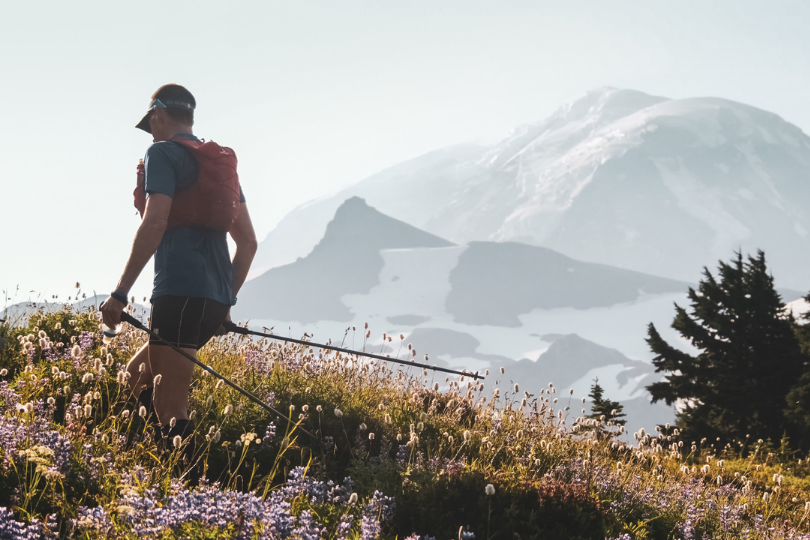
A runner passes through meadows on the Wonderland Trail.

9,000: The estimated number of years Indigenous communities have been living in regions surrounding Mount Tahoma (settler name: Mount Rainier).

6: The number of regional tribes that experience Tahoma as kin: Puyallup, Nisqually, Cowlitz, Squaxin Island, Muckleshoot, and Yakama.

6: The different Indigenous naming variations of the mountain: Tahoma (“mother of waters” or “the place where the water begins”), Tacoma, Tacobeh, Pooskaus, Ti’Swaq. Tahol, “Mother of Waters. “Snowy Peak.” “The source of nourishment from the many streams coming from the slopes.” (There are more.) Myths surrounding the mountain include floods, Coyote running to the peak for refuge from encroaching gush of water (there are more).

1792: The spring during which Captain George Vancouver sailed into the Puget Sound and named the large mountain in the distance after his comrade, Peter Rainier, an “unremarkable eighteenth-century rear admiral” who fought in the Revolutionary War, fought actively to squash the revolution. This man would not be mistaken as a god.

0: The number of times Peter Rainier, colonizer namesake of Mount Rainier, ever stepped foot in the Pacific Northwest, ever saw Tahoma with his own eyes, ever cried at its majesty, ever dropped to his knees in trembling prayer, humbled by its glaciated heft. Ever. Never.

2 out of 100: The rating for Rainier Beer on RateBeer.com, a cheap, forgettable lager that, until recently, was brewed in Irwindale, California, still named Rainier, still named after a sorry red coat counterrevolutionary who, lest we repeat, never stepped foot in the Pacific Northwest.

0: The number of times Indigenous peoples are acknowledged in the “Origins” section of Irwindale, California’s city government website, a city that brewed for decades with stolen water this unexciting lager improperly named after a stolen mountain in the Pacific Northwest, a name of a counterrevolutionary who never even saw the mountain, never smelled the land, never met or listened to any of the many tribes living there, never knew the rich tapestry of human and nonhuman communities calling this mountain home, its surrounding bounty of land, air, and water, for thousands of years before his royalist birth.

1833: The year Dr. William Fraser Tolmie, a Scot working for the Hudson’s Bay Company, decided he’d travel inland to the base of Tahoma for a “botanist excursion,” which he did, making him the first European ever to reach the mountain’s base, successful only due to the deft guidance of two Indigenous huntsman, Lachalet (Nisqually) and Nuckalkat (Puyallup).

1870: The year of the first known summit of Rainier, August 17. Hazard Stevens and Philemon Beecher Van Trump. Sluiskin, a Yakama hunter living with the Upper Cowlitz, guided the men, thinking them fools for wanting to summit. Mountains are gods meant to be left alone, to be respected. Sluiskin was not happy with their intentions of conquest, as this peak housed a lake of fire at the top where a demonic spirit resided. He begged them not to scale the mountain, but the mountaineers continued, unabated, and conquer they did.

400+: The estimated number of bodies, hikers and climbers, held dead on Tahoma’s slopes since the first summit.

1899: The year, on March 2, when President McKinley established Mount Rainier National Park, America’s fifth park. (1: Yellowstone, 1872, STOLEN; 2: Sequoia, 1890, STOLEN; 3: Yosemite, 1890,
STOLEN; 4: Rock Creek, 1890, STOLEN).

1907: The year workers broke ground on the Wonderland Trail.
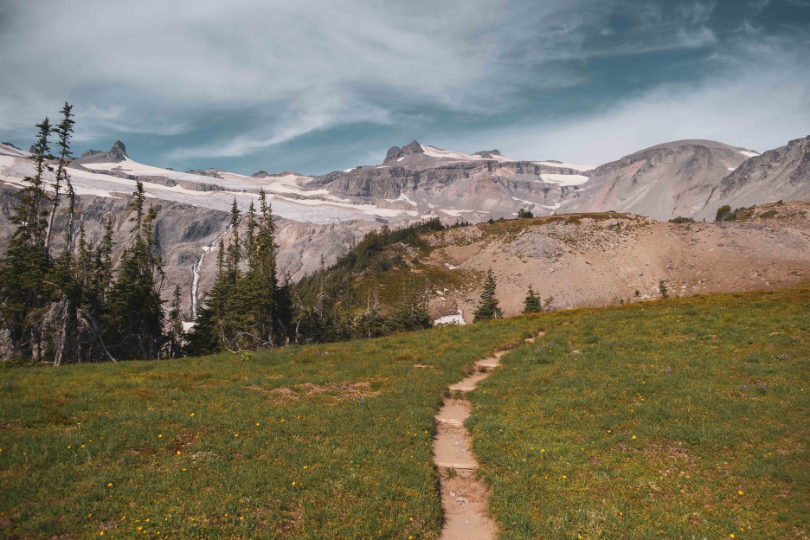
130-140: The number of miles planned when building the original Wonderland Trail.

1915: The year the Wonderland Trail was finished, just in time for the Mountaineers Annual meeting.

1917: The year the US government, through eminent domain, demanded Nisqually land for Fort Lewis, Washington, fifty miles west of Tahoma.
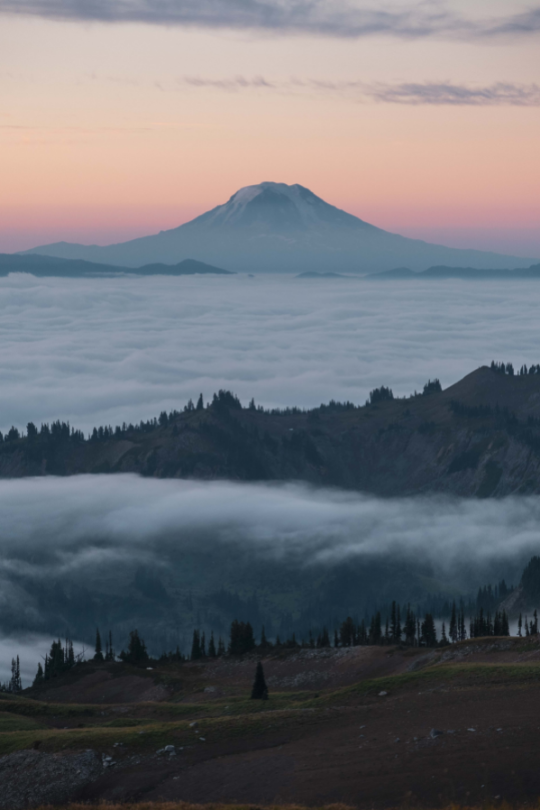
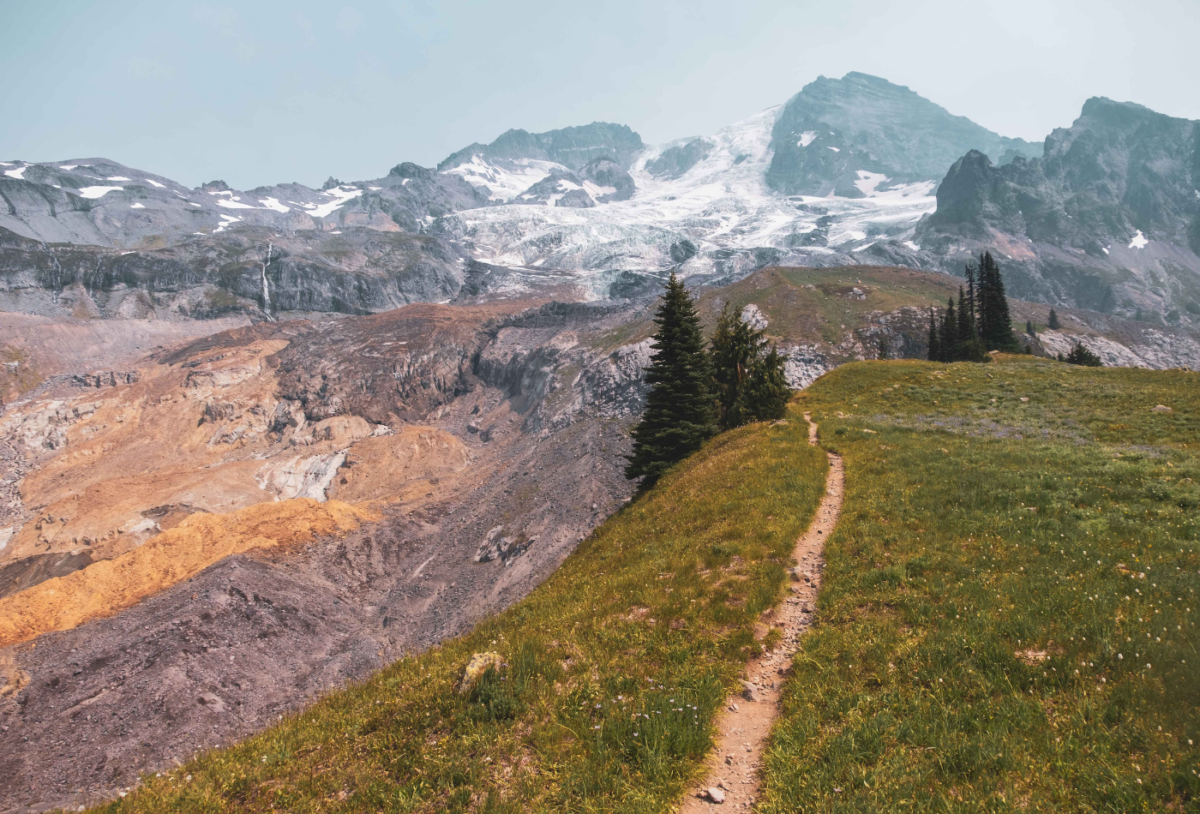
Looking out from the shoulder of Tahoma (Rainier) at Pahto (Mt. Adams)

1920: Year the Wonderland Trail was officially branded by the park’s superintendent, mainly for marketing purposes to position Rainier as a tourist destination.

32: The number of Marines killed in 1946 when their plane crashed into the South Tahoma Glacier. They remain entombed to this day.

9: Number of shiny UFO objects witnessed by the pilot Kenneth Arnold zinging through the sky on June 24, 1947, the first of many extraterrestrial accounts that now surround the volcano.

2 million: Visitors to Mount Rainier Park annually.

10,000: Number of average Tahoma summit attempts.

50%: Percentage of successful summit attempts.

1.9%: Percentage, in 2019, of Washington (another colonizer naming convention) residents who identify as American Indian.

29: federally recognized tribes in Washington State.

1,122 inches: total snowfall on Mount Tahoma in 1972.

266 inches: total snowfall on Mount Tahoma in 2014.

105: degrees Fahrenheit recorded this June in Longmire, a record.
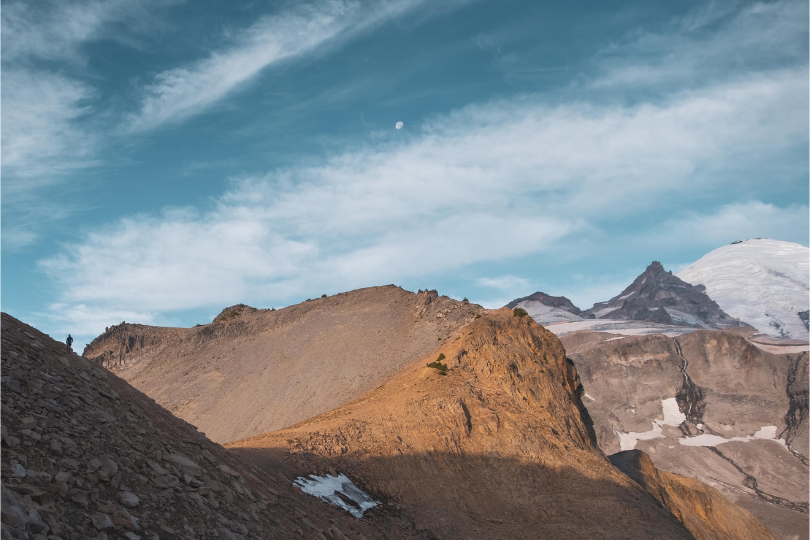
2015: The year Mount McKinley was returned to its traditional Koyukon Athabascan name, Denali.

0: The number you will find on East Rutherford, New Jersey’s city government website any mention of the Indigenous Munsee Lenape, who originally inhabited this area of New Jersey now colonized and established in 1894 as East Rutherford, about the same time Mount Rainier became a national park, 2,885 miles west.

43 – 8: The final score of the 2014 Super Bowl, held at the Metlife Stadium in East Rutherford, New Jersey, between the Seattle Seahawks and the Denver Broncos, the year the Washington State Senate temporarily changed the colonizer name of Mount Rainier not to one of several Indigenous names of the volcano, but to this:

Mount Seattle Seahawks.

Nicholas Triolo is a writer, long-distance runner, and Wonderland guide for Aspire (2016-2018). He holds a master’s of science in environmental studies from the University of Montana, where he was senior editor for Camas Magazine. Triolo currently works as Digital Strategist for Orion Magazine, and is based in western Massachusetts. He is former associate director for the Todos Santos Writing Workshop and co-facilitator for the Freeflow Wilderness Writing Institute. His writing, films, and photography have been featured in Orion, Terrain.org, Best American Poetry Blog, Juxtaprose, Trail Runner Magazine, Patagonia’s Dirtbag Diaries, and others. More at: nicholastriolo.net
Categories
Aspire Culture Blog courses Culture Destinations Diverse Voices Highlights Native YOSE Yosemite Backcountry Stage

Running on Stolen Land: Yosemite National Park

Developing a sense of context provides support for the deep connections to ourselves, each other, and the land that we celebrate on our trips. As part of our commitment to community and context, we are educating ourselves on the indigenous lands where we run trips… learning about the people who call these lands home, the forced succession of their homelands, their traditional lifeways , modern challenges, and the roles they play in land stewardship and conservation.

Coming off of a month of beautiful trips in Yosemite National Park, we share what we’ve learned Miwok people who inhabited the valley for thousands of years before the arrival or white settlers in the 1850’s.


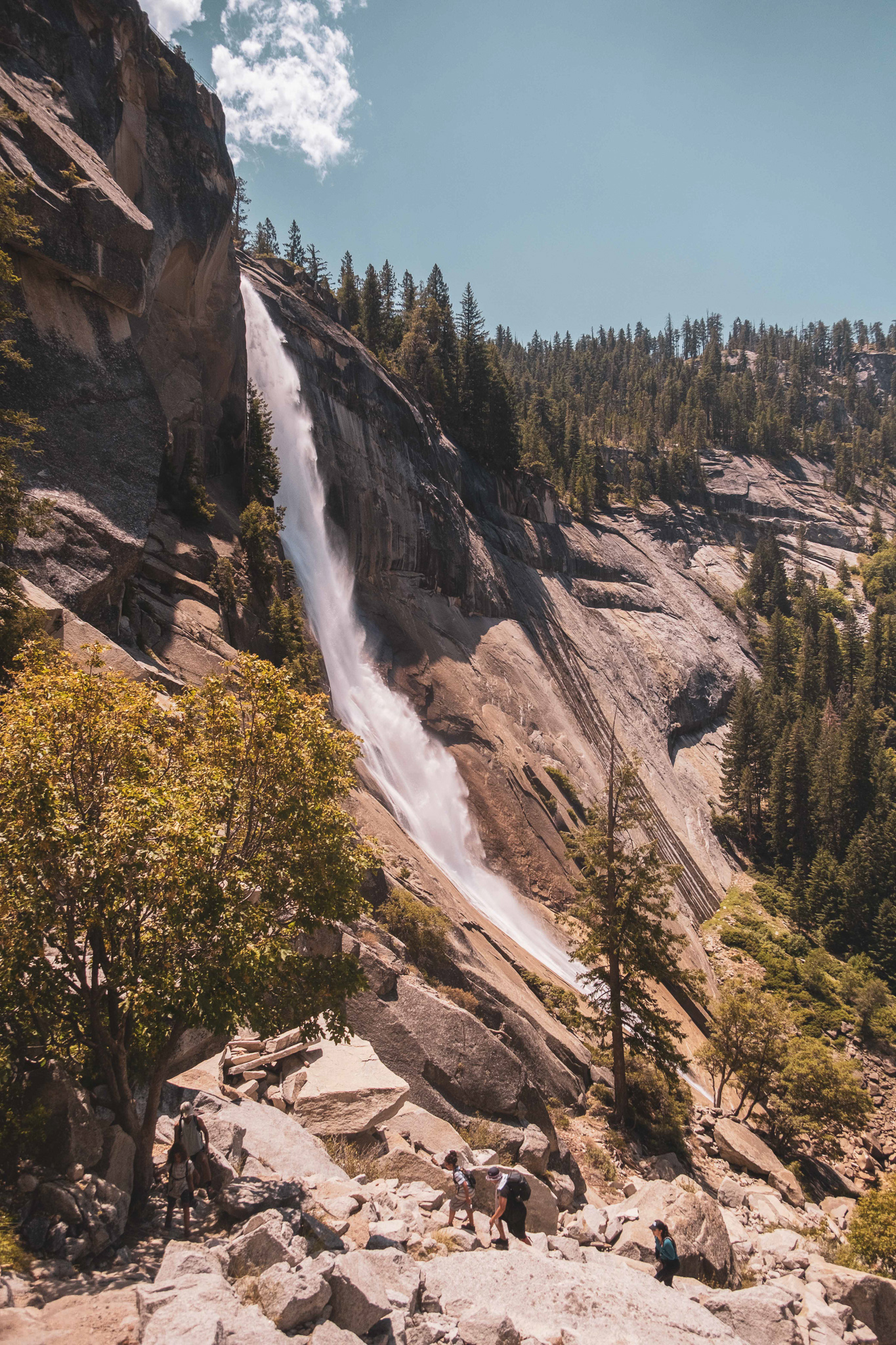
Yosemite National Park is known for its dramatic natural landscapes boasting incredible waterfalls, giant sequoia trees, and towering granite domes.  It became a National Park in 1890 and continues to hold its sense of awe and appreciation among those who visit.

While Yosemite is known as a world-class destination for climbers and outdoor enthusiasts alike, the history and unfortunate harm of the Indigenous communities in the Valley is important for present visitors to acknowledge and also have an increased awareness of the Indigenous land management and cultural practices that make these natural areas a better place for all.  


History

The area we now refer to as Yosemite National Park is the traditional homelands of the Ahwahnechee people, a Southern Sierra Miwok Indigenous Nation who lived in the Ahwahnee (Yosemite) Valley.  Ahwahnee was a Miwok word to describe the open mouth of a bear, similar to how the First Peoples viewed the open end of their valley. 

For over 5,500 years the valley had an abundance of natural resources that allowed the Indigenous people to thrive off the land. This drastically changed around 1848, when word of gold in the area brought a flood of settlers to Yosemite. This gold rush resulted in a violent clash between the Native Americans and the new coming colonists, driving the Miwok Nation out of their homeland to mine the area for gold. 

During this period, the Southern Sierra Miwok Nation suffered from violent dispossession, relocation, and economic disadvantage in their ancestral homeland from the militia group, Mariposa Battalion.  This state funded militia group waged a seven month war, systematically burning villages and food supplies, thus forcing the Indigenous Communities from their land. The Native Americans eventually relented, were captured, and were forced to relocate to a reservation, ending the tribal habitation of Yosemite Valley and beginning a new era of the settlers.

Within a year’s time, the Ahwahneechee resettled throughout the valley, but in 1864, President Abraham Lincoln designated the Yosemite Valley as a protected area.  While the efforts were made to conserve the natural environment, the newly protected region brought a rush of tourism to the valley, which further lessened the control the Miwok had of their ancestral lands. 

Petitions for Yosemite to become a National Park began in 1889 when John Muir came to the valley.  At the time, the area was preserved as a forest reserve by the State Government but officially became a part of the National Park Service in 1890.

While the creation of the Park meant environmental preservation in the Valley, it further restricted the Ahwahneechee people from using their land for cultural and traditional purposes. By 1935 the South Sierra Miwok Nation was completely relocated from their lands and were threatened with fines, arrest, and further banishment from the park if not obeyed.


Fighting for Federal Recognition

Despite a dark past of displacement, the Indigenous groups of Yosemite have continued to advocate and lobby for federal recognition and use of their ancestral lands by working with the National Park Service. In 1980, the American Indian Council of Mariposa County (AICMC) was approved for the construction of a new Indigenous Cultural center in the Valley. In 1987, they were approved for the first Native American Relationship Management Policy to outline the importance of Indigenous Americans in the National Park management. 

While Yosemite works with the AICMC to better explain the Native American history of the Valley, most of the information and museums in Yosemite still highlight the settlers’ history instead of the Ahwahneechee history. 

Currently, the Southern Sierra Miwok people are “seeking self-determination, self-governance, and acknowledgment through the federal recognition process. This designation will allow [their] tribe to acquire tribal sovereignty rights. Federal recognition allows access to further health benefits, scholarships for higher education, funding opportunities to support [their] wellbeing and cultural continuance.” (Southern Sierra Miwuk Nation). 

As explained by the Miwok Nation, the motivation for the federal acknowledgement is to support and work with the underlying issues of fundamental justice for their people.  The hope is to “significantly enhance and facilitate this interaction by establishing a formal government-to-government relationship” through self-sovereignty, child welfare, additional federal support programs, revenue sharing trust funds, educational assistance, environmental protection and land acquisition, and protection of Indigenous cultural sites, and traditional gathering and other interest in their ancestral lands.

Ultimately, with the number of people traveling to Yosemite rising each year the importance to acknowledge, support, and campaign for the preservation and rights of the Southern Sierra Miwok Nation increases.  As trail runners and outdoor enthusiasts, it’s important we not only learn the true history of these wild spaces, but also support and help in the federal recognition of the first inhabitants of these regions we enjoy so much. 


For additional information and ways to support the Southern Sierra Miwuk Nation see below:  

Southern Sierra Miwuk Nation https://www.southernsierramiwuknation.org/federal-recognition 

Native Land – Me-Wuk (Southern Sierra Miwok)

Yosemite Mariposa County 

Indian Country Today https://indiancountrytoday.com/archive/native-history-yosemite-national-park-created-on-native-homelands 

The Yosemite Valley Native Americans 

https://ppaccone.medium.com/the-yosemite-valley-native-americans-f89957da5f18

Kara Folkerts

Kara Folkerts is a plant powered trail runner, sustainable travel advocate, yoga teacher, and passionate about all things sustainability, travel, health, and outdoor movement.  Originally from Canada, Kara has spent the last few years exploring and living abroad in various countries across the globe before joining the Aspire crew in 2020. Kara has been guiding various trail running, sustainability, and health retreats internationally since completing her undergrad in Ecotourism and Outdoor Leadership.  With all of these experiences, she seeks meaningful connections with others, loves to learn of new cultures, and fosters the mindset of a lifelong learner.  With a big heart for trail running and exploring wild places, she’s always stoked to get out there with others. 

She writes about all her adventures on her blog at www.karafolkerts.com and on her instagram @karafolkerts