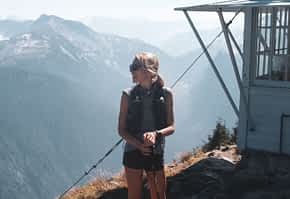
Hannegan Pass beckons. Day 3 of the Nooksack Ridgelines Rendezvous.
Credit: Jessica Vandenbush
It’s mid-summer, and runners on the Nooksack Ridgelines Rendezvous stumble off the dusty August trails physically depleted and parched, yet carrying that blissed-out affect only hours of alpine running can impart. Fortunately for their bodies, these runners find themselves at Aspire basecamp, a place where TLC flows like the glacier-fed Nooksack River we’re camped along .
The Ice Cream Social
The Aspire crew prides themselves on their playful and multi-dimensional approach to runner support. Attention to the little details creates the ideal setting for the recovering runner. The crew has a few tricks up their sleeve to bring bodies in line with spirits and minds, including often incorporating an element of surprise.
While magicians cannot reveal all their secrets, we will let you in on just one: the delight of hand-turned ice cream, this past August topped with grilled peaches and candied walnuts. If this sounds like an outrageous offering to partake in on an 85 degree day in the remote depths of the North Cascades, that’s because it is. Outrageously delicious.
Photo: Jessica Vandenbush
Backcountry ice cream is ephemeral by nature, demanding it be eaten in the moment or else be lost to the harsh realities of summer. This insistence brings everyone together. Eating dessert becomes an act of joy. Runners line up for seconds and the experience becomes the gel that defines a community.
Recovery can mean a lot of things, and watching runners forget about their tired bodies and buzz with anticipation at the pleasure of satisfying treats motivates the Aspire squad to keep the surprises coming. Aspire Rendezvous trips offer unique opportunities to get to know a region intimately on daily runs of self-selected mileage and come back to an elevated basecamp for relaxation and connection… and if you’re lucky, ice cream.
Trent Banks is a mountain runner, a disc jockey, and father of two daughters, based out of Bellingham, WA. He joined the Aspire crew in 2018. When not guiding trips with the Aspire crew, you can find him at work on Aspire’s marketing or DJing clubs and hosting events with Reflect.
We understand the importance of recovery and fueling on the trails and the vital role food plays in a successful multi-day adventure. We want to see you thrive both mental and physically on our trips, so our menu is fine tuned to offer deeply satisfying, well-rounded, and healthy meals for runners.
During our time down south in the Sierra Nevada’s, we were eating a variety of whole-food, plant-centered meals daily and were inspired to add a new item to the Aspire menu. Dubbed the ‘Sierra Bowl’ after it’s place of inspiration, it’s already an instant hit among our community that we’ve incorporated into every trip’s menu.
Sierra Bowls are a simple, one-bowl meal that is whole-food and plant based that features a bed of whole grains, fresh vegetables, healthy fats, varying sources of proteins and topped with a variety of seeds, nuts, delicious sauces and a whole lot of love.
The best part?! We make room for creativity and personal flair with the ‘build your own bowl’ meals for runners. Choose from your favorite veggies, toppings and proteins to create a delicious dish that is catered to your own preferences, needs, and taste buds.
That being said, we do have a few favorite components of our Sierra bowls that have worked wonders for recovery and our taste buds.
We like to start our bowl with a warm base of quinoa. This naturally gluten-free whole-grain has gained popularity in recent years with it’s high protein status, containing all the essential amino acids that you need, making it an excellent protein source for veg and meat-eaters alike.
Next, we like to add roasted sweet potatoes. Not only are they delicious, they also are a perfect source of complex carbohydrates needed for exercise. In addition, they are also packed with phytochemicals that can help reduce post-workout inflammation.
From there, we add a variety of healthy proteins such as edamame, whole-food based vegan meats, roasted chicken and a variety of nuts to sprinkle on top. Pairing protein with healthy carbohydrates helps promote muscle recovery after a hard effort out on the trails.
Next comes a plethora of fresh veggies. We’re talking shredded purple cabbage, carrots, steamed broccoli, sauerkraut, kale, arugula, tomatoes and more. We aim to keep it fresh, colorful, and abundant! This adds essential vitamins, minerals and phytonutrients to your meal.
Healthy fats are another component of the bowl not to be missed. While protein and complex carbs take a majority of the attention when fueling as an athlete, healthy fats play a crucial role in a balanced nutrition plan for athletes. Not only do healthy fats create a truly satiating meal, it also aids in balancing hormone levels as an athlete. Whether it’s avocado, a drizzle of tahini, a dollop of hummus or a sprinkle of nuts, we got you.
For the grand finale and to cover all bases, we’ve got all the sauces. We have a wide mix of tahini, sriracha, dijon mustard, liquid aminos, hummus, and our personal favorite, Bitchin’ Sauce. This vegan, almond-based whole-food dip has become a huge hit with everyone!
At the end of the day, the creation of this bowl is centered around deep nourishment and nutrition to fuel your big days, but also with the acknowledgement that sharing of wholesome meals for runners in the company and community of others is just as important to feel truly nourished.
Kara Folkerts is a plant powered trail runner, sustainable travel advocate, yoga teacher, and passionate about all things sustainability, travel, health, and outdoor movement. Originally from Canada, Kara has spent the last few years exploring and living abroad in various countries across the globe before joining the Aspire crew in 2020. Kara has been guiding various trail running, sustainability, and health retreats internationally since completing her undergrad in Ecotourism and Outdoor Leadership. With all of these experiences, she seeks meaningful connections with others, loves to learn of new cultures, and fosters the mindset of a lifelong learner. With a big heart for trail running and exploring wild places, she’s always stoked to get out there with others.
The Aspire basecamp is inspired by the culture of trekking in the Alps. European huts allow for a different kind of wilderness experience. Knowing there is a basecamp with full amenities at the end of your day means not only comfort, warmth, and a good night’s rest, but sometimes the important difference between safely pushing the limit and a dangerous epic. Aspire reproduces the European model with a playful combination of amenities and aprés- culture that allows runners to connect over shared adventure in incredible wilderness spaces.
Grilling up summer veggies on the Lost Coast Trail.
One of the main reasons so many runners come back to do trips with Aspire year after year is our next-level base camps. Our approach is a time-tested collection of details and creature comforts that sets the stage for recovery, relaxation and new friendships.
The Aspire Menu
You know that moment… you’re nearing the end of a long run (or maybe you just started) when all the delicious food you could be eating takes over your thoughts, with dreams of immaculate feasts overwhelming the mountain views. Yet often, post-run trailhead noms don’t progress beyond the bag of potato chips or trail mix stashed in the car.
Entry into Aspire basecamp is a different scene. Colorful appetizer spreads await runners stumbling in from the days journey. Don’t be surprised by the jar of homemade pickles or the figs from the garden. Fresh capresé? Check. We like good food and we like to share.
Meals continue the trend: Steak with summer veggies, salmon with rice pilaf and asparagus, Sierra bowls, and the famous Aspire tacos… this is not your standard trailhead menu.
Have a special requests for specific drinks, foods, or dietary needs? Say the word. Don’t eat meat? No problem. Allergic to peanuts? No problem. Craving strawberries? They’ll be at camp that evening.
Food at basecamp strikes a perfect balance between recovery focused backcountry food and the truly gourmet.
Recovery
Glamping with Aspire means everything needed to recover from time on trail and prepare for the next day. When you have to wake up the next morning and tackle another big distance, you’ll be glad for the comfort and care you were able to give your body the night before. Runners often finish the first day of a big trip like the Wonderland Trail and think they’re spent. They couldn’t possibly wake up and do it all over again the next day.
Time to unzip our camp care kit. Theraguns and foam rollers work the tension out of tired muscles.
Blisters? Our team of Wilderness First Responder certified guides is ready with our foot care kit and expert advice on blister management. Tomorrow isn’t only possible, but it’s going to be awesome!
Comfort
One word: SHOWERS! Yes, the backcountry shower is real, alive, and unbelievable refreshing. Warm water and soap go a surprisingly long ways towards revitalizing and rejuvenating.
Add to that our heaters and walled tents, and even the coldest alpine summer evenings are comfortable.
It’s not just about comfort. Being able to put the walls on our tents helps keep us warm and dry if the weather turns. The heaters don’t just warm up cold runners, they also dry out wet gear for the next day’s miles.
Connection
It’s been said that friendship is a history of shared meals… we extend that concept to miles, campfires, and sunsets. Aspire trips feature a healthy dose of all of the above, converging at basecamp. Not much beats recounting the days adventures and swapping mountain stories over beers, ciders or yes, margaritas.
Topped off with dessert, and you’ll find yourself feeling restored on mind, body, and soul levels.
We may not have European style huts in the US, but running a trip with Aspire is probably the next best thing. We bring your bags to camp for you, cook for you, and light up the campfire, all while leaving no trace. Everything in the Aspire model is designed to help runners achieve their goals out in deep wilderness with maximum enjoyment. It’s more fun this way. The food’s tastier, the beers are colder, the wilderness is wilder, and your big backcountry objectives are now within reach.
by Aspire guides Ian Carroll & Trent Banks
Check out our “What to Pack Blog” for details on what to to show up to Aspire trips with.
Recovery dinner on the beach, lot’s of greens to boot!
Have you ever busted a chain on your bike? I don’t recommend it. Once, during a xc mountain bike race, I was pumping hard uphill in a good position, when all of the sudden…”ping, whip!”, my chain snapped and came flying off.
My knee came down hard on my top tube, and I hobbled my bike to the side of the trail, collected what I could of my broken chain, and did the walk of shame back to the finish line. Needless to say, the podium finish I was hoping for did not happen.
Just like a faulty chain on your bike could cost you a race, or at the very least, screw up your plans for a fun ride, inadequate fueling and poor nutrition habits could turn your long run into a death march.
For big days in the mountains, it’s important to have your pre, during, and post run fueling strategy dialed in. No weak links, right?
Tacos, fully loaded.
What to eat BEFOREa big day in the mountains:
The main focus of your fueling strategy before a long run should be to top off your glycogen stores (the storage form of carbohydrate) in your muscles and liver.
By focusing on carbohydrate intake the night before and morning of a big day, you’re essentially topping off your gas tank before you hit the road – you’ll be able to fill up along the way, but it’s nice to start out with plenty of stored carbs that your body will use for high intensity exercise.
I always suggest that endurance athletes eat normal-sized meals (you don’t want to be overstuffing yourself) that include complex carbohydrate sources like rice, noodles, potatoes, other starchy veggies and whole grains.
For example, maybe the night before a big day you could eat sweet potatoes, rice, and veggies, and then the morning of, you could eat some oatmeal, granola, or toast.
One thing that’s important to remember is that the closer you get to actually starting your run, the smaller portion you should eat. Two hours out? A full, normal sized meal should be ok. 20 minutes before? Something smaller like a half a banana or a granola bar might be a better idea.
It’s also important that you go into an event hydrated (but not overhydrated – your pee should be yellowish clear), and that you avoid high-fiber foods, as well as excessive fat and protein.
French toast for the carbs, berries for the antioxidants, whipped cream for the YUM!
What to eat DURING your big day out:
During a trail run, or ultra-type event, you’re most likely going to be hitting a couple different intensities and paces.
At lower intensities (heart rate zones 1-3), your muscles are going to be primarily using stored body fat for energy. Even someone with relatively low body fat % could have over 100,000 calories stored as fat that they can tap into.
At higher intensities (zones 3-5) your muscles REQUIRE carbohydrates to function optimally. That’s why it’s important to make sure to have carbohydrate sources with you so you can refuel. “Bonking” or “hitting the wall”, is when a runner has burned through all of their stored carbs, and is practically forced to bring their intensity level down. Bonking in the backcountry can actually be pretty dangerous.
In general, it’s recommended that for a run or adventure lasting more than an hour, your fueling strategy includes carbs every hour. Depending on duration and intensity levels, trail runners can benefit from anywhere from 30-90 grams of carbohydrate per hour.
For back-to-back, stage-race-style running, the higher end of that scale is probably best.
So what does that look like?
Well, there are plenty of carbohydrate sources that a runner could eat during a big day. Everything from energy gel (20-30g of carbs) and sports drink (40-50 g of carbs) to a classic PBJ or a potato wrap. (50-70 g of carbs).
Practice makes perfect with endurance fueling, and you’ll have to play around with different sources and amounts of carbs to see what works best for you.
Working for it requires eating for it.
What to eat AFTER a long effort:
Following a long or more intense effort, it’s really important to make sure you are re-fueling well, so your body has the building blocks it needs to make adaptations. This is even more crucial when you are doing multiple long runs or adventures on back-to-back days.
If you’re still feeling extra sore and beat up from yesterday, today’s effort isn’t going to be near as fun.
There are 4 primary aspects of recovery nutrition that I recommend for your fueling strategy:
1. Rehydrate (that’s a no-brainer)
2. 20-30 g of protein, especially the amino acid Leucine
3. At least 20-30 g of carbohydrate
4. Foods rich in antioxidants, such as berries, greens, and spices.
Including those nutrients in your recovery meal will give your body the building blocks that it needs to recover well and make the physiological adaptations that lead to better fitness.
This recovery bowl is calling to me right now.
An easy go-to recovery food is a smoothie. You can put plenty of carbohydrates (bananas, berries, citrus, fruit juice), protein (soy milk, dairy milk, nuts and seeds, protein powder), and antioxidants (greens, berries, spices) in a smoothie that make it a recovery powerhouse.
To sum it up:
Before = carbohydrate
During = carbohydrate
After = carbohydrate, protein, and antioxidants
If it feels intimidating to start incorporating every aspect of fueling into your plan, just start with one aspect. If you haven’t been eating before your long runs and adventures, start by trying to dial that in. With time and practice, you’ll be able to find a fueling strategy that works for you so you can feel strong, fast, and enjoy doing what you love.
Editor’s Note: Nutrition on Aspire Trips
Food is an integral part of Aspire trips. Running with us means highly nutritious meals calibrated to impress your taste buds and prepare your body for (often back to back) days on the trail.
Expect mornings packed with carbs and just the right amount of protein. Lunch is build your own sandwiches and wraps with a wide array of fixings, accompanied by an ample stash of all the bars, gels and electrolytes you’ll need for your trail miles. Dinners are nothing short of revelatory, but we won’t spill the beans on the menu just yet.
Special dietary needs? Let us know and we’ll make sure you’re taken care of. Favorite beverages, bars, or snacks? We do that too!
We’re looking forward to breaking bread together! For more info, take a look into the Aspire kitchen on the blog.
Vic Johnson loves moving through wild places as efficiently as possible, and his goal is to help other outdoor athletes do the same.
He’s taught nutrition education to collegiate sports teams, and has coached triathletes, mountain athletes, and runners throughout the world. Learn more at www.mtnsportsnutrition.com.
We get it! Food on the trail is important. While we know the ravenous hunger that comes after a long day on the trail can make almost any kind of food appealing, we put care into all our meals to make your entire experience on our trips all the better. We’re committed to using high quality ingredients to make delicious, satisfying meals. So save that old bag of mixed dehydrated mashed potatoes for your solo trips and let us work some magic.
Finishing a long trail day at Aspire camp means enjoying a big spread of fresh hors d’oeuvres – from juicy local figs, a full charcuterie board, or tomato, basil and fresh mozzarella caprese bites – prior to diving into a delicious and nourishing campsite dinner.
It’s been said that friendship is a history of shared meals. At Aspire, we love good food almost as much as we love mountain miles with friends. Meals are a focal point of our trips, where runners come together and connect over the day’s adventure. We take time to plan out a full menu to ensure everyone on the trip feels fully satiated and enjoys every bite, ready to get out for more running and more camaraderie when morning calls.
All of our guides have some background in the food industry or deeper connection to food – whether they’ve worked as a cook in various restaurants, make fresh sauces and preserves at home, grow their own food in the veggie garden or continue to master their own cooking techniques in the kitchen. On top of this, all of our guides have completed the Washington State Food Worker course and have valid permits and education on proper health and safety regulations required to serve and prepare food on our trips. We believe that all of this experience and our love of quality food has carried forward to create a culture of delicious meals for everyone who joins Aspire trips.
Some of our personal favourite meals include freshly caught salmon with lemon wedges aside grilled seasonal vegetables, fully loaded breakfast burritos, burger night with all of the fixings, and a fire roasted seasonal fruit cobbler to end the night.
We also can’t forget taco night, which has become a legendary bookend for those finishing the Wonderland Trail. After three big days of mountain running, you’ll come back into Longmire greeted with a full spread of fresh pico de gallo, roasted veggies, grilled chorizo, a dollop of sour cream and a handful of fresh cilantro. Top it all off with a mountain of guacamole, we like to think we know a thing or two about tacos.
In addition to our delicious breakfasts and dinners to start and end each day, we also have food available to prepare a lunch for your big adventure on the trails. With a large variety of bars, gels, chews, and snacks to take on route, we also provide various ingredients for loaded wraps and hearty sandwiches. From hummus, veggies, meat and cheese wraps or a good old fashioned peanut butter and jelly sandwich. And let’s be honest, trail snacks are great, but the added moral boost of a fresh lunch wrap can be a great pick me up to help fuel you better throughout a long day.
For some, a cause of concern may be varying food preferences or dietary needs, but we have experience of catering to all diets. Whether you’re gluten free, vegan, keto, a heavy meat eater or really just want your favorite salty snack at the end of the night – we got you covered. We are diligent in our camp kitchen when it comes to issues of cross contamination for celiacs, various allergies that may be present, and happily cater for vegetarians and vegans alike.
So not only will a trip with Aspire include epic trails, unreal mountain views, and connecting with amazing people, but we also ensure you are eating some of the highest quality, mouth watering, and thoughtfully prepared trail food you can get your hands on.
Kara Folkerts is a plant powered trail runner, sustainable travel advocate, yoga teacher, and passionate about all things travel, sustainability, health, and outdoor movement. Originally from Canada, Kara has spent the last few years living and travelling in various places across the globe, guiding trips and going on personal expeditions before joining the Aspire crew in 2020. She writes about her experiences and adventures on her blog at www.karafolkerts.com.
Great adventures require exceptional fuel. Aspire delivers with quality, Pacific Northwest inspired cuisine to rejuvenate and restore the body after big days on the trail. A handful of homemade snacks and condiments add charm to the Aspire menu, including this irresistible fire-roasted salsa from Abram’s kitchen.
Abram’s pizza oven not required
Recipe makes about 5 pint jars Ingredients: 5lbs tomatoes, halved and cored 10 jalapeno peppers, halved and stemmed 12 cloves of garlic, peeled 3 small onions, peeled and quartered 1/2 C. apple cider vinegar 1 Tbsp. salt, or more to taste 2 Tbsp. sugar
Directions: 1. Boil the cans and lids to prepare for storage. 2. Broil tomatoes and peppers in the oven at 500 degrees for 6-8 minutes, until they have softened and have a slight charring. Remove and allow to cool. 3. Press or finely chop garlic, then add all ingredients to a large bowl and mix until well combined. 4. Chop and combine, or pulse in a food processor until desired consistency is reached. We think some identifiable veggies add to the charm. 5. Fill your cans, leaving a little headroom. 6. Boil water and drop cans into boiling water, cover, and let boil for 10 minutes to preserve. Remove carefully with jar lifter or tongs and allow to cool overnight. 7. SNACK WELL! Happy trails!
Snack time at Mowich Lake, Wonderland Trail, Mt. Rainier National Park
Exploring our schedule of trips is sure to work up an appetite. Check them out here!