Categories
Blog courses Destinations Highlights Skills Sucia Island WFA SUCIAWFA Trip Reports Trip Reports and Trip Styles Trip Styles update

Sucia Island Wilderness First Aid: Trip Report

by Maryanna Brown

Our Sucia Island Wilderness First Aid course is a collaboration with instruction from Backcountry Medical Guides and the Aspire basecamp experience, creating an idyllic classroom where trail runners recieve sport-specific instruction on how to prepare for and respond to adverse events in the wilderness. Participant Maryanna Brown shares more in the following trip report.


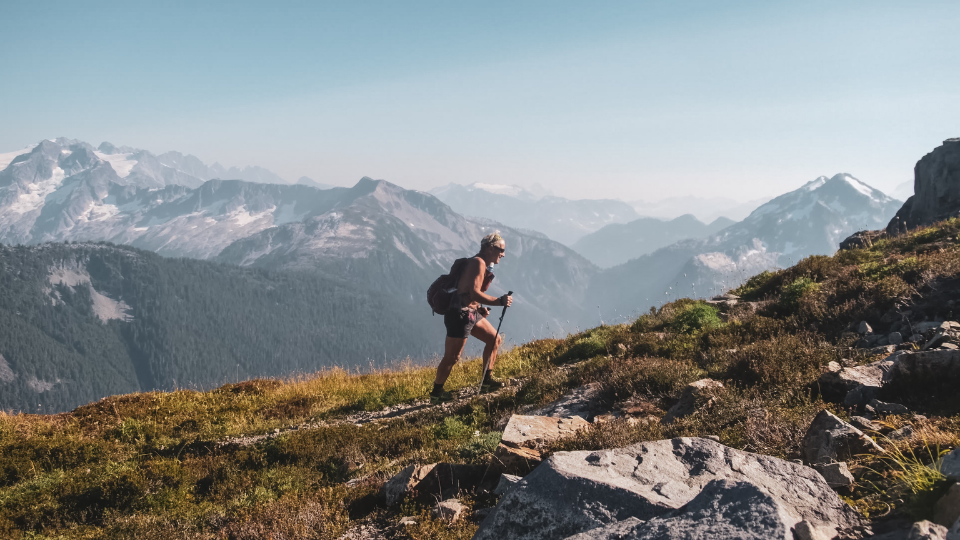
Gearing up for a summer of mountain adventures, I knew it was time to refresh my rapidly deteriorating first aid skills.  I took a Wilderness First Responder course several years ago, but I hadn’t had to use any of the skills (thank goodness) and was feeling decidedly iffy about my abilities to respond to an emergency in the backcountry. If I packed a first aid kit at all, it was either mini pre-packed baggie of mystery items I wasn’t really sure what to do with or a behemoth first aid kit overflowing with dusty gauzes, ointments, a selection of picked over bandaids.  A Wilderness First Aid course geared towards trail runners seemed like just the ticket to kick off a summer of backcountry adventures. Not only would I feel more confident about going further into the backcountry solo, but I’d be a better partner for my trail running buds.

I had never heard of Sucia Island before the course and had no idea what to expect when the ferry pulled up to Orcas Island on Friday afternoon.  From the ferry terminal, we took a quick shuttle van ride to catch our chartered boat to the mysterious Sucia Island.  Speeding through splashing white-capped waves with dolphins breaching in the distance was sheer delight.  It truly felt like we were leaving the rest of the world behind, charting a bold new path to trails that weren’t even listed on Trail Run Project.  

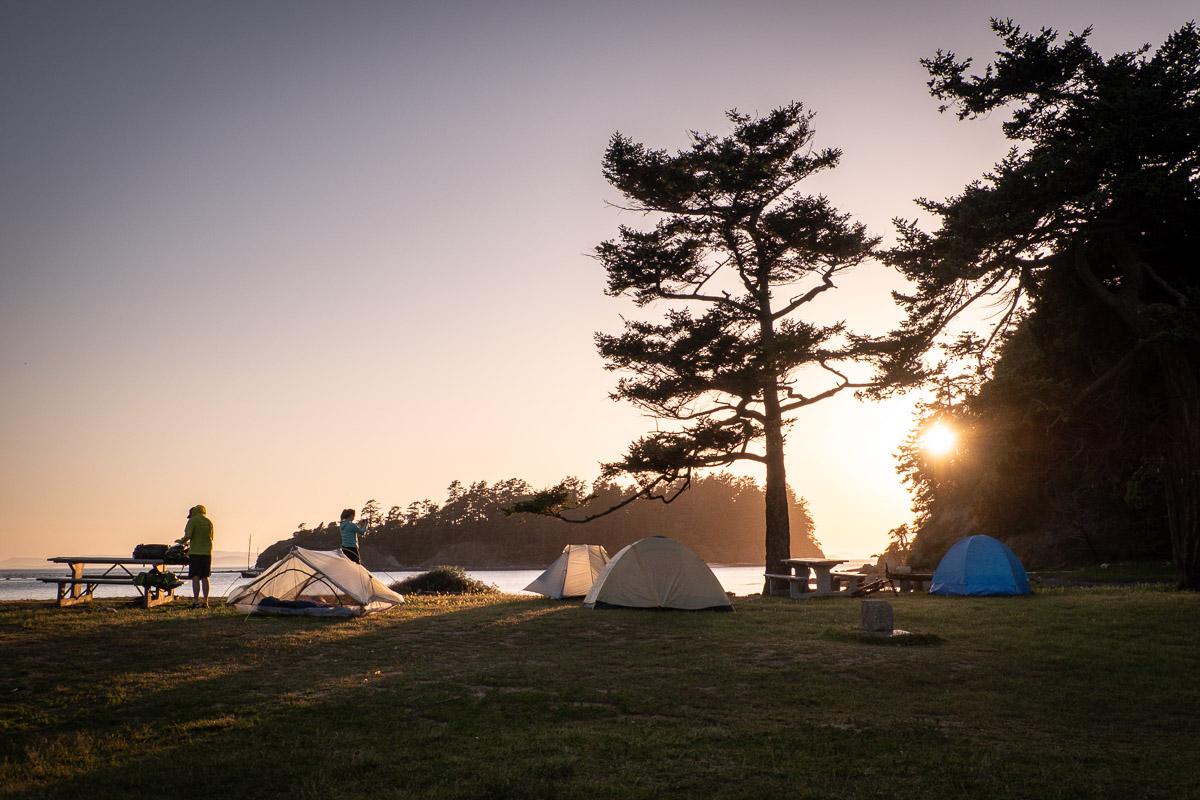
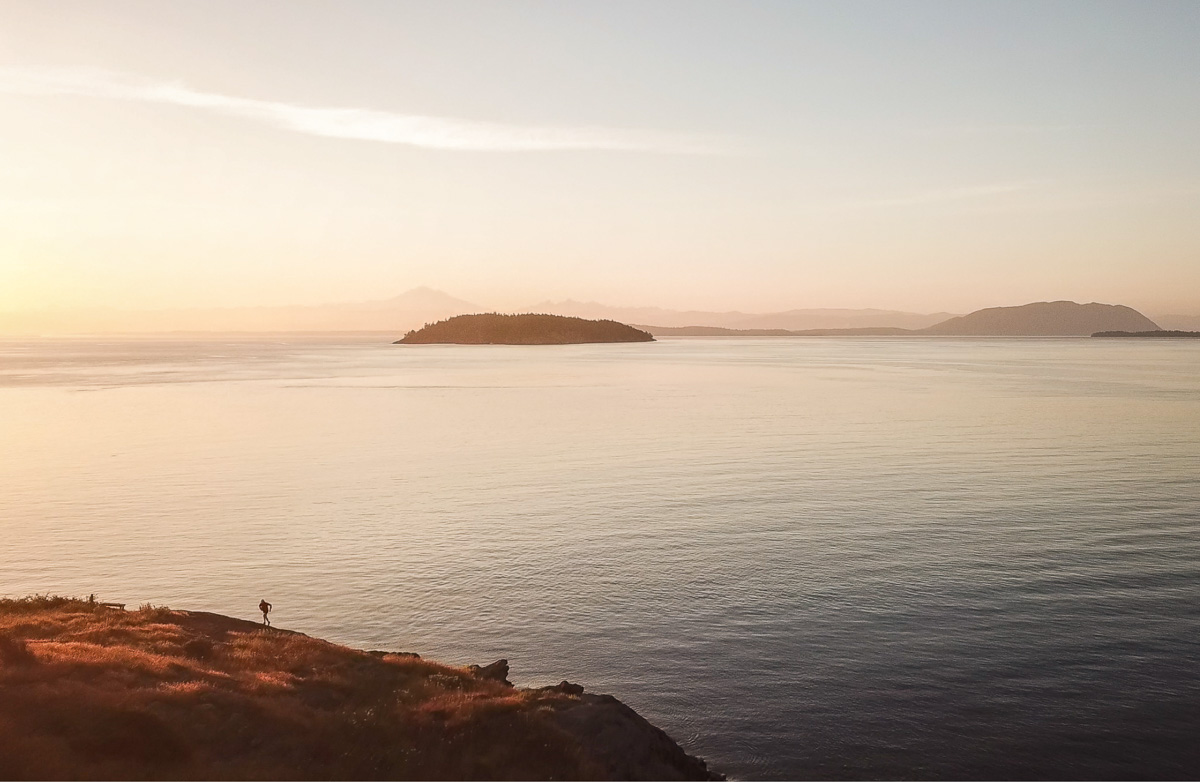
Sucia Island did not disappoint.  It was a little slice of wooded paradise with enviable sunsets and zero cars.  It’s only accessible by small boats and it’s criss-crossed with a spider web of dreamy single-track with peek-a-boo glimpses of Kulshan (Mt. Baker) and the Olympic Mountains.   We had our own secluded group campsite which had the effect of making us think we were the only ones on the island.  Not until we started exploring Sucia on our morning runs, did I realize the island was a buzz of kayakers, sailers, and the happiest dogs I’ve ever seen.   I think almost everyone there remarked at least once that they would prefer to say goodbye to life outside the island and settle in for an extended stay of sunsets, otter parties, and lonely trail runs. 


We may have been on “island time” but we had a bit of routine to our days.  The early birds would start the day with 6:30AM exploratory runs around the island,  skipping down the little land fingers that jutted out into the sound and marveling at the blossoming succulents and seals bobbing just offshore. We’d roll back just in time for freshly brewed coffee (!!!) and a delicious homemade breakfast.  I’m vegan and Aspire did an amazing job providing plant-based alternatives that were just as tasty as they were nutritious – tofu pad Thai, ridiculously good potato breakfast burritos, and high protein snacks like edamame pods. We’d even have happy hour with cold beers, cider, and hard seltzer and appetizers while waiting for dinner every night.  Now I finally understand what glamping is. I like it.  

Backcountry Medical Guides ran such an engaging and fun course.  After breakfast, we’d have class on the beach (!!!) and while it was somewhat distracting to have a family of otters playing in the background, it was pretty amazing.  The course was a perfect mix of hands-on scenarios and mini-lectures.  

We started with the ever important patient assessment system – concrete steps to take when faced with any incident in the backcountry.  From there, I learned a ton of steps to take when faced with various trauma, medical, and environmental emergencies – with a particular focus on emergencies most commonly faced by trail runners such as rolled ankles, heat exhaustion, and wound care.   One of the highlights of the course was performing chest compressions on a mannequin while one of our instructors blasted Whitney Houston’s – I Want to Dance with Somebody, to keep the beat.  Hilarious, yet surprisingly helpful.  With the soaring temperatures in Seattle this week, I’ve already used what I learned about heat emergencies and their prevention to not only keep myself safe but monitor those around me. 

One of the most helpful lessons was on first aid kits and ways to keep the weight pared down by picking items that can have multiple uses.  Apparently honey can be used as an antibiotic, source of sugar for a diabetic emergency, and a tasty addition to a peanut-butter sandwich.  

I not only traveled back from Sucia with a keen interest in perfecting my first aid kit (add honey) but some new friends!   Some of the Seattle runners exchanged numbers at the conclusion of the course (Sunday) and by Tuesday morning, I was out for a dawn patrol lap around Green Lake with another woman from the course with plans to regroup at the Big Foot 20 miler in early July with a few more students.   All in all, I couldn’t have asked for a better Wilderness First Aid course experience. The Sucia Island WFA was a perfect blend of education, glamping, trail running, and hanging out and swapping stories with other runners.   


The Fall Edition of the Sucia Island Wilderness First Aid Course takes place August 27th – 29th. Learn more and register!
Categories
Aspire Culture Blog courses Destinations Highlights SUCIA Sucia Island WFA Sucia Island: Rendezvous SUCIAWFA Trip Reports and Trip Styles Trip Styles

Geology of Sucia Island:

Folds, Faults, Tafoni, a Ghost Forest, and a Dinosaur!

What a lot of variety packed into less than a square mile of rock!  Sucia Island has many features that delight anyone interested in the natural environment.  For runners and hikers, an extensive network of trails leads the curious to all of these features. Also, at low tide much detail can be seen by walking (safely!) portions of the shoreline. Let’s briefly describe some of the most noteworthy geologic features.

The Rock

Except for the bedrock ridge making up the southwest portion of the island, bedrock here is made of sedimentary rock named the Chuckanut Formation for similar rock found on Chuckanut Mountain near Bellingham.  The rock is mostly sandstone but in places siltstone and conglomerate are interlayered, telling a story of an ancient meandering river system existing about 50 million years ago that deposited sand, silt, and pebbles.  Plant fossils are abundant, including fossilized wood, and sparse evidence of terrestrial animals has been found, mostly tracks.  The fossil assemblage suggests a humid subtropical climate during the time of deposition, quite different than today’s  local climate.

Fossil Bay was the site of quarrying of sandstone over a century ago. The massive blocks were barged to Seattle for paving stone. You can see the remains of the quarry near the dock in Fossil Bay.

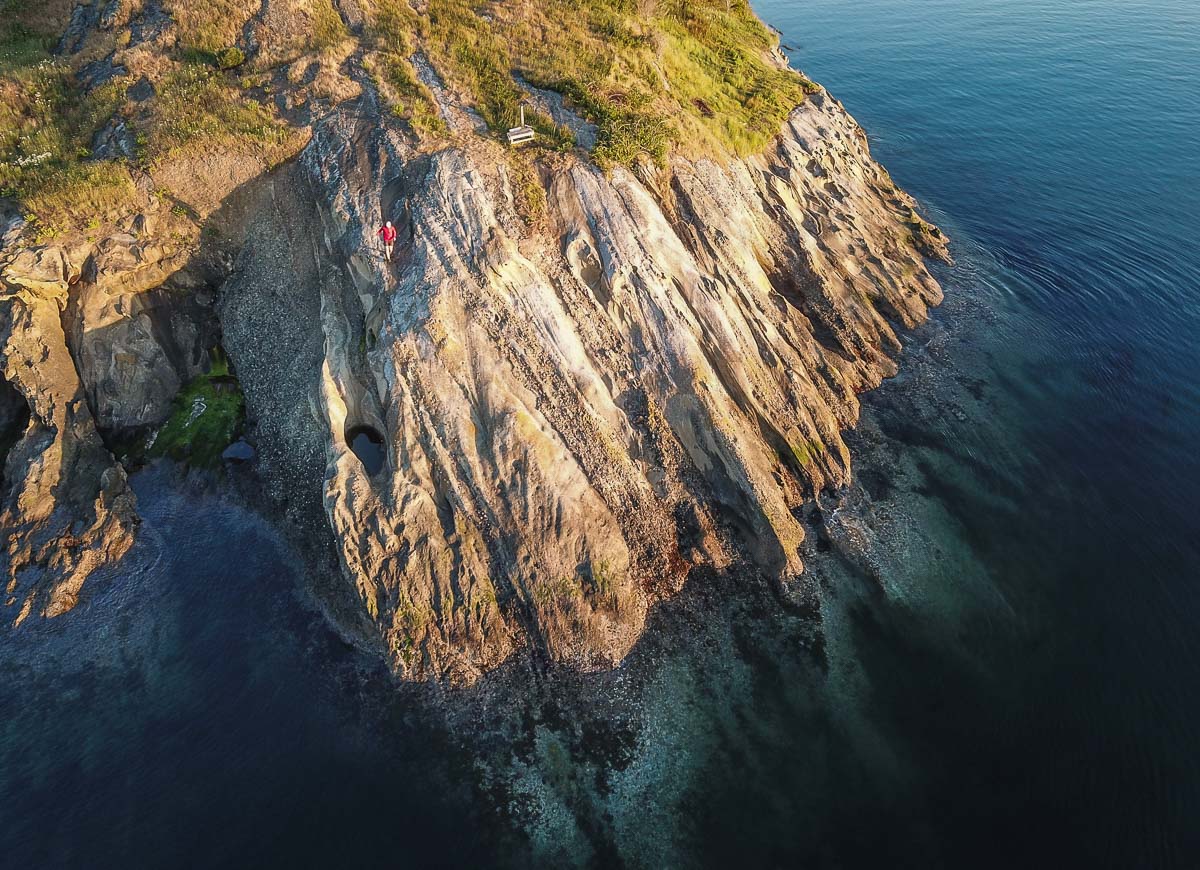
The oldest bedrock on Sucia is the Nanaimo Group,  making up Little Sucia Island, the ridge south of Fox Cove and along the south shore of Fossil Bay. Siltstone is the dominant rock type and it contains abundant fossils of invertebrate marine organisms such as clams, snails, and ammonites.  At low tide you can easily walk along the marine terrace , a product of  wave erosion, until a cliffed shoreline blocks progress.  The rock  on the high cliff is completely unsuitable for climbing, being finely fractured, soft, and unstable.  

The Nanaimo rocks are at least 75 million years old and evidence indicates they were transported as much as 1000 miles from their depositonal origin by plate tectonics.  How?  Glad you asked! The evidence is complex but centers on the latitude of formation of rock of similar age on the mainland dated by paleomagnetism.

The surface of the entire island shows clear evidence of being overridden by glaciers. Rocks include abundant  light-colored granite pebbles, cobbles, and boulders,  as well as various other rocks such as quartzite and greenstone not local to the San Juan Islands. These rocks originated in the mainland of British Columbia where they are found as bedrock. Transported by moving glaciers, the rocks were dumped when the ice melted here about 10-12,000 years ago. Maximum elevation of similar boulders on the mainland indicates that at maximum continental glaciers in the area of the  present-day Salish Sea were over one mile thick! 

The Fault

If you walk along the north shore of Fox Cove at low tide, you might notice the light gray rock making up the low backshore cliff just above high tide level. Look closely and you might see some “S” shaped folds in the bedrock. This is evidence of the Fox Cove fault, which brings into contact the 50 million year old Chuckanut Formation with the 75 million year old Nanaimo Group. The actual contact is not exposed, but the younger rock sliding over the older Nanaimo deformed  the rock near the fault contact zone into these folds.


Plunging Syncline

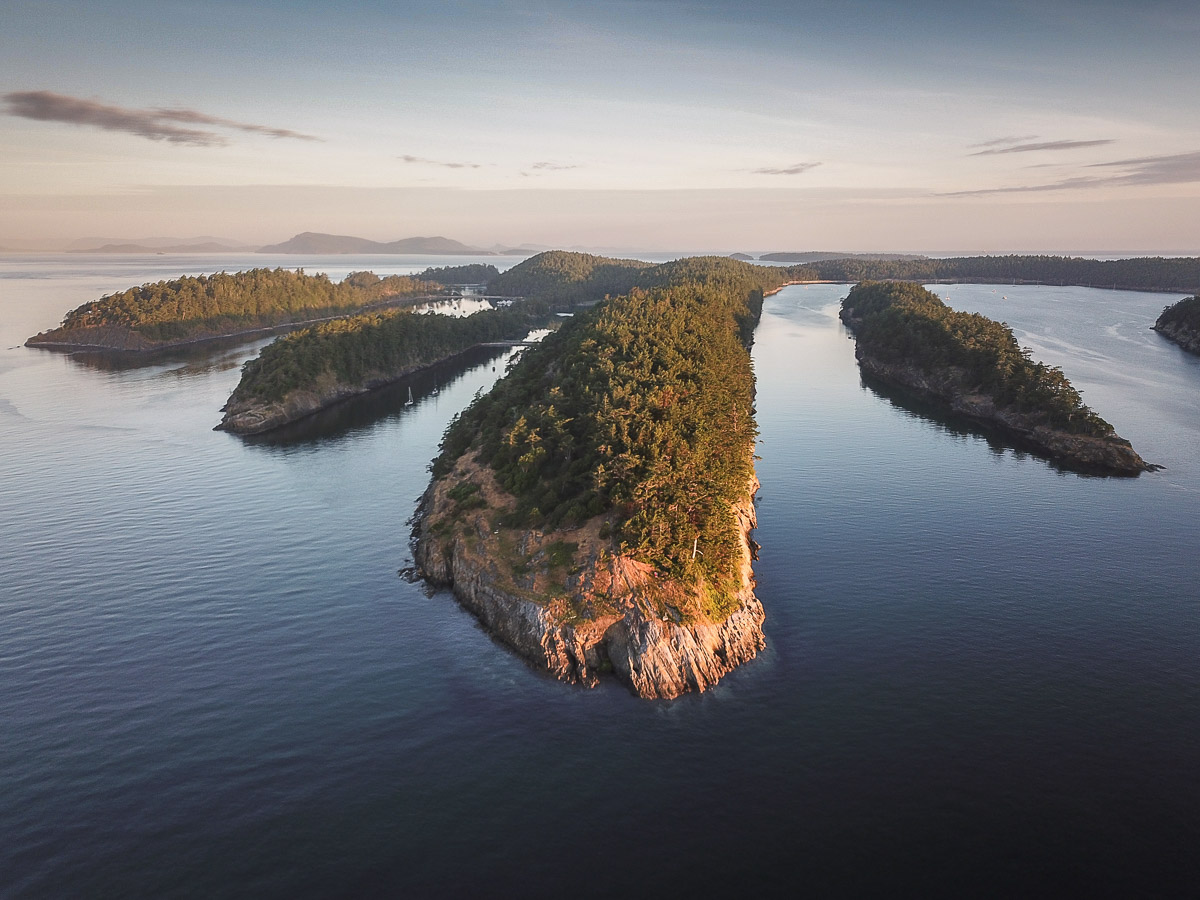
Glancing at a map you’ll see that Sucia Island is shaped like a  horseshoe  that is seeking  to be hooked on an imaginary post somewhere to the southeast. What’s going on here with this unusually shaped island?

The parallel ridges, elongated smaller islands, and intervening valleys and embayments are all part of a structure called a syncline. At the same time that the Fox Cove fault was breaking rock, the sedimentary rock layers of the Chuckanut Formation were being deformed when they were beneath Earth’s surface. Synclines form ‘troughs’ where bent layers are inclined (dipping) toward a centerline, which in this case is plunging (passively ‘diving’) toward the southeast.  The ridges are more resistant rock (sandstone) and the lower ‘valleys’ between are the less resistant rock (siltstone).

Tafoni and Honeycomb Weathering

Many places along the island’s shoreline show a “honeycomb” structure in bedrock, and along the  central shore of Shallow Bay there are large (washtub to bathtub size) cave-like cavities. The later are tafoni (Italian)and are weathering features.  To develop they require permeable rock, salt, and repeated cycles of wetting and drying. When saltwater splashed  on the rock dries , tiny salt crystals form and  wedge the sand grains apart. The sides of cavities are more shaded and are damper, inhibiting crystal formation, so the rear of a cavity deepens with time. Multiple cavities can overlap and produce bigger cavities.  Large tafoni in  the central east shore of Shallow Bay are often called the China Caves and allegedly were involved in smuggling operations long ago.

The Dinosaur!

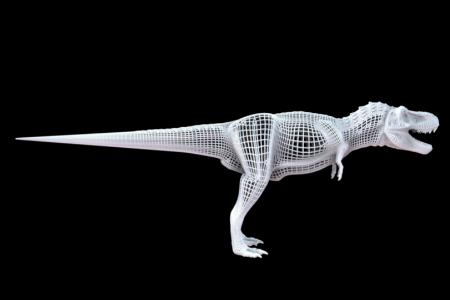
In 2014 a fossilized bone was found in the Nanaimo rocks near Ev Henry Point at the southeast end of Fossil Bay. This was identified as a part of the left femur of a theropod dinosaur, the same category of reptile that includes T-rex and velociraptors.

This is the first and only dinosaur fossil yet found in Washington! Clam shell fossils found within the hollow part of the bone prove that the skeletal remains of a land-dwelling dinosaur washed into the ocean.

“Ghost Forest”

Just inland near the south shore of Shallow Bay you will notice a number of standing dead cedar trees…a “ghost forest.” What caused the trees in this grove to die?

Hypotheses included 1) an earthquake causing subsidence and subsequent flooding, and 2) flooding from either a tsunami or large storm waves led to salt water intrusion that killed the trees. 

But recent (2008) information tells the real story. Early homesteaders blocked the natural outlet of the small stream in the area because they desired a reliable source of surface fresh water in the pond they created. The flooding killed the trees….. less dramatic but true.


While on Sucia, be sure to read the information on the kiosk up the path near Fossil Bay dock. It contains much of the preceding information including pictures. The geology panel was prepared by George Mustoe,  a former classmate  of this writer and a noted authority on both Sucia Island and Chuckanut Formation geology.

An important note is that it is illegal to collect natural materials in state parks, including rocks, fossils, and plants. Take only pictures and memories, leave only footprints!


Prepared by Doug McKeever
Geology professor (emeritus), Whatcom Community College, Bellingham

Join us for the Sucia Island Beach Camp and Trail Running Extravaganza! June 4th-6th, 2021