Categories
Blog Campaigns Highlights Preparation Runner Resources Spring Training Community Blogs Training Training Resources

The Abdominal Superhero: Transverse Abdominus

For many of us, the abs often get superficial attention at the gym as that part of the body you work on so it’ll hopefully, maybe, one day, be chiseled and flat as a washboard, but that’s about where the thought ends. It’s time to take a dive into the core and see what it’s functional role is, and how you can tailor your core training to benefit your running7.


The core musculature actually extends far beyond what most of us think of as that visible “six-pack” some people are fortunate enough to own. The core muscles comprise several other groups that support the spine, hips, low back, ribs, and internal organs6. Needless to say, these groups have a big job. A weak or unsupportive core has real implications for runners2. Conversely, a strong core can have an über helpful impact on your running experience and longevity.

The Transverse Abdominus

The first muscle that arguably deserves the most attention is called transverse abdominus (TVA). It is a broad, thin muscle that is the deepest of the core musculature situated underneath rectus abdominus (the ‘six-pack’ muscles) and the obliques (side body stabilizers/movers)6. It serves a lot of important functions, not least of which is supporting and compressing your viscera. TVA also aides significantly in maintaining stable posture, since the muscle’s attachments span from the top of the iliac crest (upper portion of the hip bone) to your lower costal cartilages (ribs), to your pubic bone3,6. The TVA is often compared to a built-in corset or girdle since its function of ‘holding everything in’ is apt (Awesome, isn’t it? No need to go out and buy an actual girdle now you know you’ve already got one at the ready). 

Since TVA attaches to so many points throughout the front and sides of the abdomen and has extensive fascial connections beyond, it is implicated in running bigtime. While this muscle doesn’t actually move limbs or joints independently, it’s stabilizing function is key5. Without TVA functioning at its full capacity muscle compensation kicks in, and you’ll get smaller muscle groups taking on a workload for which they are not optimally designed. There have been studies showing a weak TVA to be a culprit in chronic low back pain, hip, and groin injuries1,2,3,4,5,7. Since a lot of runners spend consecutive hours or days out on the trail, TVA needs to be super strong and active in supporting your upright posture. A weak TVA can lead to maladaptation of movement patterns at the hips, low back, and groin. Symptoms and pain may manifest gradually over time as a constellation of issues originating with a weak or inactive TVA2,3,5,7. 

Here again is where I can unfortunately speak from past experience on just how far reaching the effects of a weak TVA can be. About seven years ago I experienced a complex array of neuromuscular dysfunction and pain throughout my pelvis that stumped repeated self-evaluation and physician after physician. I was experiencing severe shooting pains through my pelvis and low back, and walking, running, sitting, and standing became progressively more irritative to the point of almost being unbearably painful. After a plethora of testing, poking, and prodding and still no definitive answers as to what was causing my pain, I sought input from a Physical Therapist trained in dealing with the pelvis (these very specialized PTs can be difficult to find but are worth their weight in gold). After taking a look together at a diagnostic ultrasound of my core, I was astounded to see how flaccid and frankly pathetic my TVA and deep lumbar stabilizers looked.

The PT pointed out the hyper-compensation going on throughout my core and pelvis. We determined that a whole lot of my pelvic floor musculature was in prolonged spasm, hypertonic, and aggravating a multitude of pelvic nerves. The small muscle groups located within my lower pelvis were taking over the stabilization duties of my TVA and larger lumbopelvic stabilizers–all of which appeared to be on extended holiday. After eight long months of targeted rehab and zero running, I slowly crept back from this bizarre injury. And while my experience is an extreme and highly irregular outcome of a wonky and weak deep core, it’s a good illustration of how much the deep core really does matter. 

One of the challenging aspects of training TVA is that it requires a huge amount of subtlety and intentional activation. When you do locate TVA and manage to consciously activate it, you won’t feel a big movement or experience any outwardly visible motion (like with the pecs on a bench press). This is precisely why it is one of the trickiest and often disregarded muscles that needs training. We’ll get into how to locate and activate TVA later on in this blog, but for now suffice to say it’s the core muscle to add into your strength routine if you haven’t already.  

The Obliques

Moving from the deepest layer outward, the next muscle group we encounter after TVA is the internal obliques6. Over these lie the external obliques, and collectively they are responsible for enabling spinal flexion, twisting (rotation), and stabilization of the side-body6. These muscles are implicated in counteracting the rotational force that happens with arm swing or pole usage when you run. The movements here are not huge, nor are you likely to feel particularly fatigued in your obliques after a long run. But again, this mid-layer of the core needs attention and proper activation just like TVA1,3. It is also important to note that muscles and muscle groups do not act in isolation6. When we talk about the specific action of a muscle, it should be noted that in reality muscles are always working in a complex and fluid dance with their synergists (helper muscle groups performing similar actions), antagonists (muscles that relax eccentrically allowing for the opposing group to contract), and connective tissues (ligaments, tendons, fascia)6. 

The Rectus Abdominus

The most superficial muscle group of the core is the one we’re all familiar with that creates (for some) what looks like a neatly stacked row of bricks on either side of your midline. This is the rectus abdominus group6. And while it by no means is unimportant to a globally strong core, it is the easiest to see, pinch, activate and agonize over in front of the mirror- therefore it gets the most attention. The rectus abdominus primarily acts as spinal flexor (the ‘C’ shape your torso achieves in a standard crunch is the rectus abdominus at work).  


Ok- now that we’ve taken a tour of our collective midriffs, let’s talk about activating that all important TVA muscle. The best way to begin your search for the TVA is to lie on your back with your feet planted on the floor. Take a couple deep abdominal breaths to settle down and relax those core muscles as much as possible. Next, you’ll need to locate your ASIS (anterior superior iliac spine(s)), which are the pokey bits on the front of your hip bones that are highly palpable when you’re lying on your back. Next, move your fingertips about one inch horizontally inwards towards your belly button and then one inch downward (inferiorly) toward your pubic bone. Bingo! You’ve found your TVA, now it’s time to try and get it working. First things first with activation- sucking in your stomach is not activating the TVA. Also, if you feel contractions of your rectus abdominus under your fingers (do a small crunch and note what this feels like if you’re unsure) this is also missing the target. Since the TVA is tied to the pelvic floor, you will probably feel activity in your pelvic floor when you try to activate TVA- like if you had to stop peeing mid-stream. Initially this is ok, but the goal eventually is to isolate TVA as purely as possible and differentiate it from the pelvic floor. 

To start activating, keep your fingertips on TVA and imagine slowly drawing your navel in toward your spine via a string attached from your spinal column reaching only to that innermost layer of core muscles (TVA)- do this on the exhale. As you inhale again try to maintain the contraction you’ve achieved thus far to the best of your ability, and on the second exhale contract TVA further (tighten that corset!). The contractile movements under your fingers may feel extremely small or barely recognizable- that’s ok, this will take repeated practice. I realize how impossible this sounds, but it really can be done. 

There are a few other helpful ways to think about TVA activation I came across during my own rehab journey. The first is the plastic wrap analogy. Imagine your viscera (internal organs) are all bound in a layer of plastic wrap. Your goal is to squeeze those organs further only using TVA. Think about the internal organs being compressed whilst the outer core remains unchanged. Essentially, you should see no movement, bulging, or other contortion in your abdomen. It’s visually about the most unexciting exercise ever. This takes a lot of patience, and it may help to pull up an anatomical diagram of the core musculature to help with this. The second analogy is the belt notch trick. When you are lying in the starting position imagine a belt strapped loosely around your TVA, with each exhale+contraction of TVA, your goal is to tighten the belt one notch. Again- if you feel action in the obliques or rectus abdominus stop and try again. 

While the extreme subtlety of activating TVA can feel a little infuriating, it will pay dividends to your running health be persistent, locate that badboy and strengthen it. Below you’ll find some exercises that are targeted toward TVA but will also give a great workout to your obliques and even your rectus abdominus as well. 

  1.       Plastic wrap TVA activation
  • No video 
  1. Prone Plank w/ progression
  1. Side Planks w/ progression
  1. Side swipes
  1. Russian Twist
  1. Wood Choppers
  1. Reverse Crunches
https://youtube.com/watch?v=vaTHkV2R13c
  1. Dead Bug

References:

  1. Bråten, M., Andersen, L. A. (2019) “Hva er uavhengig kroppsarbeid?” Norge Olympiatoppen. Available:https://www.olympiatoppen.no/fagstoff/teknikk_motorikk/teknikk_motorikk/page1687.html [Accessed: 27 November 2020].
  1. Hodges, P. W.; Richardson, C. A. “Delayed postural contraction of transversus abdominis in low back pain.” Journal of Spinal Disorders 1998, 11 (1), 46-56.
  1. House, Steve, Scott Johnston, and Kilian Jornet. Training for the Uphill Athlete. Patagonia Books, Ventura, California, 2019.
  1. Leetun, D. T.; Ireland, M. L.; Willson, J. D.; Ballantyne, B. T.; Davis, I. M. “Core Stability Measures as Risk Factors for Lower Extremity Injury in Athletes.” Medicine & Science in Sports & Exercise 2004, 36 (6), 926-934.
  1. Mangum, L. C., Henderson, K., Murray, K.P., Saliba, S.A. “Ultrasound Assessment of the Transverse Abdominis During Functional Movement.” Journal of Ultrasound in Medicine 2018, 37 (5), 1225-1231.
  1. Schünke, M., E. Schulte, and U. Schumacher. Thieme Atlas of Anatomy. Edited by L. Ross, and E. Lamperti. Thieme Medical, Stuttgart, 2006.
  1. Vincent, H.K., and Vincent, K.R. “Abdominal Bracing for Minimizing Excessive Pelvic Motion During Running.” Current Sports Medicine Reports 2018, 17 (4), 111.

Cate Airoldi brings over a decade of training and racing experience to Aspire, with first place finishes in distances ranging from 50 to 120 miles. With an educational background in Physiology, Kinesiology, and Sports Performance, she has been training individual and team athletes since 2011. Cate holds CPT and LMT certifications, and is a current MSc graduate student in Sports Performance Coaching.
Categories
Blog Campaigns Highlights Preparation Runner Resources Spring Training Community Blogs Training Training Resources update

Why a training plan counts even if you don’t race.

A training plan. Do you need one? What if you don’t race? Is it really necessary if your only objective is to ‘just run’? You’ve probably guessed this is headed very much in the direction of ‘yes.’ Training plans are an important tool for those that have specific goals and objectives in mind like a race, but competitive athletes definitely don’t have the monopoly on training plans. Any trail lover can build volume safely, track progress and measure change over time with a well-crafted plan. Training plans are truly brilliant resources to refer back to when things go sideways. It’s worth spending a little time delving into the nuts and bolts of what goes into creating a plan, and why you (yes you) need one.

The Basics

First we’ll cover some basic physiology and physiologic adaptations before going deeper into the specifics of training plans. It’s crucial to have a good grasp of some of the terms that are often thrown around without much context in the world of endurance sport (slow vs. fast twitch muscle fibers, VO2 max, lactate threshold, etc). The goal for most trail runners, competitively minded or not, is to build endurance. Raising the bar on your endurance limit through thoughtful, cyclic, and sustainable training will allow you to go longer, tackle tougher terrain with less effort, and decrease recovery time between workouts. 

A short primer now on some basic physiology; time to cast your mind back to High School science class! We’ll be going over skeletal muscle, and that’s what I’ll be referring to when I use the term ‘muscle.’ (There are two other types of muscle: smooth and cardiac which we won’t get into). Muscles are actually comprised of bundles called fascicles which contain tightly organized individual muscle fibers. Fibers can further be subdivided into three types, Type I slow twitch (ST), fast twitch Type IIa (FTa) intermediate-fast, and Type IIb (FTb) super-fast twitch2,3,4. Slow twitch fibers are the type most endurance runners are interested in; these are the fibers that carry the vast majority of the workload for runners going long. They have greater densities of mitochondria (cellular workhouses) and capillary beds, are fatigue resistant, and have high oxidative capacity1,4. Essentially, they are perfectly suited to long days on the trail. By contrast, fast twitch fibers are the virtual opposite in makeup and are much more suited to short, explosive bouts of work like the 100m dash. 

The reason muscle fiber distinction matters for runners is that there is significant evidence and research pointing to the fact that these fibers react to the stresses (ie: training) put upon them. Essentially- they will, over time, adapt to the training they are being asked to do and subsequently become more tailored to these activities5. While the jury is still out as to whether or not fiber types can change from Type I to Type II or vice versa, a sprinter who trains for maximal speed, short durations, and super-high force outputs will have FT fibers that are primed and ready to respond to these specific stressors. By contrast, endurance runners make full use of the aerobic capacity of ST fibers, and endurance training has been shown both to increase mitochondrial density as well as capillary bed size in slow twitch fiber groups. 

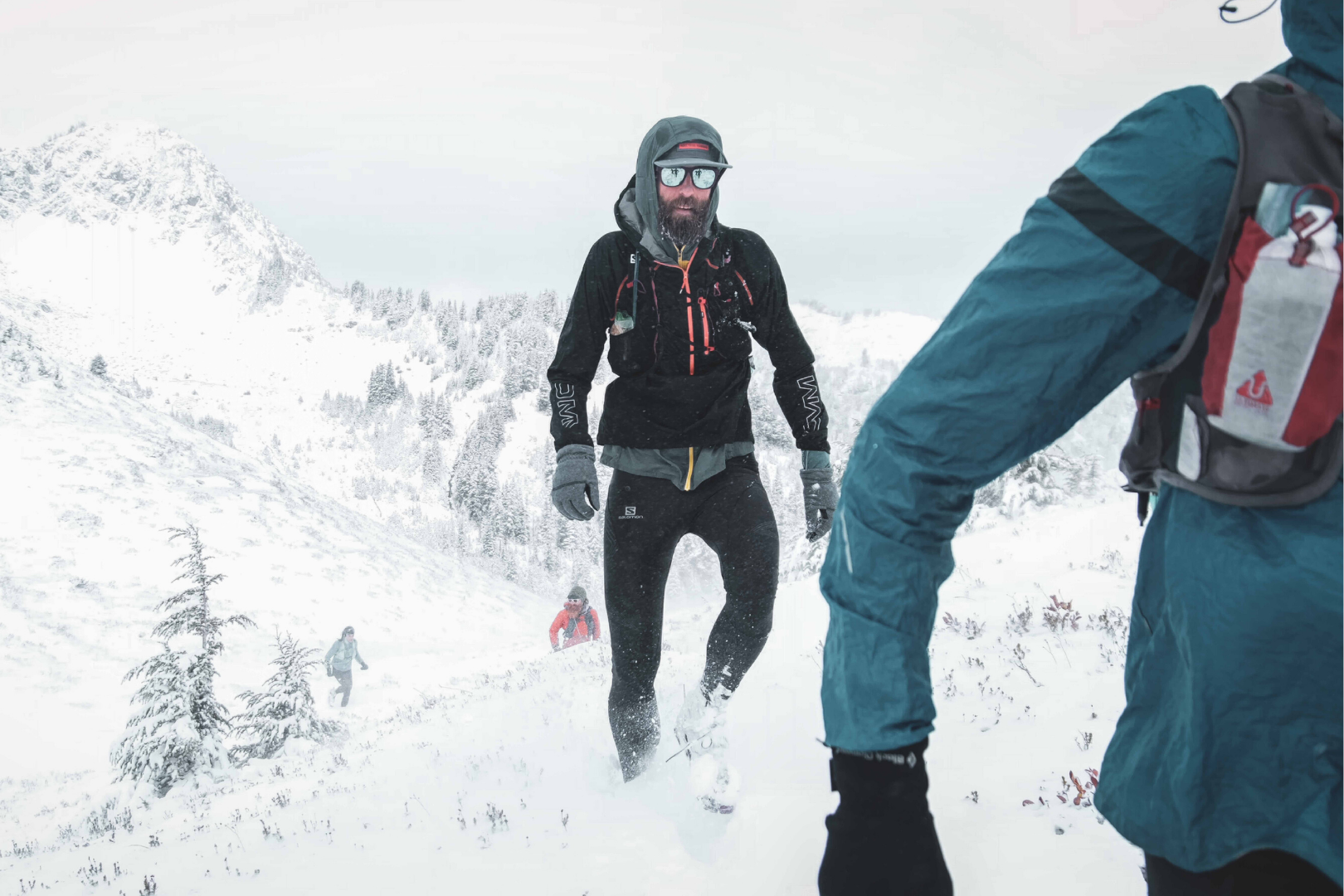
Contributor Ian Ramsey getting in the miles under snowy peaks.

A quick overview now on some common terminology relative to training plans and training plan design. VO2 max (your peak oxygen uptake) is merely one of many indicators of athlete potential, but it does not preordain you for any one particular athletic outcome. It is largely genetically predetermined, and well-trained athletes will see little if any variation in their VO2 max4,5. Lactate Threshold (LT) is the point at which your body begins to accumulate more lactate than it can remove within a given timeframe. The LT is highly trainable and is arguably a more important variable to target within a training plan than VO2 max4. A foremost goal of endurance training is to increase the LT creating progressively higher levels of tolerance to the stress training places on your body4,5,6. 

The Why and Wherefore

Ok, so how does all of this relate to training plans? The answer is that it’s the start of a toolbox any runner will need to access to for effective training. Simply going hard for every run will invariably lead to burnout1,4,5. Conversely, never testing and pushing the limits of your LT will stymy you into perpetual ultra-shuffle territory without generating much zip in your legs. Knowing when to put in a hard effort and when to take it easy, when to taper and when to build up mileage; these are all components that need consideration4,5. Increasing training volume too fast can lead to injury. Not tapering before a big endeavour (like ANY of the magical Aspire trips) can lead to difficulty or outright inability to complete your objective. 

There’re a few other aspects of training plans that need addressing here too. Plans act as a window back in time to what you were doing and when, especially when you add notes regarding your training such as: a training ‘grade’ for each day, energy levels during your run, or specific muscle aches/pains. This can be invaluable when injury strikes, and when you head to your doc only to be asked, ‘when did this start?’ To which you’ll be able to respond with a much more reliable timeline (thank you training plan!) than if you had relied solely on your hazy memories of months of training runs. Training plans are incredible tools to track progress, plateaus, and problems, to build volume, and increase your overall savviness regarding running. They create a guided timeframe that takes much of the mystery out of training. 


Rain, snow, sleet, or hail, nothing can keep us from the trail.

With those glowing attributes acknowledged, it’s time for the caveats. Do not be beholden to your training plan. Despite the best laid plans, life will throw a curveball your way at some point. So much of training is a grand experiment (albeit guided by science and training theory) and there will be a certain amount of trial and error involved too. If your plan says you’re due for an 80 minute Zone 2 run and you begin only to feel like you’ve been hit by a bus–Stop. Walk. Sit down. Go home and take a nap. I recognize this scenario is absolutely anathema to most us runners. We don’t quit, we ‘battle through,’ we ‘tough it out.’ But ignoring alarm bells from your body and going out training in spite of these warning indicators will not get you ahead or earn you a special badge of toughness. (Like so many runners I’ve learnt this lesson the hard way, more than once).  

I’ve spent a fair bit of time in Norway studying and training with endurance athletes there. The Norwegians often reference the old saying: ‘training makes you weak, recovery makes you stronger.’ Nothing could be truer, and the Norwegians have racks and racks of Olympic gold medals to prove they are indeed some of the strongest endurance athletes in the world; ergo they must be doing a great job resting! (Now would be a good time to look up the meaning of ‘hygge’ and then take it to heart). 

Take “hygge” to heart with a fire and a cup of something warm.

The Nuts and Bolts

Let’s get to the business of planning training, what general phases of look like, and things to consider along the way. Think of the following information as additions to your training toolbox; less of a rigid prescription and more of a flexible recipe, science-guided and not tempted by fad-based training that promises impractical or impossible outcomes. 

It takes a bit of humility to dive into training, especially if you’ve had a period of little or no activity. Taking an honest assessment of your baseline fitness and not worrying about what other runners are doing is important. This is where, if you’re one of those folks that enjoys the competitive side of something like Strava I’d encourage you to proceed with some caution. Never attempt to mimic the training of elite athletes. They’ve spent years or decades getting to where they’re at, often with expert coach guidance along the way9. The stellar performances the lay public witnesses from these folks is only the tip of the iceberg. Years of toil, hard work, tears, and planning9 have gone into their highly publicized successes and infrequently discussed failures. Also be wary of the competitive spirals that can happen on training platforms that are ego-oriented rather than community supportive. Jumping into an online contest with another athlete that pushes you into deleterious territory beyond your safe capacity is not ideal. It’s always good to remember that training isn’t racing, nor should it be. 

Endurance base training (BT) is the starting point of your plan1,5,8. Remember those slow twitch muscle fibers we discussed earlier? Here is where they come into play in a big way. Base training is largely dominated by long, slow runs and hikes at the lower end of the effort spectrum, <Z1-Z1. These are the runs that train those ST fibers to become increasingly reactive and preferentially recruited to the activity you’re doing: long, low-intensity runs. This is the point at which other physiologic changes will begin such as endurance-orientated metabolic adaptation, faster recovery between workouts, and increased muscular and cardiovascular endurance4,5. Base training within a four month training plan can easily comprise over one third of the training mesocycle. Another thing to keep in mind, many athletes consider base training to be a years-long process. This is not to say they spend years training exclusively at this low intensity level. Rather, it means that the physiologic adaptations they enjoy as experienced runners take years of cyclic training, base building, and thousands of hours of determinedly slow, easy training4,9. It is crucial within this phase to resist the urge to chase after the rabbits on a group run, or to overstretch your base training so that it creeps into the harder effort heart rate zones (Z3+). This will defeat the purpose of base training and deny you the physiologic adaptations you’re meant to be working on1,5. (Read on to see the note on Junk Training). To many, this phase often is the patience-testing phase since it may feel like you’re not doing much at all. Rest assured you are, and the ease with which you complete these runs is a marker of your increasing base fitness.

A runner getting in some off season elevation gain.

Building Phase (BP) is where runners will get to start building on all that hard and patient time they put in during base training. This is the point at which training will include greater variability, such as runs designed to continuously challenge the upward limit of your LT (think: hill repeats, pick ups, technique focus). This training interspersed with continually longer slow runs will put you into Z2-Z3 and maybe Z4 for brief periods4,5. Think about BP as the point at which FT fibers are being added in small doses to the larger recipe you’re creating: a more durable you5,6,7. Depending upon your objective (ie: training for a 50k versus a multi-day outing) training in Z3+ may comprise 1-2 of your weekly workouts or may only make an appearance biweekly. The duration and flavour of your BP is dependent upon your end goal. A shorter event such as a 50k may actually have more time devoted to intensity training than someone training for 100+ miles or multi-day adventuring4. A 50k runner will want and need more leg speed and require less overall base training than those going longer distances. 

If you’re attuned to the world of training theory and physiology9, you’ll probably have heard about ‘junk training’ or the training ‘black hole’…pick your negative descriptor. This is a very real concern, and definitely applies to the competitive and non-competitive alike. BP puts runners in close proximity with this type of training, and it takes a very self-aware runner to not dive into the black hole of junk training at least a few times (guilty here). Junk training is often referenced as training that occurs at the top end of Z3-Z4 and is performed repeatedly without any real consideration or respect for the true training objective of the day. This type of training is so prevalent because it feels great and productive; it’s hard enough to make you feel like you really accomplished something, but not quite hard enough to be considered a true Z4-Z5 workout1,4. It’s also not easy enough to be considered Z1-Z2+ base or lactate threshold training, meaning you’ll also miss out on all the benefits that training bestows on you1,2,5,7. Lots of runners can and do sustain junk training for months or even years (guilty again!). They may be solid runners with impressive performances, but frequently see little long-term progression, are prone to overuse injuries, and are definitely not attaining the upper reaches of their true potential. Instead, these runners often accumulate many of the negative side effects of hard training (sustained muscle damage, lackadaisical recovery, performance plateaus) without any of the benefits. Speaking from more personal experience than I would like to admit to, it took several back-to-back injuries years ago for me to evaluate my training methodology and finally begin to learn from my past mistakes.


A runner on the shoulders of Mt. Baker during Territory Run Camp

The last segment of training is actually comprised of two smaller parts: Tuning Phase and Tapering Phase (TTP). This phase is the shortest of all the phases and is highly variable depending on what you’re training for. In general terms, volume of training will decrease incrementally allowing for greater recovery while attempting to preserve the highest level of fitness you’ve attained in the previous phase. This is a great time to dial in things that are not strictly running but will have definitive influence on the success of your goal run. For example: fuelling strategy, blister and chafing management, hydration planning, navigation and logistics, and gear review. For the uninitiated, many of the things in the aforementioned list might elicit an eye-roll or not even that much attention. However, I’ve seen many a fellow runner side-lined and/or unable to finish due to any one or a combination of those items. I myself have experienced the dreaded GI distress that puts your stomach in knots for hours, failed to account for pack chafing, nearly DNF’d due to macerated feet, and been lost in the night portion of a 120 miler in the rain. All not fun. All part of the adventure, and well noted as things to learn from for future outings. The point here is that small things become very big things when you’ve been out on the trail for hours or even days, and all the training in the world will not help you if you haven’t taken care of the non-running side of business. 

The lighter training volume of the Tapering portion of the TTP is crazy making for some runners whilst others whole-heartedly embrace the freedom that comes with less training. You can generally expect the taper period to be from 2-3 weeks, with the last week largely consisting of ‘activity recovery’ (think: jogging with your 80 year old dad, riding a bike with your kid, going for a swim). To borrow a phrase from the road running community, the ‘taper tantrums’ come into play in a big way here for a lot of people. Regardless of whether you’re tapering for a race or resting up for a dreamy trip on the Wonderland Trail (ahem, did I mention Aspire yet?) the temptation to head out for a long, hard run when you’re at peak fitness and recovery is almost irresistible. But like so many things in life, good things come to those who wait!

The Next Step (after step, after step, after step)

Writing a training plan from scratch, even equipped with the information here, can be a daunting task. This blog has only scratched the tiniest of surfaces in training plan design, methodology, and implementation. To the intrepid reader who has made it this far, you’re a trooper. And for that fortitude you get to be one of the first folks in the loop about the forthcoming Aspire Spring Training Plan. This will be a 4-month plan debuting in March, geared toward getting you ready to embark on the Aspire adventure of choice or any trail objective you might have in mind for the summer. We’ll put the principles discussed in this blog to use in the Training Plan creating a supportive, ego-free community in which we can cheer our fellow runners and field questions along the way. 

So-here’s to a healthy 2021 running season and to hitting the trails together, whether that be remotely or in a socially distanced reality.

Training season means miles out in the weather.

JOIN US next month when our Spring Training Plan kicks off! We’ll provide a detailed week by week plan complete with suggested strength training and rest days. Beginning in March, we’ll host monthly webinars alongside the training program where you can ask Cate your burning questions on how to train well. Head here for more info and to join the mailing list for training plan updates!

Resources 

  1. Hedelin, R., G. Kentta, U. Wiklund, P. Bjerle, and K. Henriksson-Larsen. Short-term overtraining: effects on performance, circulatory responses, and heart rate variability. Med. Sci. Sports Exerc. 32:1480-1482. 2000.
  2. Hills, A.P., N.M. Byrne, and A.J. Ramage. Submaximal markers of exercise intensity. J. Sports Sci. 16:S71-S76. 1998.
  3. Horowitz, J. E., L. S. Sidossis, and E. F. Coyle. “High Efficiency of Type I Muscle Fibers Improves.” Int. J. Sports Med 15 (1994): 152-157.
  4. House, Steve, and Scott Johnston. Training for the New Alpinism. Patagonia Books, Ventura, California, 2014.
  5. House, Steve, Scott Johnston, and Kilian Jornet. Training for the Uphill Athlete. Patagonia Books, Ventura, California, 2019.
  6. Lambert M.I., Z.H. Mbambo, and A. St Clair Gibson. Heart rate during training and competition for long distance running. J. Sports Sci. 16: S85-S90. 1998.
  7. Noakes, T.D., M.I. Lambert, and M. Gleeson. Heart rate monitoring and exercise: Challenges for the future. J. Sports Sci. 16: S105-S106. 1998.
  8. Smith, D.J. A Framework for Understanding the Training Process Leading to Elite Performance. Sports Med 33, 1103–1126. 2003. 
  9. Tønnessen,E., Madsen, Ø., Haugen, T., Staff, H. (2019) Arbeidskrav i idretten. Norge Olympiatoppen. Available: https://www.olympiatoppen.no/fagstoff/treningsplanlegging/page557.html [Accessed: 12 December 2020].


Join our Spring Training Community to receive Cate’s Spring Training Plan, including monthly webinars exploring mountain fitness.

The first webinar on the benefits of an “off” season training plan is Sunday, February 21st. Register to get into the science, explore how to adjust a training plan for real life, and join the Q&A.

Cate Airoldi brings over a decade of training and racing experience to Aspire, with first place finishes in distances ranging from 50 to 120 miles. With an educational background in Physiology, Kinesiology, and Sports Performance, she has been training individual and team athletes since 2011. Cate holds CPT and LMT certifications, and is a current MSc graduate student in Sports Performance Coaching.

Categories
Blog Campaigns Highlights Preparation Runner Resources Spring Training Community Blogs Training Training Resources

What is “Gait” and why should runners care about theirs?

Gait and specifically human bipedal gait is enormously complex. When we add speed to accelerate our gait- ie: trail running- any latent weaknesses or postural discrepancies will often magnify and multiply. This can result in decreased performance output, nagging soreness and muscular tenderness, or outright injury.7 In this blog we’ll break down the two primary phases of gait and why they matter for your running form and health.

Running downhill on the Knives Edge, a section of PCT ridge line in the Goat Rocks.

Running and walking gait are comprised of two primary phases: stance phase and swing phase. Generally speaking, the stance phase is when your foot is in contact with the ground and the swing phase is when your foot is airborne.1,3 Within each of these larger phases there are subdivisions where it’s possible to further dissect movements to a minute level of detail. We won’t be going that microscopic, but it is important to know that running gait includes an important division within the swing phase; a “float” phase. Float phase is the point at which both feet are off the ground for a nanosecond before your opposite foot strike begins. Walking does not contain a float phase which means the left or right foot is always in contact with the ground. 1,3

So, why does this matter for runners? Why should you care that you’re catching a little air with every step? Well- it’s because float stage, while an essential component of being able to move faster than a walk, also means runners are contacting the trail surface with a force that is at least two times that of walking.3 

It may be patently obvious to most readers but descending from a greater height (like the airborne float phase of the gait cycle) equates to a greater impact each time your foot hits the trail. Harder surfaces underfoot increase the compounding effect running has on joints and soft tissues generally; all the more reason to stick to the trails wherever possible instead of pavement. 

A runner crosses the bridge between Bagley Lakes, Territory Run Camp

Keeping in mind the inevitable fact that running subjects our bodies to greater joint stress than walking, the next place we need to go is a discussion about what happens when we combine those greater stresses with aberrant gait patters. Overpronation and supination are terms most runners have probably heard of, but here’s a quick recap.

Overpronation often coincides with flatter arches and means you’re landing mostly along the medial (inner) edge of the foot. Supination corresponds with higher arches and a laterally weighted footfall, typically from the outside of your heel through to your little toe.2

There is some degree of pronation and supination that naturally occurs when you run, and biomechanically this base movement is totally ok. In fact, these movements- to some degree- are what enable the joints of the foot and ankle to do their choreographed work.1 But when these patterns become excessive or are compensatory for weakness higher up in the kinetic chain (think: knees, hips, and low back) lingering soreness and injury often ensue. For example: if your knees tend to deviate toward the midline during the float phase and impact the ground in the same fashion that will eventually cause asymmetric wear and tear on your tissues over time. The joints of the body can and must move independently of each other, but in a complex movement like running the interplay between the hips, knees, ankles, and feet is constant and intricate.7

Think of it like a car: the timing belt, tires, transmission, clutch and steering are all moving parts that can wear in irregular and detrimental ways if they’re a little askew. Like a car, your body will function best when all of its parts are aligned and working smoothly. 

Cruising the single track outside Stehekin with a smile.

Have you ever taken a look at the bottom of your shoes and noticed that some parts wear out much faster than others? The heel of the shoe is an especially good place to start your analysis. If the inner or medial surface of your shoes seems to wear especially fast, that can suggest overpronation. A lateral or outer edge wear pattern may indicate excessive supination. This shoe wear and the overpronation or supination that causes it is often only the end symptomatic piece within a larger picture of muscular weakness or maladaptation arising pre- or post-injury. A myopic focus that only includes treating a runner’s supination or overpronation misses the series of events taking place higher up the chain that cause these things to happen. 

Here is a [very] short list of issues that can contribute to altered gait:3

  • Glute weakness-especially the isometric/stabilizing and eccentric/lengthening actions
    •  Is highly prevalent in runners and can lead to abnormal foot strike during the stance phase 
    • Can also be a partial culprit in a knock-kneed running posture, sometimes referred to as “Genu Valgum”
  • Anterior hip flexor tightness
    • Can lead to diminished hip extension during the swing phase
    • Can impede upright torso stance during running generating stooped posture and low back pain
  • Poor ankle mobility- particularly dorsiflexion (pulling your toes toward your shin)
    • Can increase force on foot and ankle joints during the foot strike
    • Can predispose runners to ankle tendinopathies if range of motion remains limited

In an ideal scenario all runners would be able to consult with a gait specialist or other qualified clinician. Since that’s not the reality for most of us there are some things to watch for with your own gait, and if you have a buddy or someone who can take a socially distanced video of you running so much the better.

[I want to stress here that comprehensive gait analysis, if that’s what you’re after, can and should be done by a qualified professional. And if you have any health concerns, current or recent injury, or other limiting health factors you should always consult a qualified healthcare provider before making any modifications to your routine]. Below are a few PNW resources with folks qualified to do gait analysis. Some providers may require a more extensive health intake and occur in a clinic setting, such as a Physical Therapist’s office. Other resources like shoe stores can offer a more cursory analysis that will give you great baseline assessment plus shoe recommendations relative to your running gait:

  • Prime Sports Institute, Bellingham 
  • Northwest Physical Therapy & Sports Rehabilitation Center, Bellingham 
  • Fairhaven Runners & Walkers, Bellingham
  • BBay Running, Bellingham 
  • Sisu Sports Performance and Physical Therapy, Seattle
  • Avant Physical Therapy, Seattle 
  • Peak Sports & Spine Physical Therapy, Seattle + 6 other locations 
  • West Seattle Runner, Seattle 
  • Fleet Feet, 2 Seattle locations 
Enjoying sweeping views towards Stehekin from Cascade Pass.

With that said, let’s outline a few things you can make note of on your next run regarding your own running gait, and then look at tools to solve any problems that might be brewing.

  1. Look/feel for overpronation or supination2,3
    1. Overpronators typically have a flatter arch. The majority of your weight is dispersed along the inner side of your foot, or you may start your foot strike with your weight on the outside of your heel and then roll onto the inner foot as you toe off. 
    2. Supinators may have high arches or even be bow legged. Weight during foot strike will usually be on the outside of the foot and the big toe may make little or no contact with the ground.
  2. Check out your knees!3
    1. Knock knees: do your knees knock into each other or even just brush each other continually when you run?
    2. Wide knees: are your knees particularly far apart, or track away from the midline?
  3. Hips3
    1. Do your hips sway outward (think: Marilyn Monroe) in the stance phase on your weight bearing leg? Or is there very little mobility in your hips and you perhaps look like a piece of rebar running down the trail?

Well, if you’ve stuck with me this far- nice work! You must also be an anatomy geek… Now it’s time for some solutions. True overpronation and supination can often be helped to varying degrees by specialized and appropriately fitted orthotics, but that’s only getting at part of the problem. Let’s take a look at some targeted strength exercises that can help mitigate the gait issues we’ve covered.  


Intro Video

https://youtube.com/watch?v=CeztCvr2igg

For overpronators:

For overpronators, knock kneed runners, and runners with Marilyn Monroe hips- You’ll want to target the glutes and stabilize your core with exercises like the following:4,5,6

  • Clam Shell
    • Progression=Use resistance band
https://youtube.com/watch?v=HuSZLBOW6TA
https://youtube.com/watch?v=waoHz5NtSDU
  • Monster Walks with Band
  • Floor Bridges
    • Progression=Top leg lift (side bridge), Alternating leg lift (prone bridge)

(NO Video)

  • Quadruped Balance/Extension
    • Progression=Weighted quadruped
https://youtube.com/watch?v=dMogTRZ3gkM
  • Squat to stand
    • Progression=Weighted (ie: use weighted pack/belt)
https://youtube.com/watch?v=_Z_1ydz-yzo
https://youtube.com/watch?v=i41cCqSfnjA
  • Supine hip lift
    • Progression = Single leg lift
https://youtube.com/watch?v=epywi8XogDs

For supinators:

For supinators and runners with a bow-legged stance or ‘wide knees’ think about strengthening the inner thigh and stabilizing the core:4,5,6

  • Side lunge
    • Progression= Lunge with band
https://youtube.com/watch?v=hYwRE_Zgjb4
  • Wide leg squat
    • Progression=Squat to toes
https://youtube.com/watch?v=sh2CZQ24j9w
  • Side-lying leg lift with ball or towel
    • Progression=move from towel to ball or increase size of yoga ball
https://youtube.com/watch?v=MCoDTFhLlUU
  • Supine leg lift with ball
    • Progression=Lift arms overhead
https://youtube.com/watch?v=W2RiMVIoNBw

The off season (yep, I mean right now) is the absolute perfect time to get after it with starting a strength routine that will help you build durability, stability and longevity. With all the time you’re saving without that commute into a physical workspace right now I’d hazard a guess most of us have a few extra moments of downtime in the day. Time use those bonus minutes to turn off the Netflix and turn on glutes! 

References:

  1. Dugan, Sheila A, and Krishna P Bhat. “Biomechanics and analysis of running gait.” Physical medicine and rehabilitation clinics of North America, vol. 16, no. 3, 2005: 603-21. doi:10.1016/j.pmr.2005.02.007
  1. KA Kirby; Biomechanics of the normal and abnormal foot. J Am Podiatr Med Assoc, vol. 90, no. 1: 2000: 30–34. doi: https://doi.org/10.7547/87507315-90-1-30
  1. Novacheck, Tom F. “The Biomechanics of Running.” Gait & Posture, vol. 7, no. 1, 1998: 77-95. doi: https://doi.org/10.1016/S0966-6362(97)00038-6.
  1. Anonymous (2020a) Forutsetninger teknikk- Lange løp. Norge Olympiatoppen. Available:  https://olympiatoppenvideo.no/folder/2._idretter/friidrett/forutsetninger_teknikk/friidrett_gen. [Accessed: 29 November 2020].
  2. Anonymous (2020b) Forutsetninger teknikk-Friidrett gen. Norge Olympiatoppen. Available: https://olympiatoppenvideo.no/folder/2._idretter/friidrett/forutsetninger_teknikk/friidrett_gen. [Accessed: 28 November 2020].
  3. Friidrettsforbund (2015) Athletix: Lower Body Øvelser som hovedsakelig trener bein og sete. Available: https://www.friidrett.no/barn-og-ungdom/athletix/ [Accessed: 2 December 2020].

Bråten, Morten og Andersen, Lars Arne (2019) Hva er uavhengig kroppsarbeid? Norge Olympiatoppen.Available: https://www.olympiatoppen.no/fagstoff/teknikk_motorikk/teknikk_motorikk/page1687.html [Accessed: 27 November 2020].


Categories
Aspire Culture Blog Culture Highlights Preparation Training Resources update

Elevated by the X-factor

In 2013, Aspire crew Nick Triolo set off to run across Mexico’s Baja peninsula in one day. The run was centered around a locally-led campaign to end permitting for an open-pit gold mine in the Sierra Laguna Mountains. He was joined by two locals whose lack of trail running experience was outpaced by determination and motivation for the cause. Nick connects his Baja run and his experience guiding on the Wonderland trail into a fantastic read, identifying a powerful but often overlooked aspect of our running.

A Protest Run

Baja flora. PC: Kara Folkerts

Seven years ago, I had this idea to run across Mexico’s Baja peninsula in one day. The route, a seventy-mile transect across the peninsula’s southern bulge, was centered in a local campaign to end permitting for a Canadian open-pit gold mine in the Sierra Laguna Mountains. Though I didn’t expect many others to join in the full attempt, I knew that some might, and dozens had already pledged to run sections of the route.

At three in the morning, I arrived to the Sea of Cortez on the east side, and standing there was a large crowd of Mexican comrades ready to run the first twenty miles to the base of the mountains. Two runners looked especially nervous—Pedro and Eduardo. They’d come to attempt the full seventy-mile crossing.

Predawn at the Sea of Cortez

I asked them in my pathetic Spanish if they’d ever traveled on foot for what might be a twenty-hour-day.

Eduardo: No.

Pedro: No.

Eduardo had only run a half marathon. Pedro, one marathon. Both appeared fantastically unprepared for running three consecutive marathons over poorly marked mountain paths. Neither had much for gear and the day’s forecast called for searing. I remember Pedro wearing a heavy-duty cotton tee with cutoff sleeves and clenching a Dasani bottle filled with what looked like Pepto Bismol. I had no idea what to expect either; no one had ever attempted such a crossing. What unfolded was a longer and more colorful story, one of ranch families lining the route in solidarity, of police escorts and hornet attacks, full-body cramps and sunburned eyelids and hot mayonnaise sandwiches.

Pedro, Eduardo and Nick

We would make it to the Pacific Ocean eighteen hours later, arriving by headlamp to jump into the surf. Pedro and Eduardo were the true heroes of the day, for they showed up to the precipice of something wildly unknown and entrusted the land and their intentions to guide them across.

The Emergence of “X”

I share this story because it was the first time I witnessed what’s casually referred to as an “X factor,” some unquantifiable force that kicks in when conviction supersedes experience, when resolve taps in after rationality taps out, when something larger than our selves propels us beyond known contours.

This is something I’ve seen countless times while guiding Aspire trips around Mount Rainier. To be clear, this circuit asks a hell of a lot out of you. To wake up and heave your sore ass around the largest volcanic mound of earth in the Pacific Northwest for days on end—if that sounds like a lot, it’s because it is a lot.

But here’s the thing: It’s far more within grasp than you might think.
I’ve seen this fire in the eyes of dozens of runners around the Wonderland. I’ve seen it from all fitness levels, all shapes and sizes, all ages and backgrounds and racing resumes. People show up having asked: Am I ready for this? And after some deliberation, the answer almost unequivocally
seems to be: Let’s find out. Maybe I’ll surprise myself.

Baja Coast. PC: Kara Folkerts


The Baja crossing was a surprise. I surprised myself. Pedro and Eduardo surprised themselves. They didn’t know they had it in them until deciding to wake up at an ungodly hour and try to run across their entire home state, through the spiny-hearted mountains central to mining threats. The whole campaign moved us toward something far bigger, older, and more important than ourselves, and that’s what carried us to the other side.
It’s been over seven years, and no mining permits have been granted.

Of course, The Wonderland Trail is no protest run, but here’s my point: Success defined solely by prior running experience rarely defines one’s capacity to elevate in a given circumstance. One’s resume must never dictate the potential for transcendence. Time and again, runners arrive to the Wonderland feeling unprepared, nervous, having their phantom injuries whisper sweet lies to reconsider. But then, some magic happens.

Crossing one of the Wonderland Trail’s many glacial rivers.

An agreement takes form

It’s unclear if it’s the power of the mountain or the financial and logistical commitments of getting there—likely a combination of both—but something shifts. After over thirty miles and twelve thousand vertical feet on day one, everyone arrives into Mowich Lake dog-ass whooped. There, you receive not only a hot, nutritious, calorie-dense meal (and an IPA, wine, or kombucha, to add), but you’re also gifted strong affirmation from the group, all circling together around something larger than themselves.

On the second day, you’re probably not feeling your best, all blisters and sore things, but most of this hurt is superficial. What’s enduring comes packaged in the passage itself, and this is where the X factor lives. It waits for us there, that ineffable force conspiring with landscape to reflect our own capacity for stitching such long days together. I’ve seen it time and again, this agreement between organism, landscape, and the why:
Why are you here, doing this, paining your way along this path?

Maybe it’s because you are getting married in a few months, your best friend is the officiate, and you two want to spend time together before the ceremony.

Maybe it’s because this is your first time sleeping in a tent by yourself after a Hiroshima-sized divorce and you’re not used to the sounds of a forest at night, alone, and so you play light, meditative nature sounds from your iPhone X to fall asleep. In your tent. In nature.

Maybe it’s because you are from the east coast and have always dreamed of heading west to apprentice with snowcapped Cascadian giants and listen to what secrets they share.

Or maybe it’s because you’re a seasoned ultrarunner, and this is the single best multi-day training block imaginable, and you wish to give it all you’ve got, supported by a readymade crew.

Runners enjoy open vistas on the Wonderland Trail

Whatever the case, the Wonderland is seeded with all sorts of X factor, just like we found in Baja, just like you’ve found bumbling along local trails, and in everyday life, too, when faced with something seemingly insurmountable. You trust instinct, the land, your people. You then apprentice with this X factor and see what happens next. Friend and mentor Joe Grant calls what happens next “the reveal.”

First, you perform all necessary physical and mental training to show up as ready as possible, and you let go of whatever might happen and hand your life over to the day, to see what’s revealed. You let go of any pre- determined epiphany and you go.

The wind blows hard among the pines
Toward the beginning
Of an endless past.
Listen: you’ve heard everything.
S. Takahashi

We’ve heard everything. That musty animal burrowed and gnawing inside us knows of this familiarity, in heaving afoot for days around volcanoes, that through allying more frequently with this X factor we might reclaim some of our forgotten corners, fragments of divested courage we’d previously said couldn’t possibly be ours.

And so, we prepare. We ready-steady body and mind. We train. Do our homework. Study maps. Pine over routes. We show up with our big fat dollops of curiosity and open up to the reveal, elevated all the while by the X factor, just another fancy, sharp-lettered cliché showing us the way home, back to our courageous selves.

If X indeed marks the spot, then that spot is us.


Nicholas Triolo is a writer, long-distance runner, and Wonderland guide for Aspire (2016-2018). He holds a master’s of science in environmental studies from the University of Montana, where he was senior editor for Camas Magazine. Triolo currently works as Digital Strategist for Orion Magazine, and is based in western Massachusetts. He is former associate director for the Todos Santos Writing Workshop and co-facilitator for the Freeflow Wilderness Writing Institute. His writing, films, and photography have been featured in Orion, Terrain.org, Best American Poetry Blog, Juxtaprose, Trail Runner Magazine, Patagonia’s Dirtbag Diaries, and others. More at: nicholastriolo.net